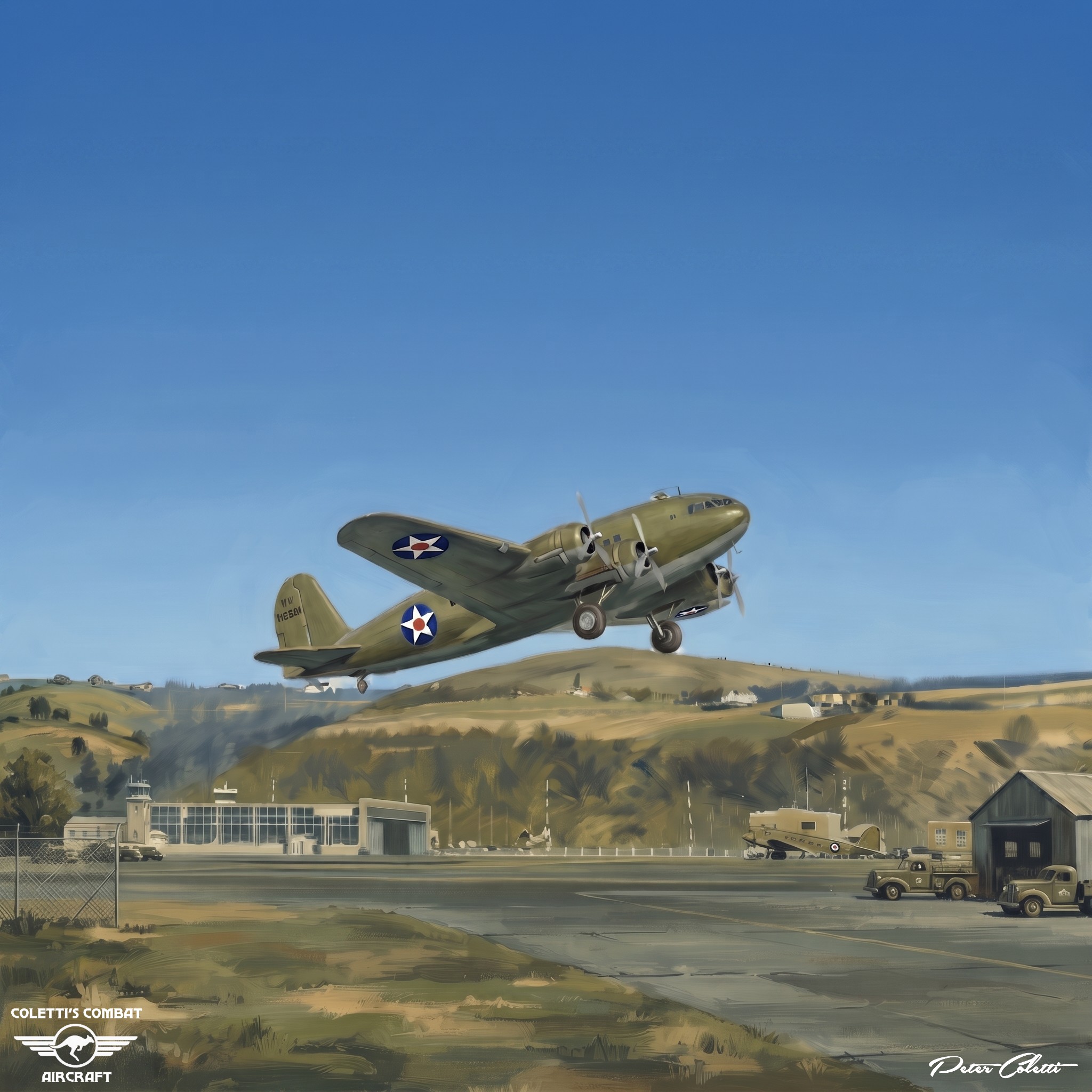
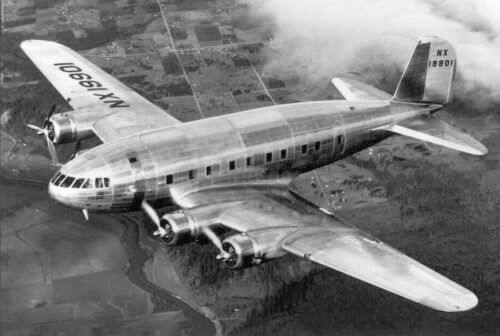
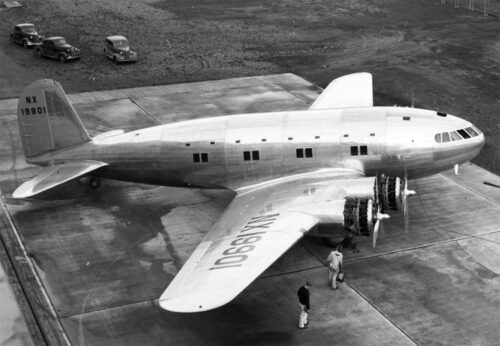
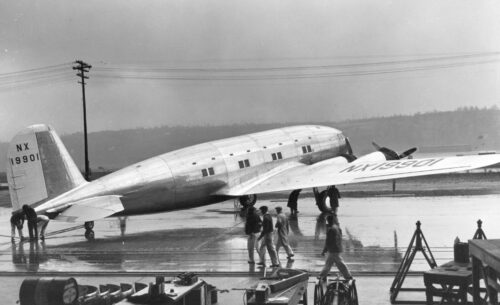
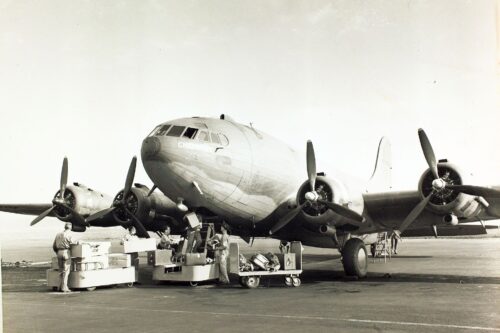
The Boeing C‑75 Stratoliner emerged directly from one of the most advanced civil airliners of the late 1930s: the Boeing 307 Stratoliner.
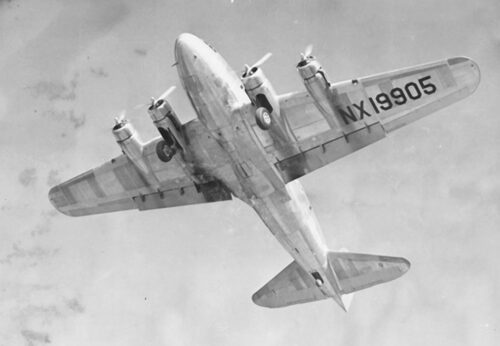
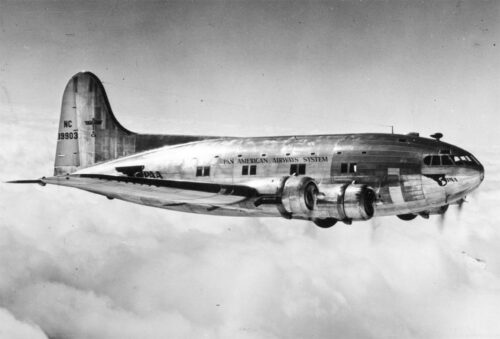
The 307 was the world’s first pressurised commercial transport, derived from the Boeing B‑17C bomber’s wing, tail, and powerplant architecture but fitted with a new circular‑section fuselage designed to maintain cabin pressure at high altitude.
When it entered service in 1940 with Pan American Airways and Transcontinental & Western Air (TWA), it represented a leap in long‑range passenger comfort and operational ceiling.
The outbreak of the Second World War abruptly changed the aircraft’s trajectory.
By late 1941, the U.S. Army Air Forces (USAAF) urgently needed long‑range, high‑altitude transports capable of crossing the Atlantic and supporting diplomatic, military, and intelligence missions.
The small fleet of Boeing 307s—only ten had been built—offered a ready-made solution.
In December 1941, immediately after the attack on Pearl Harbour, the USAAF requisitioned five TWA Stratoliners.
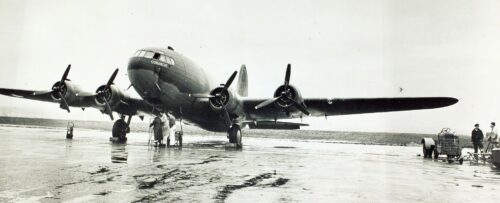
These aircraft were stripped of their civilian interiors, redesignated C‑75, and pressed into service as strategic transports.
The conversion process was rapid and pragmatic.
Boeing and TWA maintenance teams worked together to modify the aircraft for wartime use, focusing on weight reduction, range extension, and reliability.
The result was a transport that retained the 307’s advanced aerodynamics and structural lineage but was optimised for long-distance military operations.
Design Characteristics
Airframe and Structure
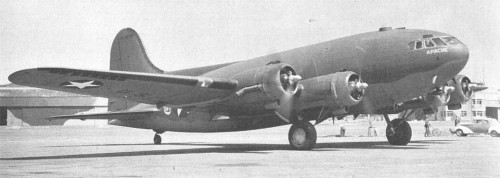
The C‑75 retained the Boeing 307’s distinctive circular fuselage cross‑section, chosen originally to withstand pressurisation loads.
However, the USAAF removed the pressurisation system to save weight and simplify maintenance.
The fuselage was reinforced in places to handle increased fuel loads and cargo stresses, and the luxurious passenger accommodations were replaced with utilitarian seating, cargo tie‑downs, and equipment racks.
The wing, tailplane, and control surfaces were essentially those of the B‑17C bomber, giving the aircraft robust structural integrity and predictable handling.
The mid‑mounted wing featured a high aspect ratio and four engine nacelles, while the tail unit used the characteristic Boeing fin and rudder profile of the era.
Powerplant
The C‑75 was powered by four Wright GR‑1820‑G102A Cyclone radial engines, each producing approximately 1,100 horsepower.
These engines were reliable, well‑understood by maintenance crews, and shared lineage with the powerplants used on early B‑17s.
For long‑range missions, the engines were often operated at conservative power settings to maximise fuel economy and endurance.
Systems and Equipment
Because pressurisation was removed, the C‑75 operated at lower altitudes than the civilian 307, typically between 8,000 and 12,000 feet.
Oxygen equipment was installed for crew use during high‑altitude segments.
Additional fuel tanks were fitted in the cabin and cargo areas, dramatically increasing range but reducing payload flexibility.
Navigation equipment was upgraded for transoceanic operations.
Long‑range radio sets, celestial navigation domes, and improved instrumentation allowed the C‑75 to operate in poor weather and over vast stretches of ocean with minimal ground support.
Performance
The C‑75’s performance reflected its hybrid civilian‑military origins.
With the added fuel tanks and reduced interior weight, the aircraft achieved a maximum range of roughly 3,000 miles (4,800 km), depending on winds and payload.
Cruise speed typically hovered around 200 mph (320 km/h), with a maximum speed slightly higher under favourable conditions.
The service ceiling was lower than the pressurised 307’s original capability, but the aircraft remained capable of operating above much of the weather that plagued lower‑flying transports.
Payload varied depending on fuel configuration, but the C‑75 could carry a small number of passengers, diplomatic couriers, or high-priority cargo.
Operational History and WWII Context
The C‑75 played a niche but strategically important role during the early years of U.S. involvement in World War II.
Operating primarily under the Air Transport Command (ATC), the aircraft flew transatlantic routes linking the United States with Britain, North Africa, and later the Middle East.
These missions often carried diplomats, military planners, intelligence personnel, and critical documents.
Because only five C‑75s existed, they were assigned to missions where reliability, range, and relative speed were essential.
Their operations were demanding: long flights over the North Atlantic, often in winter, with limited diversion options and minimal navigational aids.
The aircraft’s B‑17‑derived structure proved resilient in these harsh conditions.
By 1944, newer and more capable transports—such as the C‑54 Skymaster—began to dominate long‑range logistics.
The C‑75s were gradually withdrawn from frontline service.
After the war, the aircraft were returned to TWA, where they were rebuilt to near‑civilian 307 standards, re‑pressurised, and re‑equipped for passenger service.
Their wartime modifications were reversed, and they resumed peacetime operations until retirement in the late 1940s.
Variants
Boeing 307 Stratoliner (Baseline Civil Model)
The original pressurised airliner, seating around 33 passengers with luxury accommodations.
Served as the foundation for the C‑75.
C‑75 (Military Transport Conversion)
Five aircraft converted from TWA’s 307 fleet.
Key changes included the following:
Removal of pressurisation system
Installation of auxiliary fuel tanks
Stripped interior for cargo and personnel
Reinforced structure and upgraded navigation equipment
No further subvariants were produced due to the small fleet size and the rapid evolution of wartime transport requirements.
Legacy
The Boeing C‑75 Stratoliner occupies a unique place in aviation history.
It represents:
The first pressurised airliner adapted for military service
A bridge between pre‑war luxury aviation and wartime strategic airlift
A rare example of a civilian aircraft requisitioned, militarised, and later restored to commercial use
Although overshadowed by larger wartime transports, the C‑75’s contributions were significant during a critical period when the United States lacked sufficient long‑range aircraft.
Its operations demonstrated the value of high‑altitude, long‑distance air transport and helped shape the development of postwar intercontinental aviation.