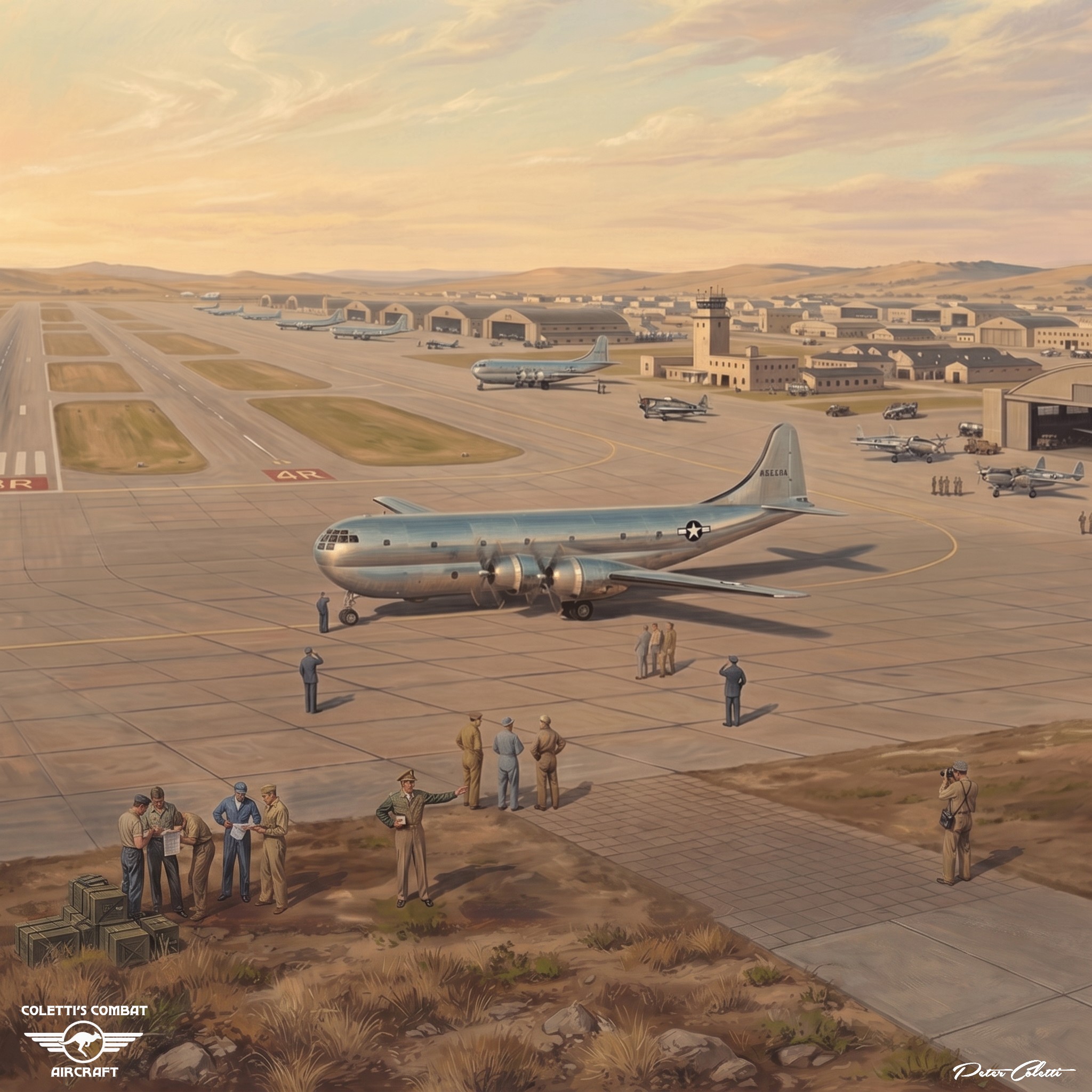
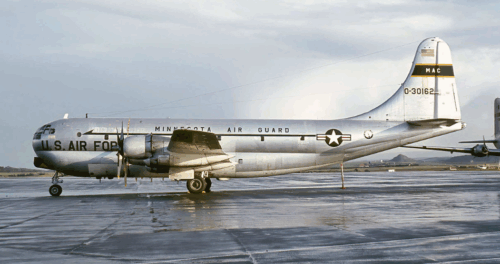
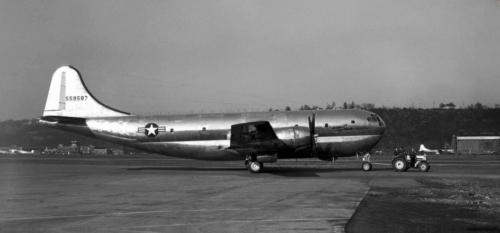
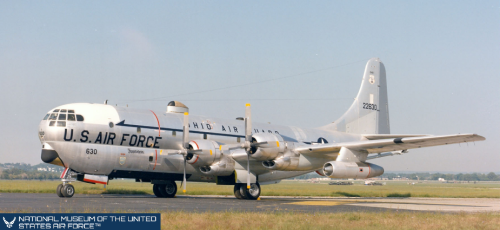
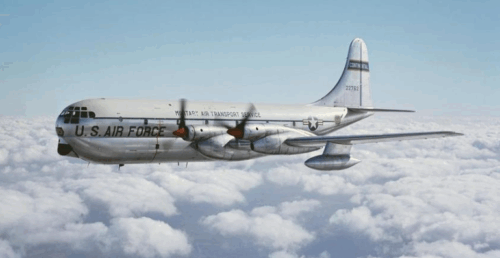
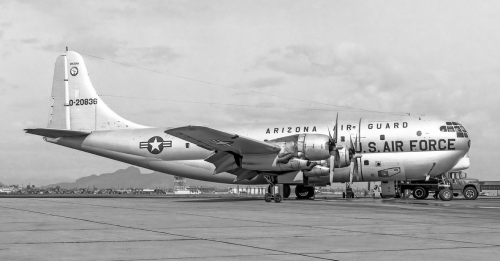
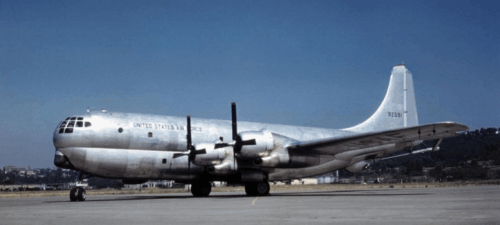
The C-97 Stratofreighter was conceived in the middle of World War II, at a moment when the US Army Air Forces were learning—sometimes painfully—how much strategic air power depended on logistics.
The Boeing B-29 Superfortress was already in development as a very long‑range bomber, and Boeing’s engineers quickly saw that its wing, engines, and lower fuselage could form the basis of a high‑capacity transport.
Design work on a transport derivative began around 1942, with the goal of creating an aircraft that could move heavy loads across oceans and continents in support of global operations.
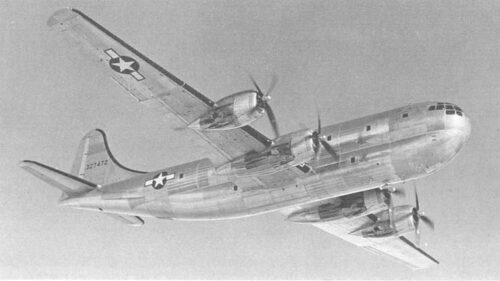
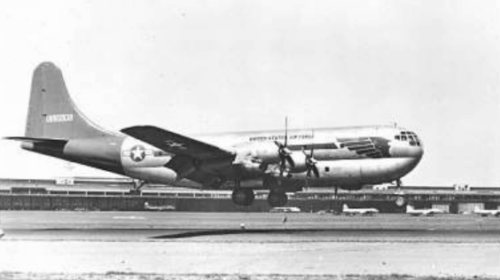
XC-97
Although the C-97 is often associated with the early Cold War, its roots are firmly in the late-war environment.
The US anticipated large‑scale redeployment of men and materiel across the Pacific and, eventually, to occupied territories.
The B-29’s long range and high-altitude performance made it an ideal starting point.
The transport derivative, initially designated XC‑97, was not intended as a tactical airlifter for rough forward strips but as a strategic freighter linking major bases and depots—essentially the airborne backbone of a global supply system that the US knew it would need beyond the war itself.
The first prototype XC‑97 flew on 9 November 1944, while the war in Europe was still raging and the Pacific campaign was entering its final, brutal stages.
By the time the aircraft was ready for serious evaluation, the war was nearly over, so the C‑97 did not become a major wartime workhorse.
Instead, it emerged as one of the key bridges between the World War II bomber era and the postwar world of dedicated strategic transports and aerial tankers.
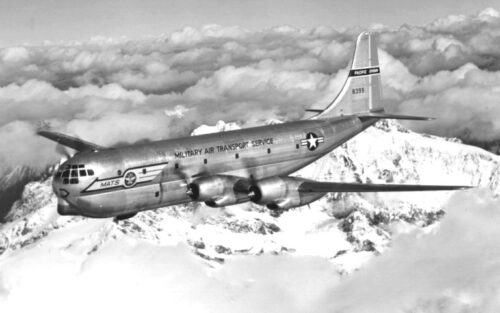
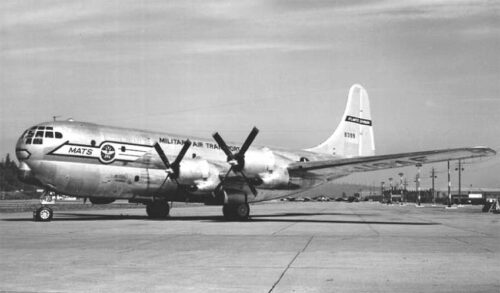
C-97A
Design and engineering
Overall configuration
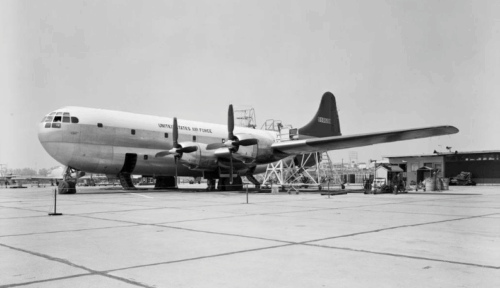
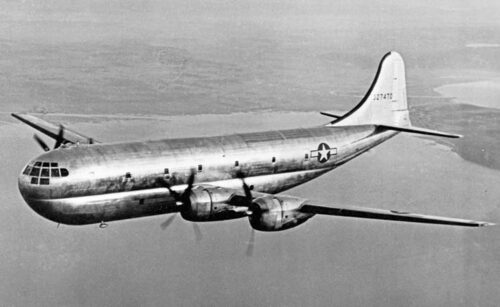
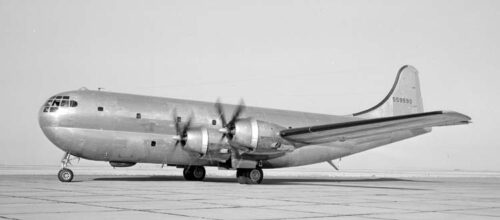
The C-97 was structurally a hybrid: it combined the B-29’s wing, tail, and lower fuselage with a completely new upper fuselage, producing the distinctive “double-bubble” cross-section.
The lower lobe was essentially the bomber’s original fuselage, while the upper lobe was a much larger, nearly circular section that provided a spacious cargo deck.
This arrangement maximised internal volume without requiring a completely new wing or tail design, and it foreshadowed the fuselage cross‑sections of later Boeing jet airliners.
The aircraft was a high‑wing monoplane in functional terms, though visually it retained the B‑29’s mid‑mounted wing on the lower fuselage.
The tail unit—fin, rudder, and horizontal stabilisers—was initially similar to the B‑29’s, but later prototypes and production aircraft adopted the taller fin and rudder developed for the improved B‑50 Superfortress, which provided better directional stability for the larger, heavier transport.
Fuselage and cargo system
The double‑lobe fuselage was the heart of the design.
The main cargo deck in the upper lobe was roughly 12 ft wide and about 7½ ft high, long enough to accommodate trucks, artillery pieces, or large pallets.
The aircraft could carry around 35,000 lb (about 16,000 kg) of payload, including combinations such as two 2½‑ton trucks, towed guns, or light tracked vehicles.
In troop transport configuration, it could carry well over a hundred passengers or large numbers of stretcher patients in aeromedical evacuation roles.
Access to the cargo hold was via large clamshell doors at the rear underside of the fuselage.
When opened on the ground, these doors allowed two retractable ramps to be deployed so vehicles could be driven directly into the aircraft.
This made the C‑97 very efficient for loading and unloading at established airfields with suitable ground handling, but the design was not optimised for rough or short strips.
The doors could not be opened in flight; for airdrop missions, they could be removed on the ground and cargo dispatched through the open tail area.
The cabin was fully pressurised, a significant advantage for long‑range flights at high altitude.
Pressurisation improved crew endurance and passenger comfort and allowed the aircraft to cruise above much of the weather, a feature inherited from the B‑29 and carried forward into the postwar era of long‑range transports and airliners.
Powerplant and systems
The earliest XC‑97 prototypes used the same Wright R‑3350 Duplex‑Cyclone radial engines as the B‑29, each producing about 2,200 hp.
These engines gave adequate performance for testing, but as the design matured and gross weight increased, more power was needed.
From the tenth aircraft onward, the C‑97 adopted four Pratt & Whitney R‑4360 Wasp Major 28‑cylinder radial engines, each rated at roughly 3,500 hp.
This change, along with the taller B‑50 tail, effectively defined the configuration of the production C‑97 family.
The aircraft used four‑blade constant‑speed propellers and carried large fuel loads in its wing tanks, giving it intercontinental range.
Typical cruise speeds were in the 250–300 mph range, with maximum speeds somewhat higher, and service ceilings around 30,000–35,000 ft depending on configuration and weight.
The landing gear was a robust tricycle arrangement, with a twin‑wheel nose gear and multi‑wheel main units retracting into the wing‑root fairings and fuselage.
The flight deck was arranged for a multi‑person crew: two pilots, a flight engineer, and, in military service, often a navigator and radio operator.
The cockpit layout reflected its bomber ancestry, with extensive engine instrumentation and systems controls to manage the powerful radials and the pressurisation system over long flights.
Prototypes, testing, and early performance
The first XC‑97’s maiden flight on 9 November 1944 demonstrated that the basic concept was sound.
A notable early demonstration came on 9 January 1945, when the prototype flew from Seattle to Washington, D.C., carrying about 20,000 lb of cargo in just over six hours, averaging roughly 380 mph—an impressive performance for a large piston-engined transport of the time.
The US Army Air Forces ordered ten YC‑97 development aircraft.
These allowed refinements in systems, structure, and aerodynamics, and the later examples incorporated the more powerful R‑4360 engines and taller tail.
These near‑production aircraft validated the C‑97’s ability to carry heavy loads over long distances at relatively high speeds and altitudes, confirming its role as a strategic transport rather than a short‑haul tactical lifter.
By the time the first production C‑97A was delivered in 1949, the war was over, and the US Air Force had been created as a separate service.
The C‑97 entered a rapidly evolving environment in which new transports like the Douglas C‑124 Globemaster II would soon offer nearly double its payload.
Even so, the C‑97’s combination of range, speed, and pressurisation made it a valuable asset in the immediate postwar years.
XC-97
Operational history and strategic role
Early postwar service and the Berlin Airlift
The C‑97 entered service in 1947 and quickly found itself involved in one of the defining airlift operations of the early Cold War: the Berlin Airlift (1948–1949).
Although the bulk of the airlift was flown by smaller transports such as the C‑47 and C‑54, C‑97s participated as heavy lifters, moving bulk cargo into West Berlin during the Soviet blockade.
Their large cargo volume and pressurised cabins made them well suited to high‑altitude routes into the city, though their numbers were relatively small compared with the more numerous C‑54s.
Korean War and global logistics
During the Korean War, the C‑97 served as a long‑range transport and aeromedical evacuation aircraft, moving troops, equipment, and wounded personnel between the continental United States, Japan, and Korea.
Its ability to carry large loads over the Pacific, combined with pressurisation and relatively high cruise speeds, made it an important link in the logistical chain supporting UN forces.
Beyond Korea, C‑97s operated worldwide with the Military Air Transport Service (MATS) and other USAF commands, connecting bases in Europe, the Middle East, and Asia.
They were used for troop rotations, cargo missions, and special assignments, including VIP and staff transport in modified VC‑97 variants.
Tanker service and the Strategic Air Command
The most numerous members of the family were not pure transports but tanker‑transports: the KC‑97 series.
As the US Air Force built up its Strategic Air Command (SAC) bomber force in the late 1940s and early 1950s, aerial refuelling became essential.
Boeing adapted the C‑97 airframe to carry fuel and fitted it with a flying‑boom refuelling system in the rear fuselage.
The KC‑97E and F, and especially the KC‑97G, became the primary SAC tankers for B‑47 Stratojet and early B‑52 Stratofortress bombers.
However, the piston‑engined KC‑97 faced a fundamental limitation: speed compatibility with jet bombers.
The KC‑97’s economical cruise speed was around 230–260 mph, while the B‑47 and B‑52 had much higher minimum refuelling speeds.
To take on fuel, the bombers had to descend to lower altitudes and fly near their stall speeds, which was operationally awkward and potentially hazardous.
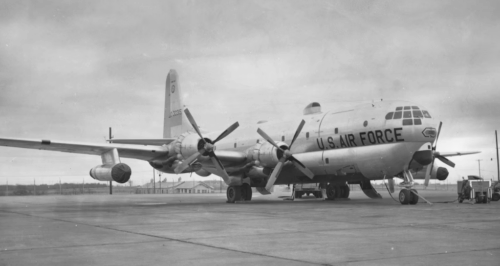
To mitigate this, the KC‑97L variant added two underwing J47 turbojet engines, giving extra thrust during refuelling and climb, but this was a stopgap.
The arrival of the jet‑powered KC‑135 Stratotanker from 1957 onward gradually pushed the KC‑97 out of front‑line SAC service.
Many KC‑97s were then transferred to Air National Guard units, where they continued to serve as tankers and transports well into the 1970s.
The last US examples were retired around 1978, giving the basic C‑97/KC‑97 family a service life of more than three decades.
Other operators and secondary roles
In addition to the United States, small numbers of C‑97‑derived aircraft served with other air arms, including the Israeli Air Force and the Spanish Air Force.
Some were used as transports, others as tankers or special‑mission aircraft.
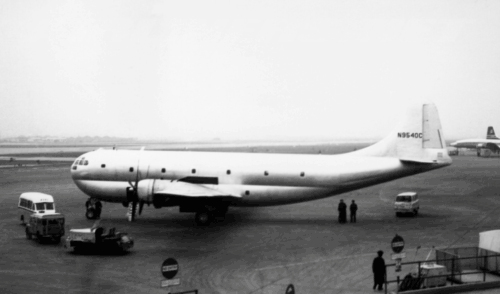
After military retirement, a number of airframes were converted for civilian cargo work or specialised roles such as aerial firefighting.
C-97A
Variants and derivatives
Core transport variants
XC‑97 and YC‑97:
Experimental and development aircraft, starting with R‑3350 engines and B‑29 tail surfaces, then evolving to R‑4360 engines and the taller B‑50 tail.
These aircraft proved the concept and refined the design for production.
C‑97A/D Stratofreighter:
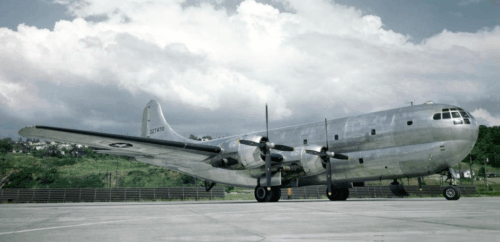
Early production transports with R‑4360 engines, pressurised cabins, and full cargo capability.
The C‑97D incorporated various improvements and was used in roles including cargo, troop transport, and aeromedical evacuation.
VC‑97:
VIP and staff transport versions with modified interiors, sometimes referred to as “Stratocruiser” in USAF service, though distinct from the civil Boeing 377.
Tanker‑transport variants
KC‑97E/F/G Stratofreighter:
Aerial refuelling versions equipped with the flying‑boom system.
The KC‑97G was the most numerous, combining tanker equipment with a full cargo floor, allowing it to serve as both tanker and freighter.
These aircraft formed the backbone of SAC’s tanker fleet in the early to mid‑1950s.
KC‑97L:
The modified KC‑97G with two J47 turbojet engines in underwing pods improved performance during the refuelling of jet aircraft.
This variant extended the useful life of the airframe in the jet age, particularly in Air National Guard service.
Experimental and special variants
YC‑97J:
A turboprop testbed variant, used to explore alternative powerplants and performance improvements.
It did not lead to a production turboprop C‑97 but contributed to broader USAF understanding of large turboprop transports.
Technical performance summary
While exact figures varied by variant and configuration, a representative C‑97/KC‑97G had the following approximate characteristics:
Powerplant:
Four Pratt & Whitney R‑4360 Wasp Major radial engines, about 3,500 hp each.
Dimensions:
Wingspan about 43 m (141 ft); length about 36 m (117 ft); height about 11.5–12 m (around 38 ft).
Weights:
Empty weight around 82,500 lb (37,000+ kg); maximum takeoff weight up to about 175,000 lb (79,000+ kg).
Performance:
Maximum speed on the order of 320–340 mph;
typical cruise around 260–300 mph;
service ceiling roughly 30,000–35,000 ft;
range with maximum fuel in the 3,500–4,300-mile class, depending on load and variant.
Capacity:
Payload around 35,000 lb; configurations for more than 100 passengers, or large numbers of troops, paratroopers, or litter patients; in tanker form, substantial fuel offload capability while retaining some cargo capacity.
Assessment and legacy
The Boeing C‑97 Stratofreighter was not a headline‑grabbing combat aircraft, nor did it dominate World War II in the way its B‑29 ancestor did.
Instead, it occupied a crucial but quieter role: it was one of the first truly modern strategic transports, combining long range, high altitude, pressurisation, and large internal volume in a single airframe.
It bridged the gap between wartime bombers adapted for transport and the purpose‑built jet transports and tankers that would follow.
In its tanker guise as the KC‑97, the design underpinned the Strategic Air Command’s global reach in the early Cold War, enabling B‑47 and early B‑52 operations until the KC‑135 took over.
As a transport, it served in the Berlin Airlift, the Korean War, and numerous peacetime missions, and it provided the structural basis for both the luxurious Stratocruiser airliner and the outsized Guppy cargo aircraft.