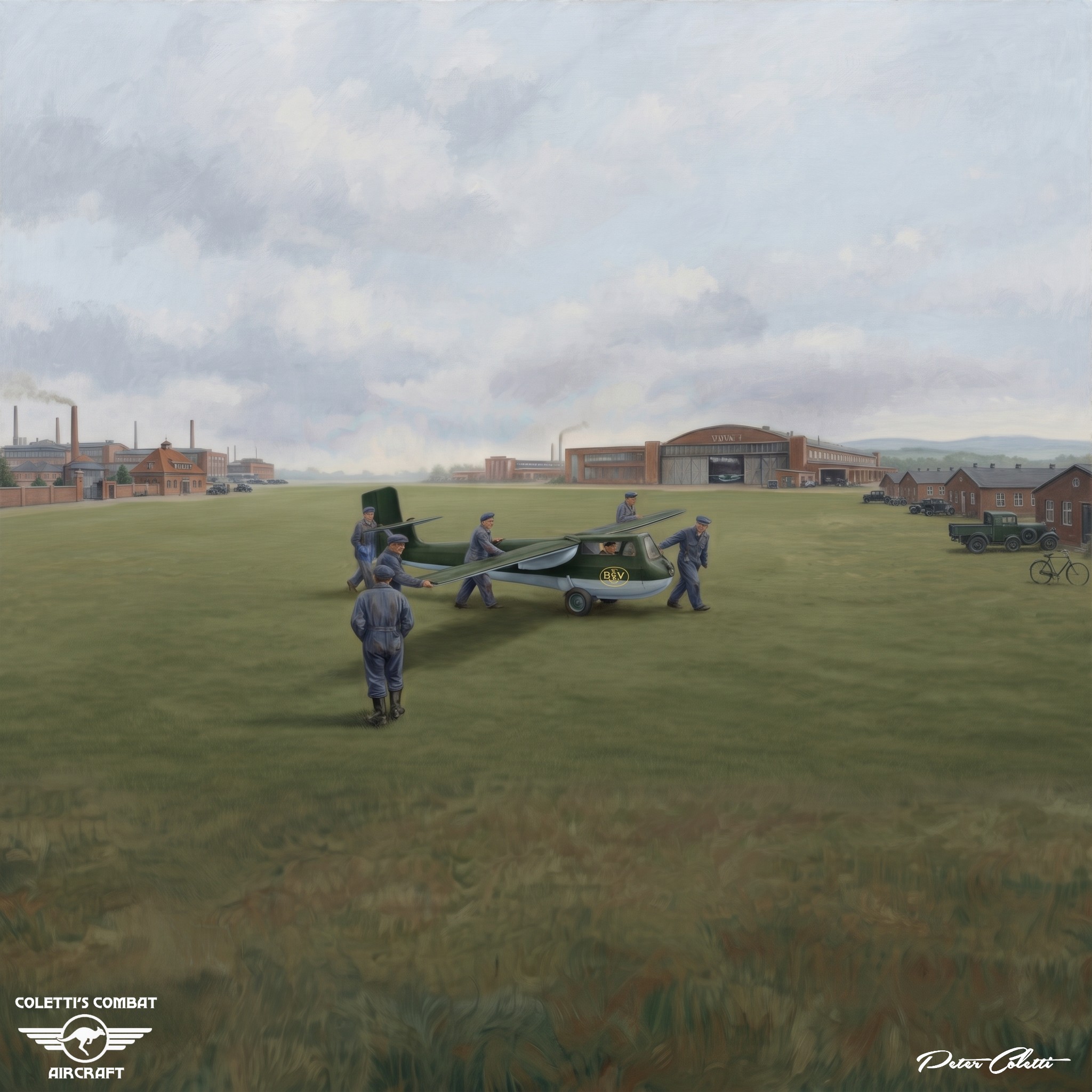
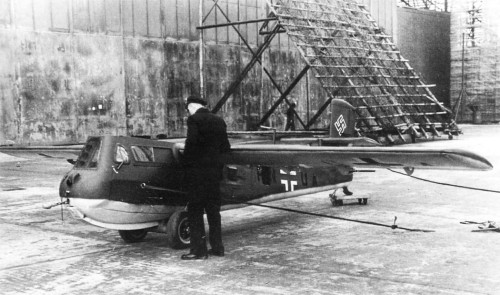
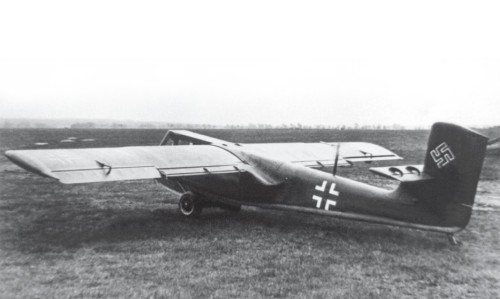
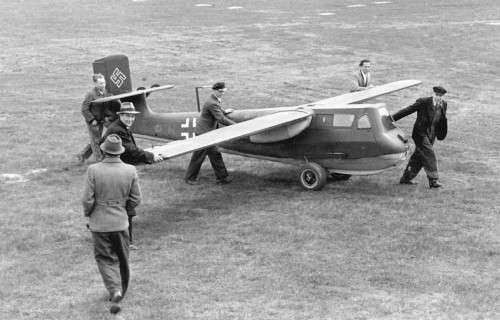
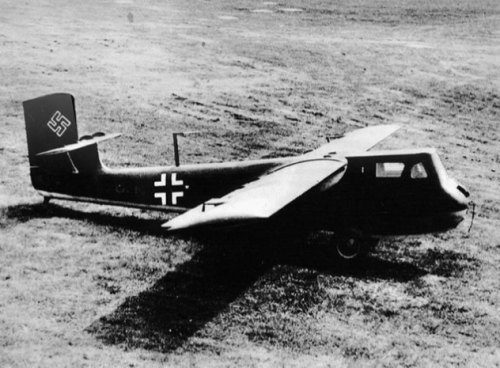
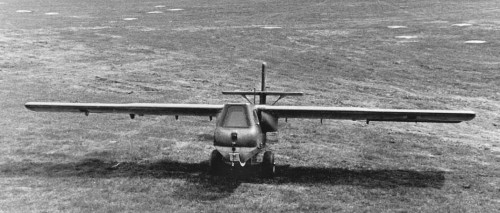
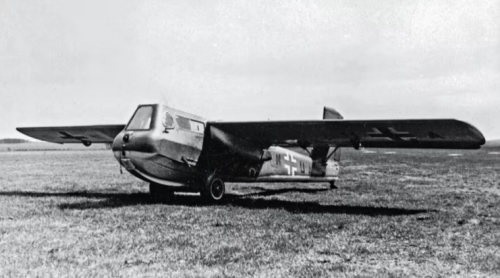
The Blohm & Voss BV 40 was one of the most radical products of Germany’s late‑war desperation—a tiny, heavily armoured fighter‑glider conceived to meet massed Allied bomber formations with a cheap, expendable interceptor.
It never reached operational service, but its conception, design, and brief test career capture the Luftwaffe’s struggle to defend the Reich in 1943–44.
Strategic background and origins
By mid‑1943, the Luftwaffe was under intense pressure from Allied strategic bombing.
Daylight raids by USAAF heavy bombers and night attacks by the RAF were inflicting mounting damage on German industry and infrastructure.
Conventional fighters—Bf 109s and Fw 190s—were increasingly stretched, and Germany faced shortages of fuel, aluminium, and highly trained pilots.
In this context, Dr Richard Vogt, chief designer at Blohm & Voss, proposed an unconventional solution: a heavily armoured, unpowered glider interceptor that could be built largely from non‑strategic materials and flown by pilots with relatively modest training.
The idea was to create a low‑cost, high‑survivability platform dedicated to attacking bomber formations head‑on, where the bombers were most vulnerable and their defensive fire least effective.
The Reich Air Ministry (RLM) responded favourably in late 1943.
An initial development order of around 19–21 aircraft was placed, with the expectation that, if trials proved successful, production could ramp up to hundreds of units per month.
The project carried the internal designation P 186 before being formalised as BV 40.
Concept of operations
Initial ramming concept
The earliest concept for the BV 40 was extreme even by late‑war German standards.
The glider would be towed to altitude by a single‑engined fighter—typically a Messerschmitt Bf 109G—and released slightly above the bomber stream.
From there, it would dive steeply towards the formation and physically ram the vertical tail of a bomber, destroying the target and disrupting the tight combat box formation.
To support this, the BV 40 was to be heavily armoured, with robust wings capable of surviving the impact long enough to give the pilot a chance of survival.
The RLM also specified a single 30 mm MK 108 cannon to neutralise the bomber’s tail gunner before the ramming manoeuvre.
However, further analysis quickly revealed serious practical and psychological problems.
Achieving the necessary closing speed from the rear demanded very high release altitudes, and the idea of deliberately ramming a bomber posed obvious morale and training challenges.
Vogt himself later argued against the ramming concept, suggesting instead a more conventional gun‑attack profile.
Revised gun‑attack role
The BV 40’s mission evolved into a head‑on gun interceptor.
Towed to a position roughly 250–750 m (820–2,460 ft) above the bomber stream, the glider would be released and dive through the formation, firing its 30 mm cannon(s) in a brief, high‑speed pass.
After the attack, it would glide back to base, landing on a skid.
This concept aimed to:
Minimise cost: no engine, simple structure, and use of wood and mild steel.
Maximise survivability: heavy armour around the pilot and small frontal area.
Reduce pilot training burden: glider pilots could be trained more quickly than full fighter pilots.
Design and construction
Airframe layout
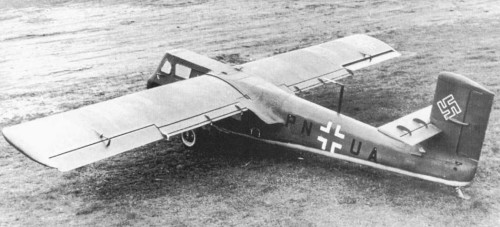
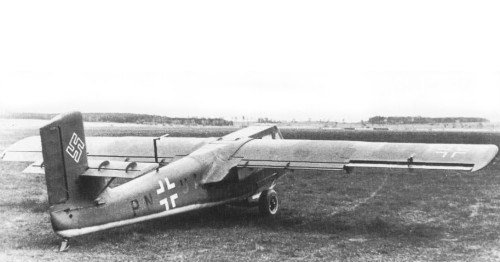
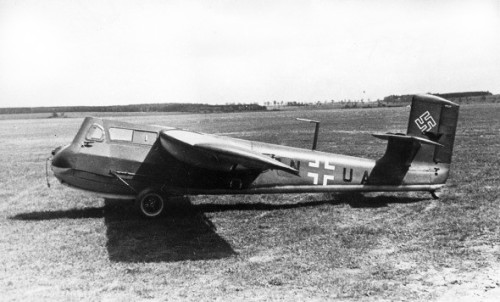
The BV 40 was compact and angular, optimised for a small frontal silhouette and straightforward manufacture:
Fuselage: very narrow (about 0.7 m wide), with a boxy cross‑section.
The central fuselage used riveted sheet steel; the rear fuselage and tail were largely wooden to conserve strategic metals.
Wings: high‑mounted, straight wings with a span of roughly 7.9 m (about 26 ft).
The high mounting improved lift and kept the wing roots clear for cannon installation.
Tail unit: a conventional single fin with a mid‑mounted tailplane, set slightly forward on the fin to suit the compact fuselage.
Dimensions were approximately:
Length: ~5.7 m (18 ft 8 in)
Wingspan: ~7.9 m (25 ft 11 in)
Height: ~1.6 m (5 ft 4 in)
Prone-pilot position
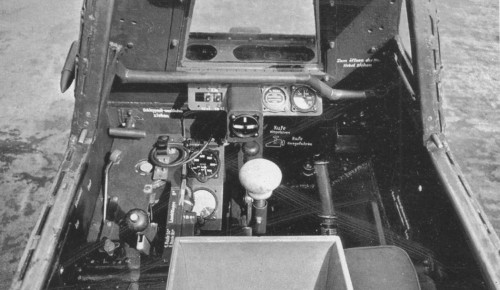
One of the BV 40’s most distinctive features was the prone pilot position.
The pilot lay on a padded bench in the nose, supported by chin and side pads, looking forward through thick armoured glass.
This arrangement served two purposes:
Reduced frontal area: a prone pilot allowed a very low, narrow cockpit, shrinking the target presented to bomber gunners.
Improved G‑tolerance: German research, including tests with the Akaflieg Berlin B9 experimental aircraft, suggested that pilots lying prone could withstand significantly higher G‑loads than seated pilots—potentially up to around 12 G versus 5 G.
The cockpit itself was a heavily armoured “capsule” at the front of the fuselage, with limited but adequate forward and slightly downward visibility for the attack run.
Armour protection
Survivability was central to the BV 40 concept.
Armour accounted for roughly a quarter of the aircraft’s total weight.
Typical armour layout included the following:
Front plate: about 20 mm of steel.
Side plates: around 8 mm.
Underside: about 5 mm.
Windscreen: approximately 120 mm of bullet‑resistant glass.
This armour was intended to protect the pilot from frontal and limited side fire during the brief head-on pass through the bomber formation.
Undercarriage and landing
The BV 40 used a simple, jettisonable undercarriage:
Take‑off: a small twin‑wheel unit attached under the forward fuselage.
After takeoff, the wheels were dropped, leaving the glider “clean” for combat.
Landing: The aircraft touched down on a semi‑retractable belly skid, sliding to a stop on the airfield.
This arrangement reduced complexity and weight and was acceptable for a glider expected to operate from prepared surfaces.
Armament and performance
Planned armament
The intended combat configuration of the BV 40 featured:
2 × 30 mm MK 108 cannon mounted in the wing roots, one per side.
Ammunition: about 35 rounds per gun.
The MK 108 was a short‑barrelled, low‑velocity cannon optimised for close‑range air combat.
A few hits from its high‑explosive shells were sufficient to cripple or destroy a heavy bomber.
In some early proposals, a single MK 108 was specified, but the twin‑gun arrangement became the standard concept for production aircraft.
Test aircraft were generally unarmed or carried reduced armament, as weight issues forced the removal of some armour and at least one gun on prototypes to achieve acceptable flight characteristics.
Weight and basic performance
Approximate weights:
Empty weight: ~835 kg (about 1,845 lb).
Maximum takeoff weight: ~950 kg (about 2,095 lb).
As a pure glider, the BV 40 had no engine.
Performance depended entirely on tow aircraft and release altitude:
Tow speed: test flights reached around 470 km/h (292 mph) while under tow.
Attack speed: calculations and some sources suggest potential dive speeds up to roughly 900 km/h (559 mph) in a steep attack run, though this was more theoretical than operationally proven.
Glide performance was adequate at higher speeds but deteriorated rapidly as speed fell below about 140 km/h (87 mph), making low‑speed handling and landings demanding.
Development and test programme
Prototypes
Around six to seven BV 40 prototypes were completed, designated V1, V2, etc.:
V1: first towed flight on 6 May 1944, behind a Heinkel He111.
On its second flight (2 June 1944), it was released to glide back to the ground but suffered a crash when performance degraded at low speed; the aircraft was damaged, though the pilot survived.
V2: conducted short test flights in early June 1944.
V3: used as a static test airframe.
V4: badly damaged in a crash in late June.
V5 and V6: entered the test programme later; V6 made a longer towed flight on 27 July 1944, being towed from Stade to Wenzendorf by a Bf 110.
Across the programme, roughly 17 test flights were conducted.
These demonstrated that the BV 40 could be towed at relatively high speeds and had acceptable high-speed gliding characteristics but also revealed structural and handling issues, especially in turbulence and at low speeds.
Technical and operational concerns
Several factors undermined the BV 40’s prospects:
Overweight prototypes: armour and structural reinforcement made the aircraft heavier than planned, forcing removal of some armour and one cannon in test configurations.
Vulnerability to fighters: while the BV 40 might survive bomber defensive fire, it was slow, unpowered, and highly vulnerable to Allied escort fighters, which dominated the airspace around bomber streams by 1944.
Limited flexibility: the glider concept tied each BV 40 to a towing fighter, reducing overall efficiency compared with simply fielding more conventional fighters or emerging jet and rocket interceptors.
Variants and proposed developments
The BV 40 programme never progressed beyond prototypes, but several variations and refinements were considered:
Standard fighter‑glider (BV 40): the baseline design with twin MK 108 cannons and full armour.
Weight‑reduced test versions: prototypes with reduced armour and armament to improve handling and allow safe flight testing.
Alternative roles: at one stage, as the bomber‑interception concept lost favour, there were proposals to adapt the BV 40 for anti‑shipping attacks using specialised bombs, exploiting its small size and low cost for coastal defence.
This remained notional and did not progress to hardware.
No powered or significantly redesigned variants are known to have reached construction; the core concept remained a pure glider interceptor.
Cancellation and WWII context
By mid‑1944, the technological and strategic landscape had shifted.
Germany was investing heavily in advanced interceptors such as the Messerschmitt Me 262 jet fighter and the rocket‑powered Me 163 Komet, as well as improved conventional fighters.
These offered far greater flexibility and combat potential than a specialised glider interceptor.
In August 1944, the BV 40 programme was cancelled after only six or seven prototypes had been completed out of the roughly 19–21 ordered.
The remaining airframes and tooling were subsequently destroyed in Allied air raids later that year.
The BV 40 thus remained a footnote in Luftwaffe history—an imaginative but ultimately impractical attempt to solve the bomber problem with minimal resources.
It reflects several broader themes of late war.
German aircraft development:
Resource scarcity: reliance on wood and mild steel, and the search for low‑cost solutions.
Desperation for bomber defence: willingness to consider extreme concepts, including ramming.
Rapid obsolescence: as jet and rocket technology matured, specialised glider interceptors lost relevance.
Assessment and legacy
Technically, the BV 40 was innovative in its use of a prone pilot position, heavy armour in a glider, and the idea of a dedicated, expendable interceptor.
It demonstrated that a compact, armoured glider could be towed at high speed and flown, albeit with demanding handling characteristics.
Operationally, however, the concept was flawed:
It depended on towing fighters that could themselves be used more effectively as conventional interceptors.
It offered little defence against escort fighters, which were the decisive factor in protecting bomber formations by 1944.
Its single‑purpose nature and limited endurance made it unsuitable for the fluid, large‑scale air battles over Germany.