The Bestetti Nardi BN.1 emerged from a period of intense Italian concern over national aviation prestige in the late 1930s.
In June 1938, engineer Pietro Luigi Nardi presented the results of aerodynamic studies that identified the twin‑fuselage configuration as the optimal layout for a light twin‑engine aircraft.
His proposal was not initially military; it was a response to Italy’s disappointing performance in international air races, where German types such as the Siebel Si 104 and Messerschmitt Bf 108 Taifun had decisively outclassed Italian competitors like the Caproni Ca.309 and Nardi FN.305.
Italian aviation authorities concluded that only radically improved aerodynamics could restore national competitiveness, and they identified two promising directions: the single‑engine SAI‑Ambrosini 7 and Nardi’s twin‑fuselage concept.
To test Nardi’s theory, the government commissioned a four‑seat light touring aircraft that could also serve as a high‑performance sport machine capable of challenging German dominance.
On 5 September 1938, the Amministrazione Aeronautica awarded a contract to the Bestetti company to build the prototype, designated Bestetti‑Nardi modello 1, or BN. 1.
The Bestetti Company and Industrial Context
The Bestetti firm, led by brothers Guido and Angelo Bestetti, descended from the pioneering aviation work of their father, Carlo Bestetti.
Located in Arcore, in the Brianza region—an area renowned for its woodworking and furniture craftsmanship—the company specialised in producing light aircraft designed by external engineers, such as the Bestetti‑Colombo C.3.
This regional expertise in woodcraft would become central to the BN.1’s construction philosophy.
Design Philosophy and Construction Innovations
Use of “Reconstructed” Wood
One of the BN.1’s most distinctive features was its entirely wooden construction, but not in the conventional sense.
Nardi insisted on using wood as a fibre source, not as pre‑shaped structural components.
Each structural element was made from “reconstructed” wood—weakened, broken down, and then reassembled using special adhesives to create a material with predictable strength and, after fire‑retardant treatment, remarkable resistance to burning.
The wood came exclusively from Italian species such as beech, poplar, and spruce, aligning with Italy’s autarkic industrial policies of the era.
Airframe Layout
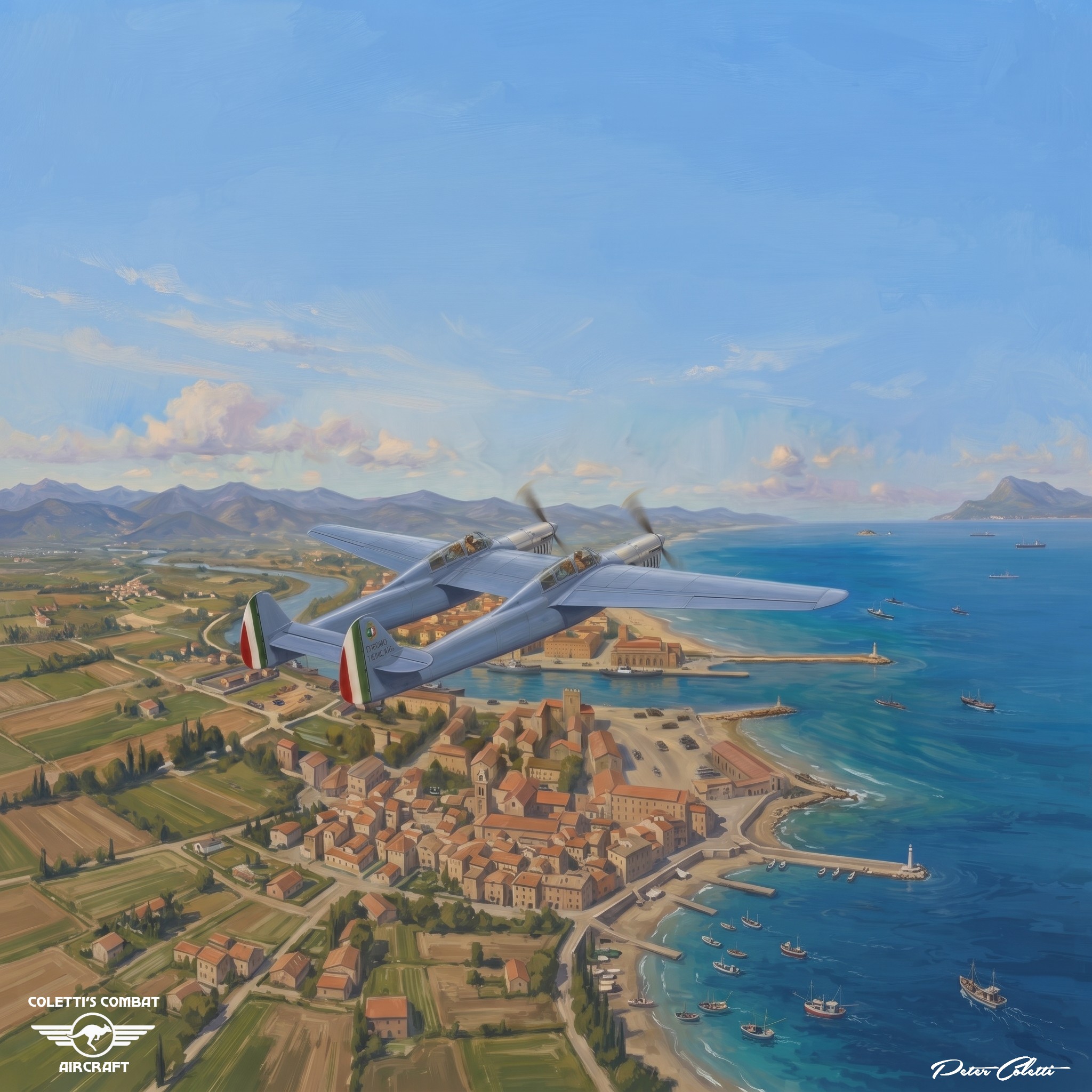
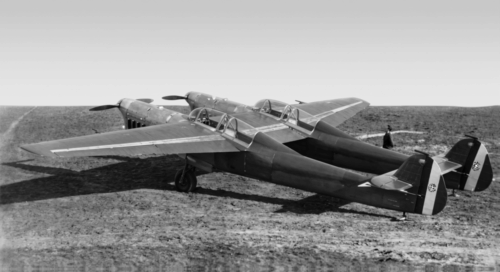
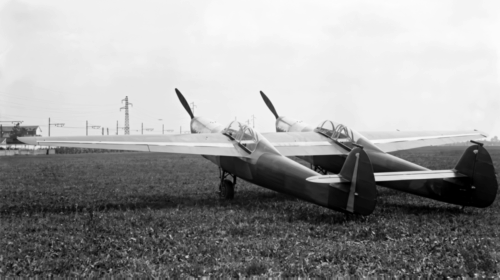
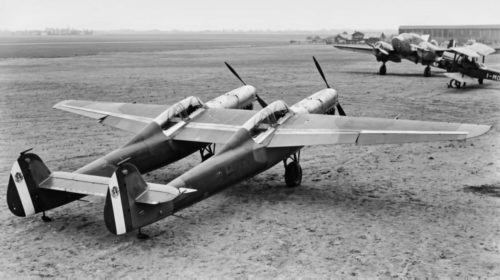
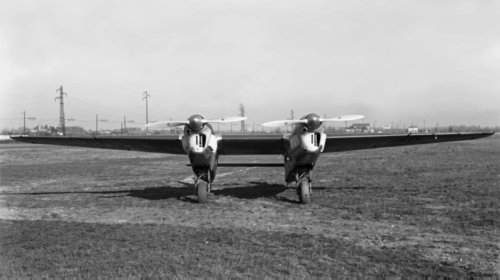
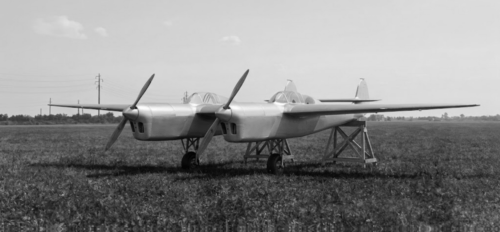
The BN.1 was a twin‑engine, twin‑fuselage, four‑seat, high‑wing monoplane.
Its wing comprised a central section joining the two fuselages and two trapezoidal outer panels.
The wing was a single‑spar structure built from reconstructed wood and covered in plywood and fabric.
Control surfaces—ailerons and flaps—ran along the full trailing edge of each outer wing panel and were wood‑framed with fabric covering.
The tail unit consisted of a single horizontal stabiliser spanning between the fuselages and two vertical fins, all of wooden construction with fabric covering.
Movable surfaces incorporated aerodynamic compensation systems, though these were not fully developed during early testing.
Landing Gear
The main landing gear retracted forward into nacelles behind the engines.
The wheels were low‑pressure types with dual shock absorbers and brakes, and each fuselage carried a sprung tail skid.
Cockpits and Systems
Each fuselage housed a cockpit with a pilot’s seat and a passenger seat.
Access was via side‑hinged transparent canopies.
Both cockpits carried full instrumentation for flight and engine monitoring.
Fuel tanks were located in each fuselage between the engine and cockpit, with a combined capacity of 420 litres.
Powerplant Evolution and Performance Expectations
The BN.1 was originally intended to use Hirth engines, later replaced in planning by the Alfa Romeo 116, a supercharged development of the Alfa Romeo 115.
When the 116 failed to materialise, the design reverted to the Alfa Romeo 115, forcing a recalculation of performance.
The change reduced maximum takeoff weight from 2000 to 1900 kg and payload from 800 to 650 kg and lowered projected maximum speed from 360 to 350 km/h, while range dropped from 1500 to 1100 km.
Despite these setbacks, the government approved a revised contract in April 1939, keeping the prototype price at 362,000 lire and the static‑test components at 184,000 lire.
Prototype Construction and Early Testing
By September 1939, static testing was underway, and both cockpits were complete.
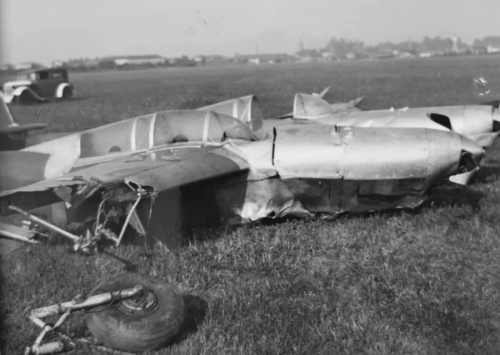
Flight testing began in summer 1940, but on 31 July 1940, test pilot De Michelis struck a power line during a low approach and crashed.
The aircraft caught fire yet survived thanks to its fire‑resistant reconstructed wood structure.
After six months of repairs, the BN.1 flew again under test pilot Bonomi, who criticised its poor controllability.
He recommended rebalancing the vertical tail, adding aerodynamic compensation to the horizontal tail, and enlarging the tail surfaces overall.
Official Evaluations and Rejection
After approximately 50 test flights, the aircraft was scheduled for evaluation at the Guidonia Experimental Centre.
A DGCA commission visited in July 1941 and found persistent control issues.
A second commission six months later rejected the aircraft outright, noting that the horizontal tail compensation system had not been completed—though it was developed shortly afterwards. Current page.
The BN.1 remained with the Bestetti company and continued flying sporadically into 1942–43, after which its fate is unknown following the Italian armistice.
Variants and Related Projects
BN.2 Parasite Fighter Concept Using the same reconstructed‑wood technology, Nardi designed the BN.2, a small parasite fighter intended to be carried aloft by a larger “mother” aircraft and released via a special hook system.
Static tests of the BN.2’s wing and fuselage began in March 1943, but the Regia Aeronautica had lost interest due to Allied air superiority and the impracticality of such composite aircraft concepts under wartime conditions.
By this time, Nardi had already severed ties with Bestetti, which was fully occupied with military contracts.
Influence on Reggiane Projects
In March 1943, DGCA asked Reggiane to build two all‑wood wings for the Re.2005 and Caproni Ca.331 using Nardi’s methods, aiming to exploit Italy’s abundant woodworking labour and reduce reliance on strategic metals.
Nardi joined Reggiane in November 1942, where work focused on adapting the Re.2005 to wooden construction.
Progress was slow, but the studies produced an intriguing proposal for a twin‑fuselage Re.2005, reflecting the same aerodynamic logic that had inspired the BN.1.
Ultimately, Nardi’s reconstructed‑wood technology found postwar use only in fire‑resistant wooden interiors and spiral staircases, not in aviation.
The Bestetti Nardi BN.1 represents a fascinating but ultimately unsuccessful attempt to combine aerodynamic innovation, national industrial policy, and lightweight materials science in pre‑WWII Italy.
Its twin‑fuselage layout anticipated later successful designs—most famously the P‑38 Lightning—but the BN.1 was conceived for sport and touring rather than combat.
Its failure stemmed from:
persistent control‑stability problems,
delays and compromises in engine availability,
the limited industrial capacity of its manufacturer,
and the rapidly shifting priorities of wartime Italy.
Yet the BN.1 remains historically valuable as the following:
an early exploration of twin‑fuselage aerodynamics,
a testbed for advanced wood‑composite construction,
and a symbol of Italy’s struggle to maintain aviation prestige on the eve of WWII.