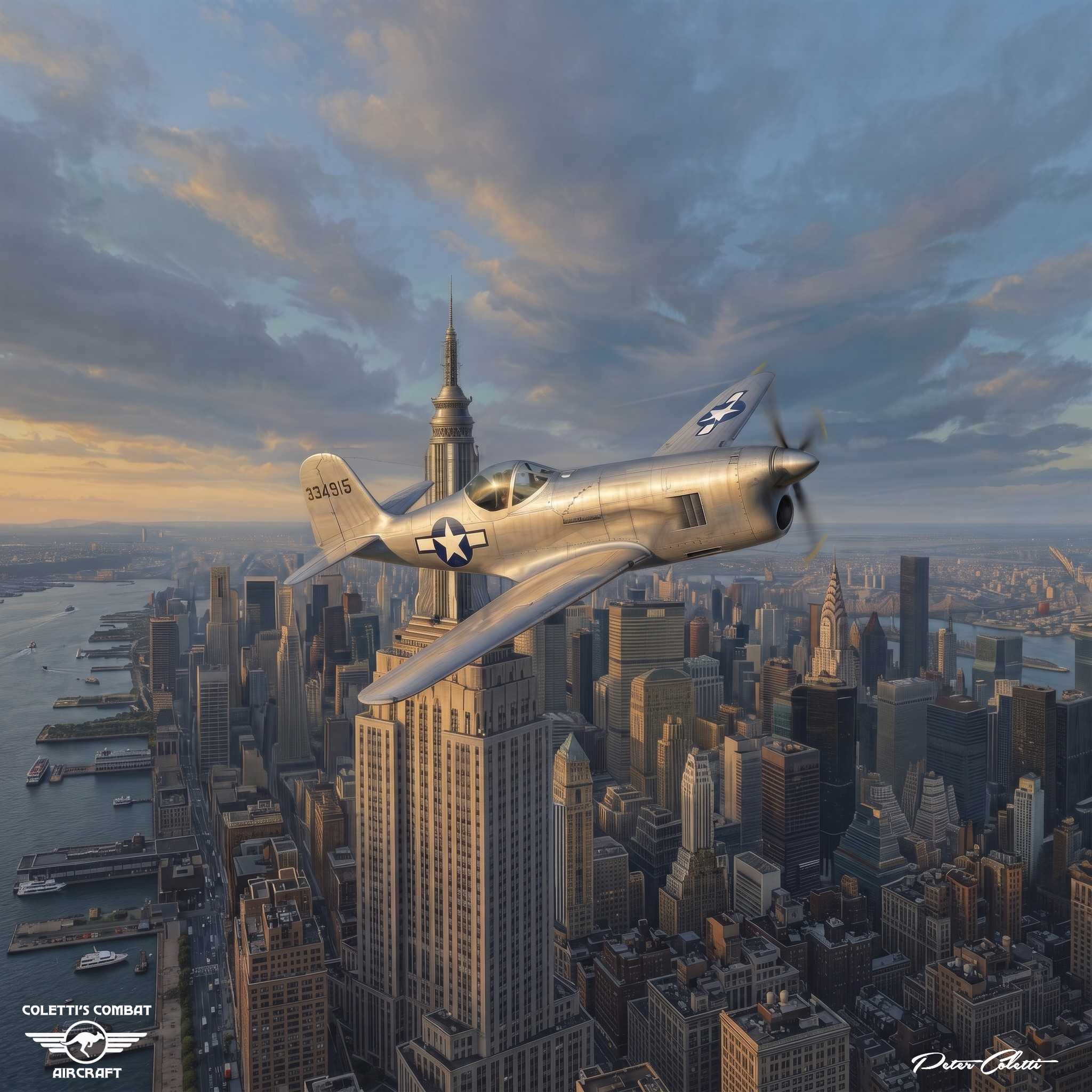
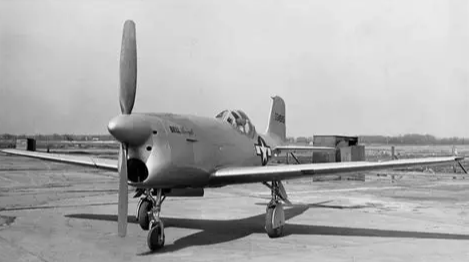
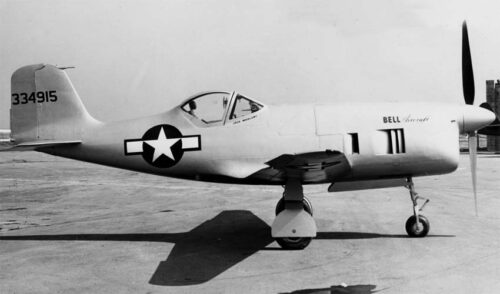
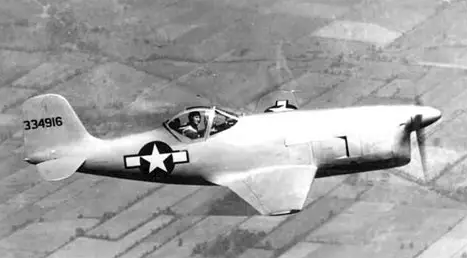
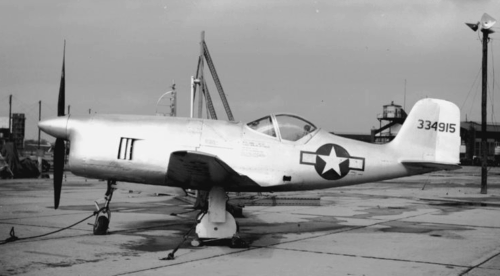
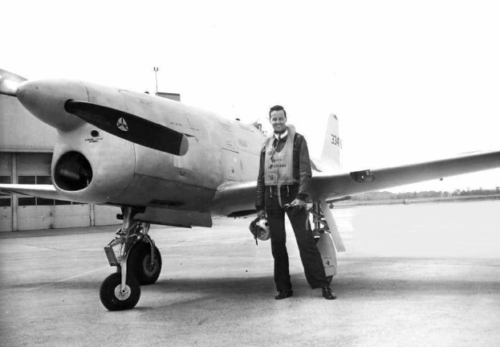
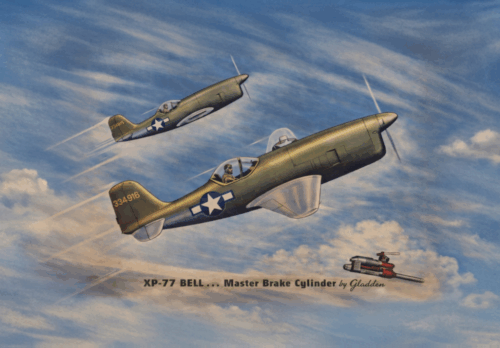
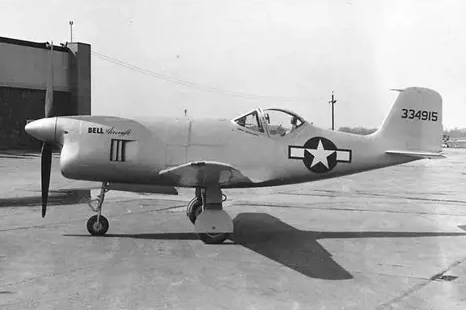
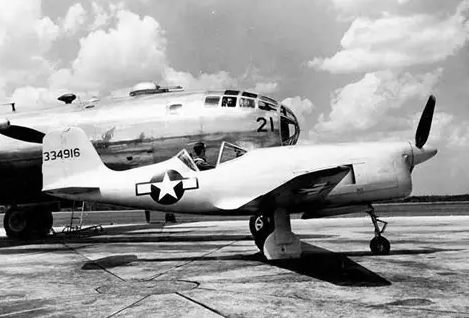
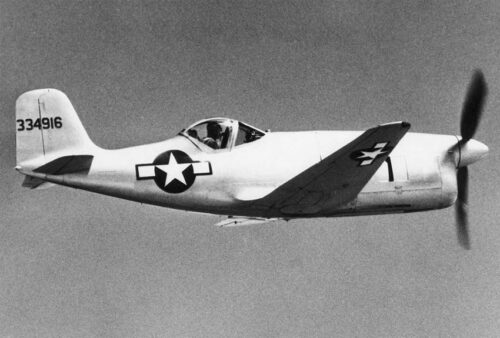
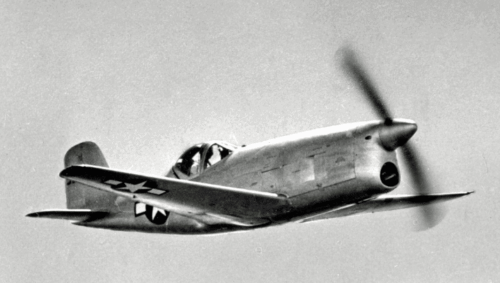
The Bell XP‑77 was one of the most unusual American fighter concepts of the Second World War: a tiny, lightweight, largely wooden interceptor intended to conserve strategic materials while delivering high performance.
Conceived at a moment when US planners feared shortages of aluminium and other critical resources, the XP‑77 embodied an experimental approach to fighter design that ultimately proved impractical.
Only two prototypes were completed, and the programme was cancelled before the end of 1944.
Origins and Strategic Context (1941–1942)
The XP‑77 originated in October 1941 as Bell Aircraft’s response to a U.S. Army Air Forces (USAAF) interest in a “very light” interceptor that could be built quickly, cheaply, and with minimal use of strategic materials.
Bell’s internal designation for the concept was Tri‑4, shorthand for an informal requirement of “400 hp, 4,000 lb, 400 mph”.
The strategic logic was clear: early-war U.S. production was constrained by limits on aluminium, skilled labour, and factory capacity.
A fighter made largely of non‑strategic materials, especially wood, could be built by subcontractors outside the traditional aircraft industry.
The USAAF hoped such an aircraft might supplement mainstream fighters by providing a small, manoeuvrable, high-altitude interceptor analogous to the Spitfire, Bf 109, or A6M Zero—aircraft whose combat performance had demonstrated the value of agility and climb rate.
On 16 May 1942, the USAAF recommended construction of 25 XP‑77 prototypes, reflecting early optimism about the concept.
Design and Construction
Airframe and Materials
The XP‑77 was a single‑seat, single‑engine, low‑wing monoplane built principally of wood, especially Sitka spruce, with a resin‑bonded skin covered in fabric.
The wooden structure was intended to allow rapid production by non‑aircraft manufacturers.
However, this approach created persistent problems:
subcontractor delays and disputes over releasing parts
structural concerns about glue bonding
weight growth beyond the 3,700‑lb design limit
These issues undermined the very rationale for the aircraft.
Layout and Features
The XP‑77 incorporated several Bell trademarks:
Tricycle landing gear, unusual for fighters of the era, gives excellent ground handling.
A bubble canopy, providing good all-around visibility except forward-downward due to the long nose.
A long, slender nose and triangular‑section fuselage, reminiscent of 1930s air racers.
Straight, clipped‑tip wings with a laminar‑flow airfoil and wooden ribs.
The aircraft was described in wartime promotional material as “an engine with a saddle on it”, reflecting its extremely compact form.
Engine and Propulsion
The XP‑77 was designed for the 500‑hp supercharged Ranger XV‑770‑9 inverted V‑12 engine, but development delays forced Bell to use the non‑supercharged XV‑770‑7, producing only 388 kW (520 hp).
This was a critical shortfall: even fighters of 1940 typically had twice the power.
The underpowered engine severely limited climb, acceleration, and top speed.
Armament
Planned armament included:
1 × 20 mm Hispano cannon firing through the propeller hub
2 × 0.50 in (12.7 mm) Browning M2 machine guns
Optional 300‑lb bomb or 325‑lb depth charge (requiring deletion of the cannon)
The prototypes were completed with two .50‑calibre guns only.
Programme Contraction and Prototype Construction (1942–1944)
By late 1942, inspection of the full‑scale mockup revealed serious concerns about weight, delays, and subcontracting issues.
Bell requested—and received—permission to reduce the order from 25 aircraft to two prototypes.
The first XP‑77 flew on 1 April 1944 at Niagara Falls, New York.
The date—April Fools’ Day—was later noted ironically by historians, as the aircraft’s performance proved disappointing.
Flight Testing and Performance
Handling and Stability
Testing revealed:
Noise and vibration from the Ranger engine
Long takeoff run
Poor stability, especially in the vertical axis
Spin problems, which caused the second prototype to crash on 2 October 1944 (pilot survived)
Measured Performance
According to test data:
Max speed: 330 mph (531 km/h)
Ceiling: 30,100 ft (9,175 m)
Range: 550 miles (885 km)
Takeoff weight: 4,028 lb (1,827 kg)
While respectable for a wooden aircraft with a 520‑hp engine, these numbers were inferior to contemporary USAAF fighters, which now included the P‑51D Mustang, P‑47D Thunderbolt, and P‑38L Lightning—aircraft with far greater power, armament, and survivability.
Operational Assessment
USAAF evaluators concluded the XP‑77 was:
Underpowered
Structurally troublesome
Operationally inferior to existing fighters
No longer relevant to wartime needs by 1944
Cancellation and Aftermath
The XP‑77 programme was terminated on 2 December 1944.
One prototype had crashed; the surviving aircraft was transferred between Wright Field and Eglin Field for postwar display, eventually disappearing from records.
Its final disposition remains unknown.
Variants
Only two prototypes were built:
XP‑77 (43‑34915) – first prototype, flew April 1944
XP‑77 (43‑34916) – second prototype, crashed October 1944
No further variants or production models were developed.
Assessment and Legacy
The Bell XP‑77 stands as a case study in wartime innovation constrained by material shortages and shifting priorities.
Its goals—rapid production, low cost, minimal strategic materials—were overtaken by events.
By 1944, U.S. industry was producing vast numbers of high‑performance fighters, eliminating the need for a lightweight wooden interceptor.
Nevertheless, the XP‑77 contributed to research on:
lightweight wooden structures
laminar-flow wings
tricycle landing gear on small fighters
Its failure also underscored the limitations of low‑power engines and the challenges of wooden airframes in high‑performance roles.