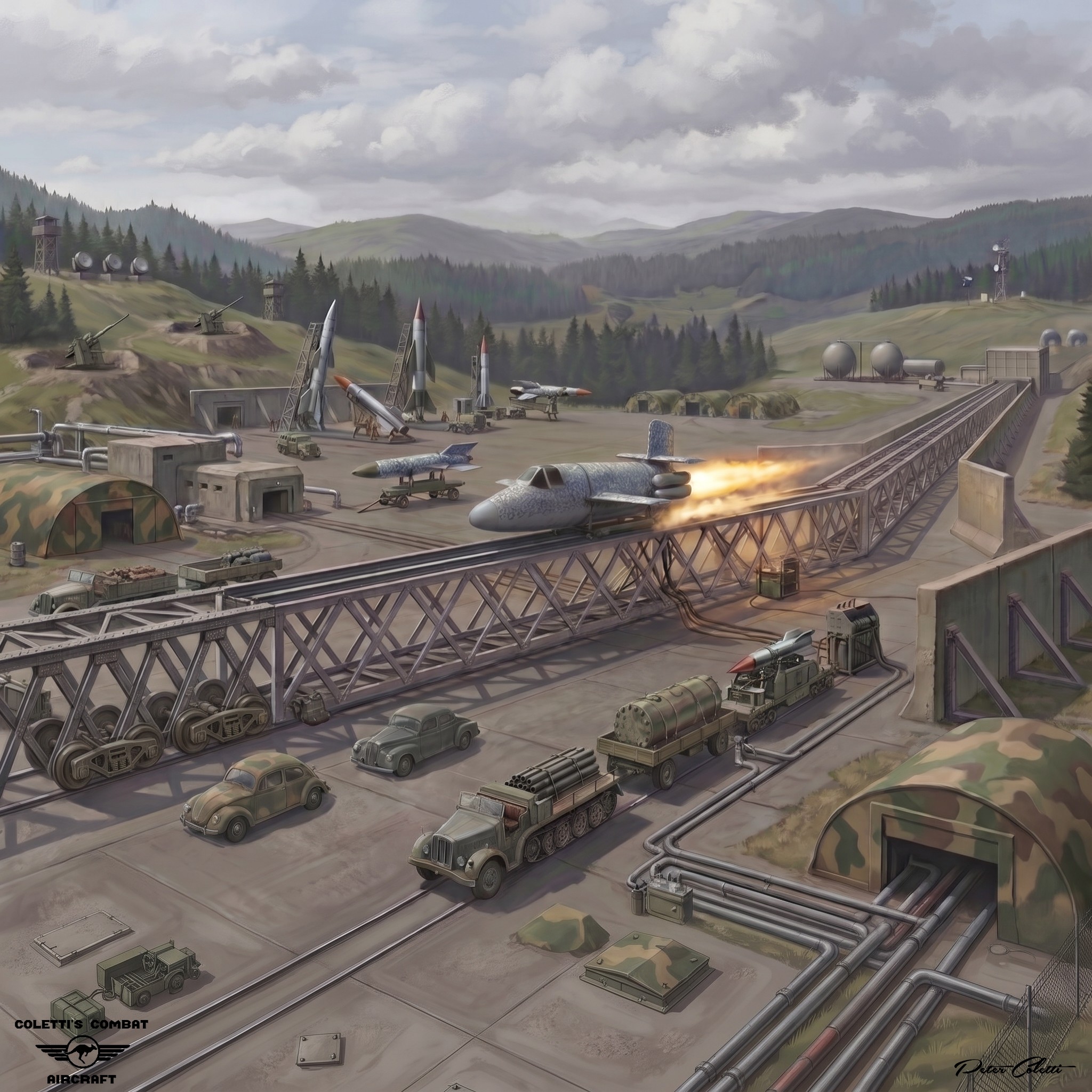
A Vertical‑Launch Interceptor of the Luftwaffe’s Final Months
Origins and Strategic Context
By the spring of 1944, Germany’s air-defence system was collapsing under the weight of relentless Allied daylight bombing.
Conventional fighters were too few, too vulnerable during takeoff, and increasingly outclassed.
In desperation, the Reichsluftfahrtministerium (RLM) began entertaining radical concepts for point‑defence interceptors that could be built cheaply, launched quickly, and flown by minimally trained pilots.
It was in this climate that Erich Bachem revived an idea first proposed in 1939: a vertically launched, rocket‑powered interceptor designed for a single attack run against bomber formations.
The concept was not entirely new. Wernher von Braun had outlined a similar vertical‑launch fighter in July 1939, capable of climbing to 8,000 m in just 53 seconds, but the RLM dismissed it as impractical.
Bachem, then technical director at Fieseler, had explored related designs under the Fi 166 designation, but these too were rejected.
When the RLM issued a 1944 requirement for a cheap, expendable point‑defence fighter, Bachem resubmitted his idea—now designated BP 20 “Natter” (“Viper”)—through General Adolf Galland.
The Technical Department again rejected it, citing its one‑use nature, but Bachem secured the personal support of Heinrich Himmler, and within 24 hours the project was reinstated with high priority.
A small factory at Waldsee was assigned to Bachem, joined by experienced engineers such as former Dornier technical director H. Betke and Walter Werke rocket‑engine specialist Grassow.
By August 1944, the Natter was incorporated into the “Emergency Fighter Programme”, receiving urgent development attention despite its unconventional nature.
Design Philosophy and Construction
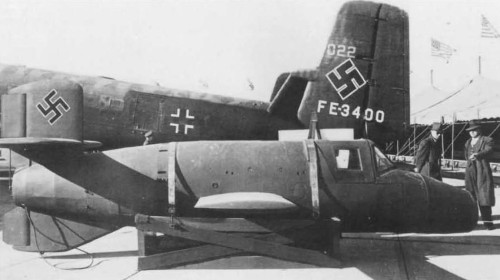
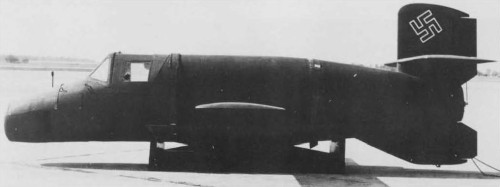
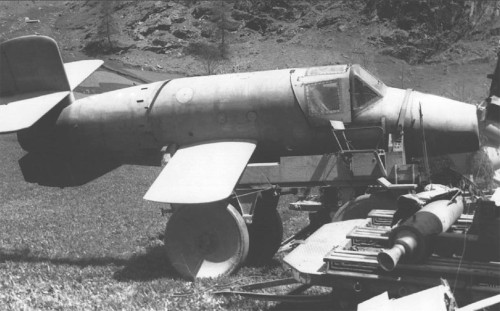
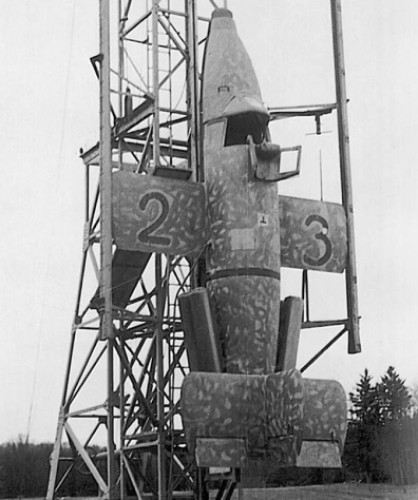
The Ba 349 was conceived as a disposable, vertically launched, rocket‑powered interceptor built almost entirely of wood, using unskilled labour and non‑strategic materials.
Only control linkages, hinges, and fittings were metal.
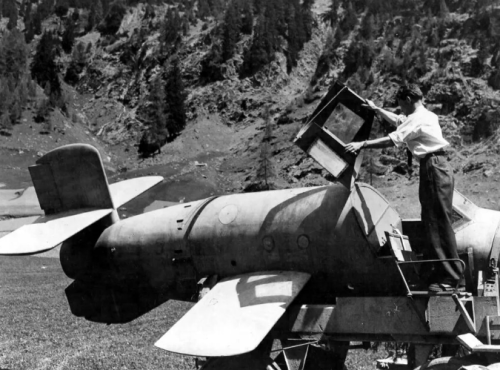
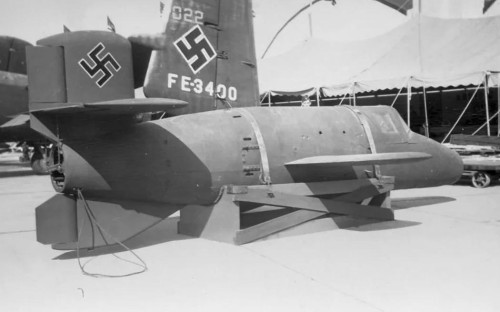
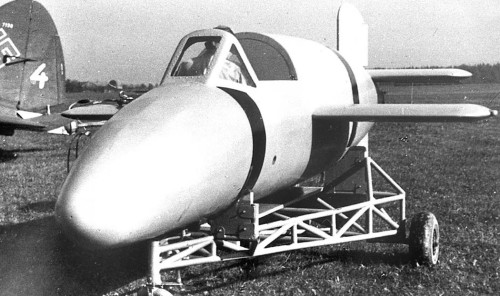
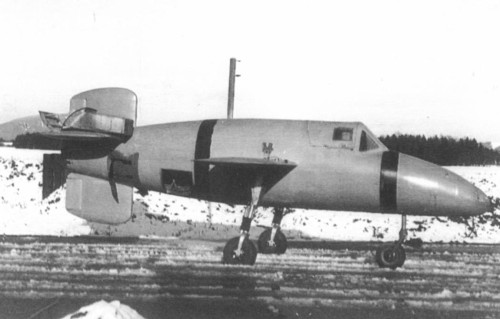
The airframe was a semi‑monocoque wooden fuselage with a simple rectangular wing and cruciform tail.
The wing had a single spar running through the fuselage fuel tanks and no flaps or ailerons—control was entirely via tail surfaces.
Airframe and Aerodynamics
Wind‑tunnel tests at Braunschweig examined the design up to Mach 0.95 and found no compressibility or stability issues.
The wing used a symmetrical 12%‑thick airfoil at mid‑chord, and the tail was arranged as an “asymmetric cross”, with the lower fin shortened to clear the launch rail.
Later prototypes enlarged the control surfaces and added water‑cooled gas‑jet vanes for low‑speed control during vertical ascent.
Propulsion
The Natter used a Walter HWK 509A liquid‑fuel rocket engine, burning hypergolic T‑Stoff (high‑test peroxide) and C‑Stoff (hydrazine‑methanol mixture).
Two fuselage tanks carried 440 L of T‑Stoff and 190 L of C‑Stoff.
Because the Walter engine alone lacked sufficient thrust for vertical launch, the aircraft used four Schmidding solid‑fuel boosters, each burning for 10 seconds before being jettisoned at 170–200 m altitude.
Pilot Protection and Cockpit
Despite being a throwaway aircraft, the Natter incorporated substantial armour:
A forward armored bulkhead with pedal cutouts
Side armor panels
A rear armored bulkhead separating the pilot from the volatile fuel tanks
Equipment was minimal: a simple ring‑and‑bead sight and basic flight instruments.
The cockpit was extremely cramped, and Betke determined that a conventional ejection seat could not be fitted.
This forced a unique escape system: the pilot would jettison the entire nose section, releasing his parachute while the rear fuselage descended separately under its own chute.
Armament and Attack Method
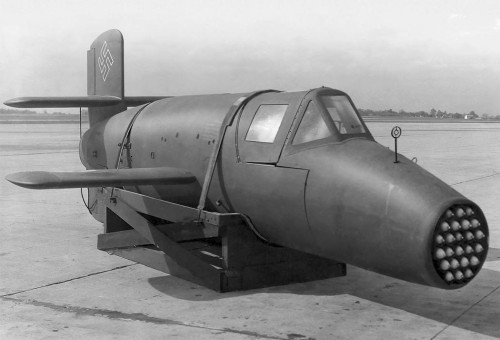
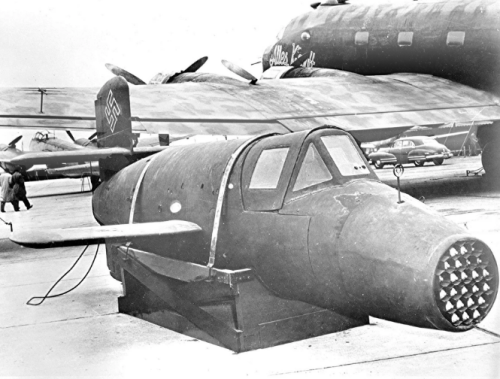
The Natter’s primary armament was a honeycomb battery of unguided rockets, fired in a single salvo at close range:
24 × 73 mm “Föhn” (Hs 217) rockets,
or
33 × 55 mm R4M rockets
The rockets were housed in hexagonal or square tubes behind a disposable plastic nose cone.
Earlier concepts explored 49 × 30 mm SG 119 rockets or even a 40‑round automatic cannon, but these were abandoned after ground‑test explosions caused by gas‑venting issues.
Attack Profile
Vertical launch under booster thrust
Autopilot-controlled climb towards bomber stream
The pilot takes control 1.5–3 km from the target.
Nose cone jettisoned
Full‑salvo rocket attack at close range
The pilot releases harness, jettisons nose, and parachutes down
The rear fuselage and engine descend separately for recovery
The aircraft was intended for pilots with minimal training—essentially a guided missile with a human operator for terminal aiming.
Testing and Development
Glider Trials
The first unpowered test occurred in November 1944, when a He 111 towed a loaded Natter to 6,000 m.
Test pilot Züber reported good stability and controllability from 200 to 680 km/h. .
Unmanned Vertical Launches
The first attempt on 18 December 1944 failed when the Schmidding boosters burned through their ignition wiring.
A second attempt four days later succeeded, and ten more unmanned launches followed, though low speed before booster separation caused control issues.
This led to the redesigned tail and gas jet vanes introduced on the V16 prototype.
First Full‑System Flight
On 25 February 1945, the first complete mission profile was flown with a dummy pilot.
The Natter launched, climbed, separated its nose and engine, and recovered both components successfully—impressing the RLM, which demanded immediate manned trials despite Bachem’s objections.
Fatal First Manned Launch
On 28 February 1945, Oberleutnant Lothar Sieber became the first human to launch vertically in a rocket‑powered aircraft.
After liftoff, the canopy unexpectedly opened at about 500 m.
The aircraft pitched over, climbed inverted to roughly 1,500 m, then dived into the ground and exploded.
The cause was never conclusively determined, though an improperly latched canopy was suspected.
Despite the tragedy, three further manned flights were completed successfully.
Variants
Ba 349A
The initial production‑test series.
Approximately 36 were completed, with 25 flight‑tested and 7 flown by pilots.
Armament consisted of rocket batteries only.
Ba 349B
A refined version with:
Walter 509C engine with cruise chamber
Revised rear fuselage
Provision for two 30 mm MK 108 cannon as alternative armament
Slightly increased fuselage height
Optional replacement of four boosters with two Schmidding 533 units
Endurance increased to 4.36 minutes at 790 km/h and 3,000 m altitude, compared to 2.23 minutes for the A‑series.
Only three were completed before the programme ended; one flew with older boosters.
Operational Plans and Cancellation
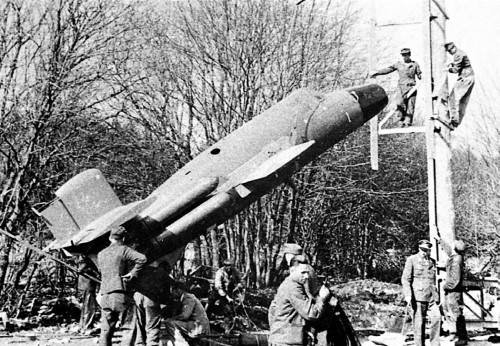
In April 1945, ten Ba 349A Natters were deployed near Kirchheim unter Teck to defend Stuttgart from American bombers.
However, Allied ground forces arrived before any operational launches could occur.
The launch sites and aircraft were destroyed by their own crews to prevent capture.
The Natter programme ended with Germany’s collapse.
Although often portrayed as a “suicide weapon”, its designers intended pilot recovery, and the aircraft represented a desperate but technically innovative attempt to counter overwhelming air superiority.
Technical Summary (Ba 349B‑1)
Wingspan: 4.00 m
Length: 6.00 m
Height: 2.24 m
Wing Area: 4.50 m²
Empty Weight: 880 kg
Normal Takeoff Weight: 1,770 kg
Max Takeoff Weight: 2,234 kg
Engine: 1 × Walter WK‑509C (2,000 kgf)
Boosters: 4 × 500 kgf + 2 × 1,000 kgf (optional)
Max Speed: 990 km/h
Cruise Speed: 790 km/h
Range: 57 km
Rate of Climb: 11,400 m/min
Ceiling: Classified as defence; operational altitude ~10,000 m
Crew: 1
Armament: 24 × 73 mm “Föhn” rockets,
or
33 × 55 mm R4M rockets,
or
2 × 30 mm MK 108 cannon (30 rpg)
Assessment and Legacy
The Bachem Ba 349 Natter stands as one of the most extreme aircraft ever built: a disposable, wooden, vertically launched rocket interceptor designed for mass production and minimal pilot training.
It embodied the technological desperation of late‑war Germany but also showcased innovative thinking in vertical launch systems, rocket propulsion, and modular construction.
Although it never entered combat, the Natter contributed to postwar interest in VTOL interceptors, booster‑assisted launch systems, and rocket‑powered flight and remains a striking example of the Luftwaffe’s final experimental efforts.