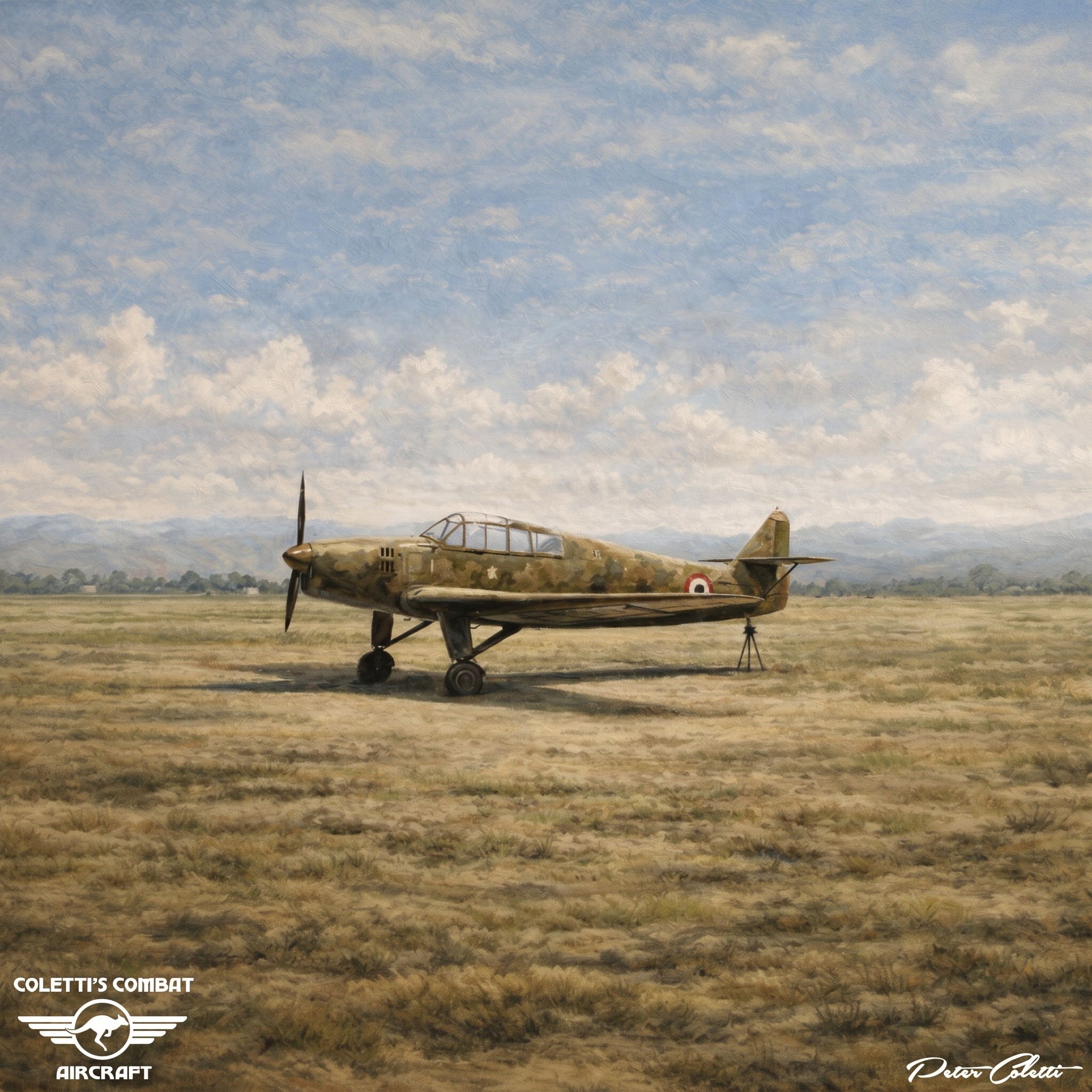
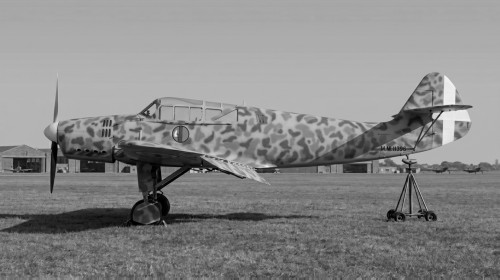
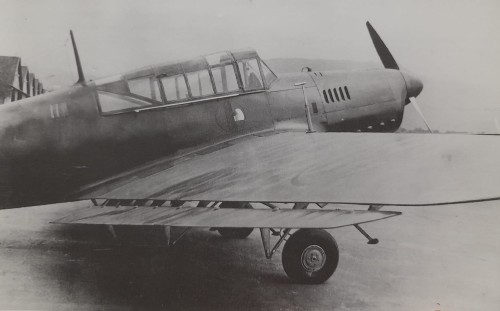
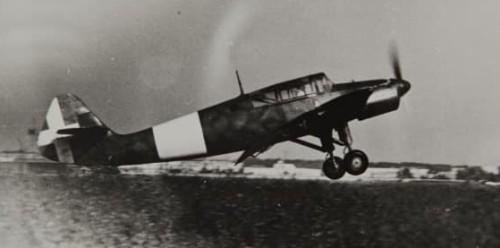
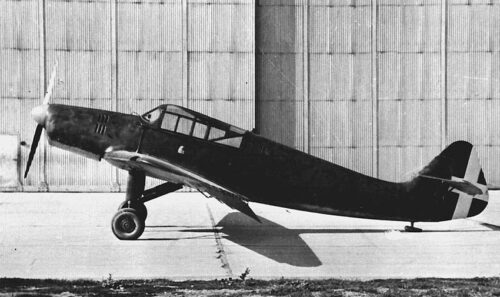
The Caproni‑AV.I.S. C.4 emerged from a late‑1930s Italian Air Force (Regia Aeronautica) requirement for a simple, inexpensive, short‑range liaison and utility aircraft.
In November 1938, the Air Force announced a competition for a light, three‑seat communications aircraft that could operate from rough, undeveloped airstrips, especially in Italy’s African colonies.
The benchmark was the German Fieseler Fi 156 Storch, which had impressed Italian observers with its short‑field performance and versatility.
Formal technical requirements were issued on 12 December 1938, emphasising ruggedness, ease of manufacture, and suitability for hot‑climate operations.
Despite the modest nature of the programme, only two firms submitted designs by 17 March 1939: IMAM and Caproni‑AV.I.S. (Avio Industrie Stabiensi).
The Caproni‑AV.I.S. entry, designated C.4, was designed by engineer Ugo Abbate.
Although the IMAM Ro.63 would ultimately be judged superior, the Air Force saw value in the C.4’s lower projected cost and therefore did not immediately discard it.
On 8 March 1940, the Regia Aeronautica placed a contract for six pre‑series aircraft (serials MM.11585–MM.11590).
Construction proceeded quickly, and the first prototype flew in June 1940 from Capodichino airfield, piloted by Giulio Faido and Mario de Bernardi.
Design Characteristics
General Configuration
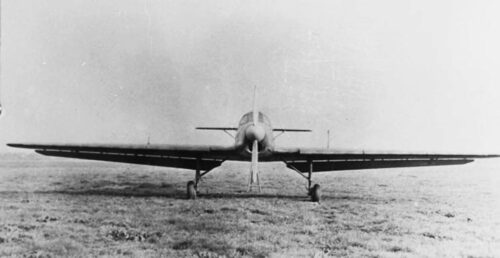
The C.4 was a low‑wing monoplane of mixed construction, reflecting the Italian industry’s preference for combining metal and wood to reduce cost and conserve strategic materials.
Fuselage: Welded metal tube structure with thin duralumin sheet skin.
Wing: Two‑spar wooden structure with plywood skin, mounted low for stability and ease of maintenance.
Landing Gear: Fixed, wide‑track undercarriage with low‑pressure automotive‑type tyres, optimised for rough‑field operations.
Crew and Cabin
The cabin accommodated one pilot and two passengers, arranged for liaison duties.
A medical evacuation configuration was also possible, replacing the passenger seats with stretcher mounts, making the C.4 a potential light ambulance aircraft.
Powerplant
The aircraft was powered by a single Hirth HM 508D, a German 280 hp liquid‑cooled inline engine driving a two-blade, in-flight-adjustable propeller.
This engine was selected as the best match among several proposed options.
Control and Stability Issues
Early test flights revealed poor handling qualities, particularly instability at low speeds—a critical flaw for a liaison aircraft expected to operate from short, rough strips.
Caproni‑AV.I.S. attempted to correct this by enlarging the fin and rudder, but the improvements were marginal.
Flight Testing and Evaluation
Factory Trials
Initial trials at Capodichino showed the C.4 to be inferior to both the IMAM Ro.63 and the Fi 156 in agility, controllability, and short‑field performance.
The aircraft’s low-speed instability was repeatedly criticised, and its overall flight characteristics were considered unsatisfactory for frontline liaison duties.
Military Testing
In May 1941, the C.4 was transferred to the Guidonia test centre, where Regia Aeronautica test pilots confirmed the same deficiencies.
The aircraft was judged operationally unsuitable, and its prospects for adoption collapsed.
Operational Fate and WWII Context
Although six aircraft were built, the Regia Aeronautica officially accepted only one (MM.11586) in spring 1942.
The remaining five were diverted to meteorological stations, where their subsequent history is largely undocumented.
Caproni‑AV.I.S. proposed a follow‑on batch of 20 improved aircraft, but by this stage the Air Force had lost all interest.
The IMAM Ro.63 itself saw only limited service, and Italy increasingly relied on German Storch aircraft for liaison roles.
Place in WWII Aviation
The C.4 never reached operational units and had no direct combat role.
Its significance lies instead in illustrating the following:
Italy’s struggle to produce a domestic equivalent to the Fi 156.
The limitations of smaller firms like AV.I.S. during wartime industrial mobilisation.
The Regia Aeronautica’s chronic shortage of effective liaison and observation aircraft.
In the broader WWII context, the C.4 is an example of a promising but ultimately unsuccessful attempt to fill a vital support niche.
Technical Data (C.4 Prototype)
Wingspan: 13.96 m
Length: 8.70 m
Height: 3.00 m
Wing Area: 28.00 m²
Empty Weight: 826 kg
Max Takeoff Weight: 1,329 kg
Engine: 1 × Hirth HM 508, 280 hp
Max Speed: 240 km/h
Cruise Speed: 208 km/h
Range: 800 km
Service Ceiling: 6,200 m
Crew: 2 (pilot + observer/passenger)
Variants
The C.4 programme never progressed beyond the initial six‑aircraft pre‑series.
No formal variants were produced, though:
A stretcher‑equipped ambulance configuration existed.
Caproni‑AV.I.S. drafted plans for a modernised production version, which was never built.
Assessment
The AVIS C.4 was a well‑intentioned but flawed design.
Its mixed construction and low cost aligned with Italian requirements, but its handling deficiencies and inferior performance compared to competitors doomed it.
In a period when Italy urgently needed reliable liaison aircraft, the C.4 failed to meet expectations and faded into obscurity.
Yet, for historians, it remains a valuable case study in the challenges of wartime aircraft development within smaller industrial firms and the Regia Aeronautica’s struggle to field effective support aircraft.