The Armstrong Whitworth A.W.52 emerged directly from Second World War–era British research into advanced aerodynamics, particularly laminar‑flow airfoils and the potential of the flying‑wing configuration.
Interest in tailless aircraft in Britain dated back to the pre-WWI work of J. W. Dunne, later influencing designers such as G. T. R. Hill and the Westland-Hill Pterodactyl series during the 1920s–30s.
By the mid‑1940s, the Ministry of Supply tasked Armstrong Whitworth’s chief designer John Lloyd with developing a full‑scale laminar‑flow wing for wind‑tunnel testing at the National Physical Laboratory.
This work, conducted during WWII, included fitting a laminar-flow wing to a modified Hawker Hurricane for real-world trials.
Simultaneously, Armstrong Whitworth envisioned a large jet‑powered flying‑wing airliner, potentially using four to six turbojets and integrating the passenger cabin into the wing.
The A.W.52 was conceived as a half‑scale research aircraft to validate the aerodynamics, control systems, and structural concepts needed for this ambitious transport design.
Development Path: From Glider to Jet Prototype
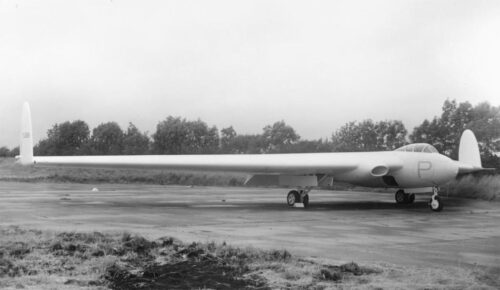
A.W. 52G Glider
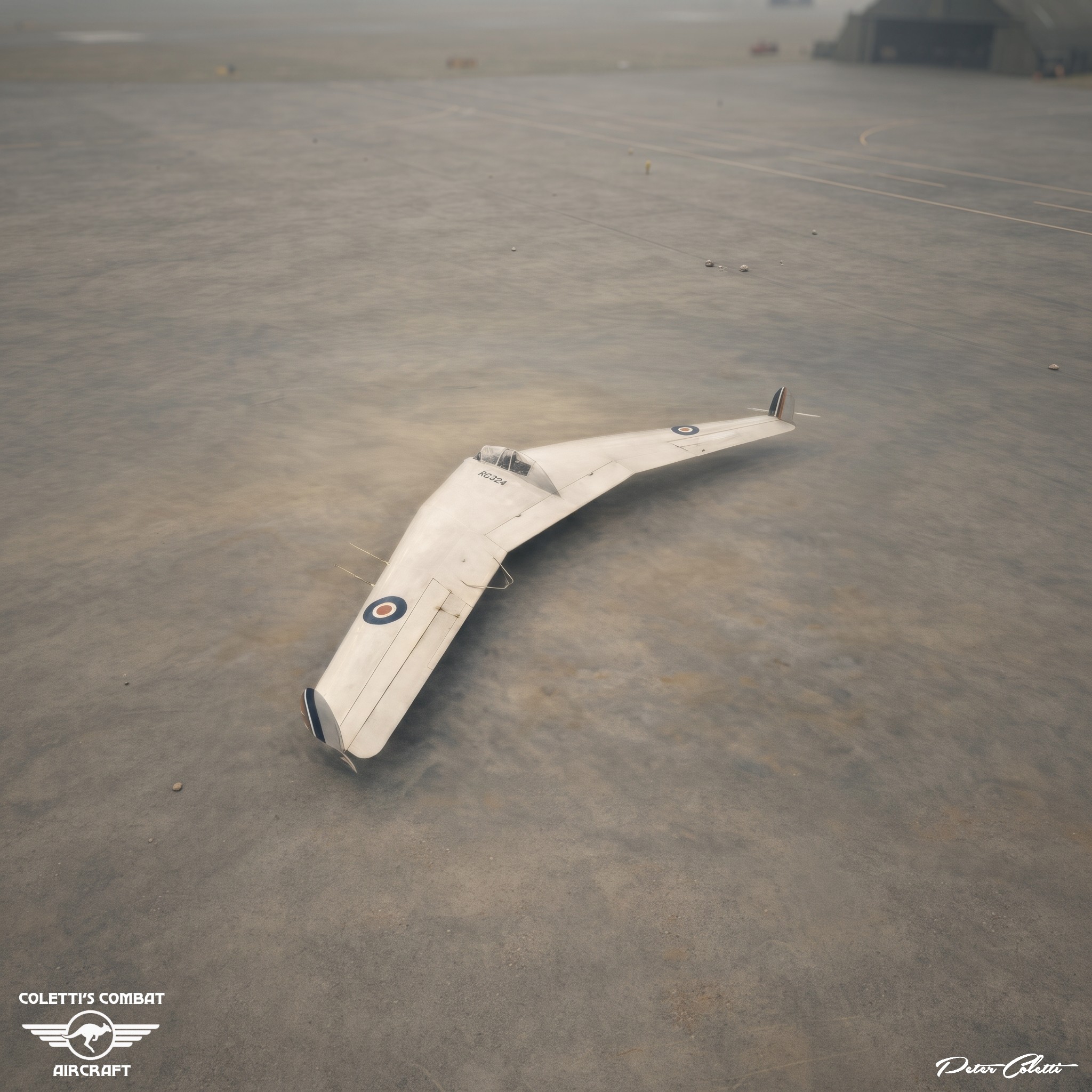
Development began during 1943, with the first step being the A.W.52G, an unpowered, wooden, two‑seat glider used to test flying‑wing stability, load behaviour, and trim‑control concepts.
It first flew on 2 March 1945, shortly before the end of the war in Europe.
The glider incorporated an automated pitch‑management system to counter trim changes inherent to flying-wing designs, a key challenge for tailless aircraft.
After fulfilling its research role, the glider deteriorated and was eventually scrapped.
Transition to Jet‑Powered Aircraft
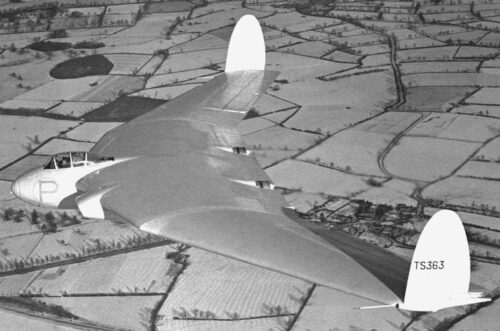
Taxi trials for the jet‑powered A.W.52 began in April 1947, leading to the first flight of the initial prototype, TS363, on 13 November 1947.
A second prototype, TS368, followed.
These aircraft were built primarily to gather aerodynamic data and evaluate laminar‑flow performance at high subsonic speeds.
Design and Technical Characteristics
General Configuration
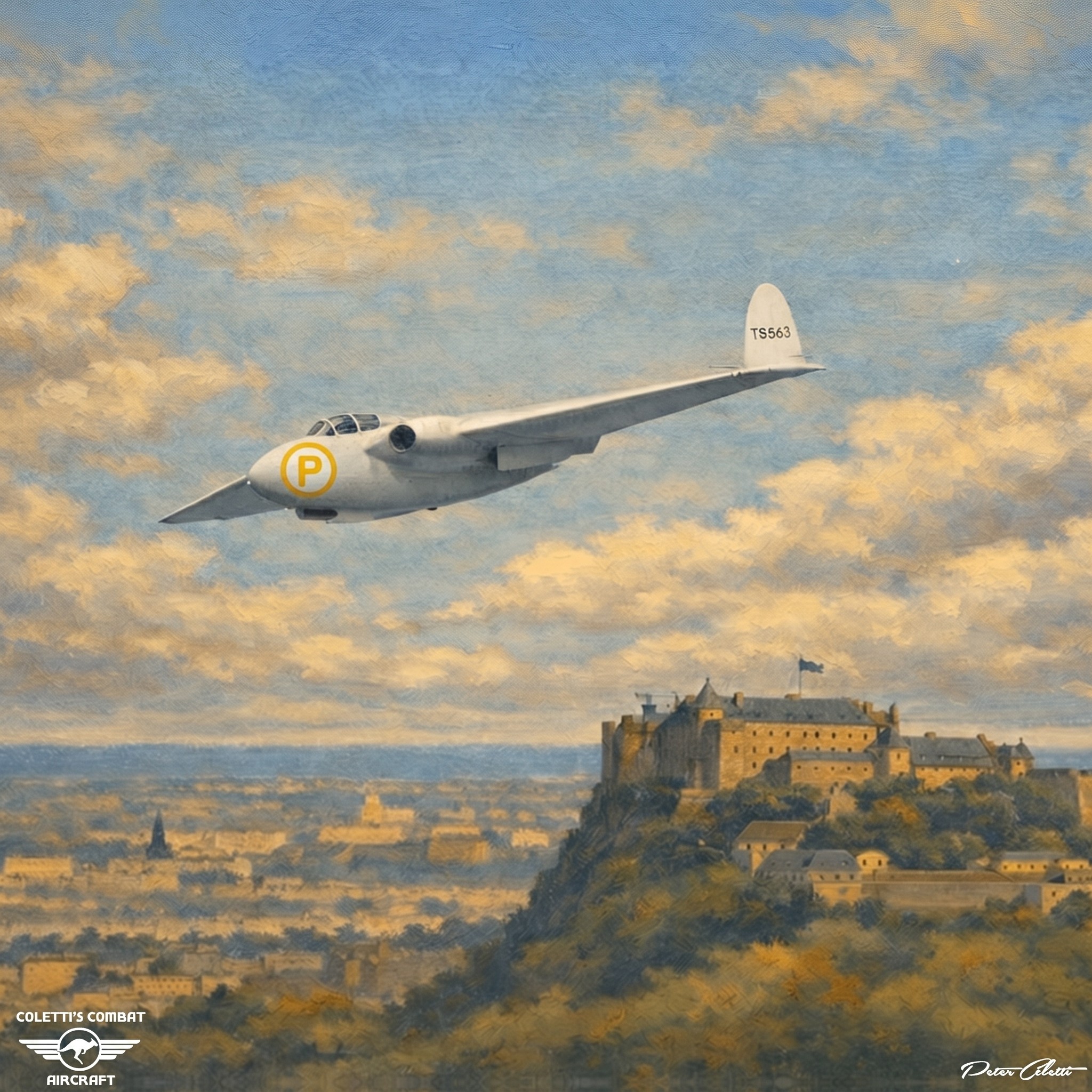
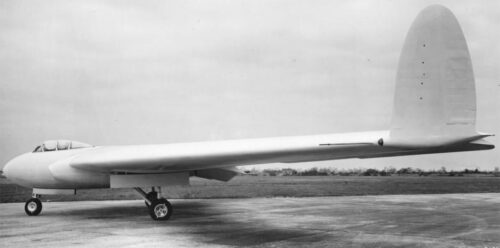
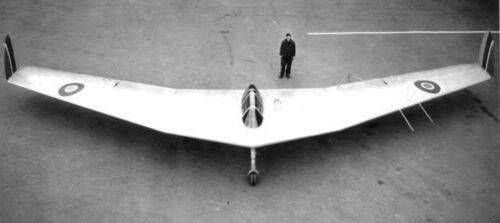
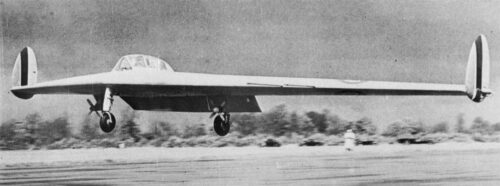
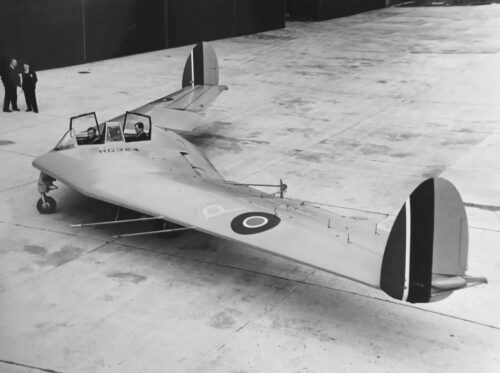
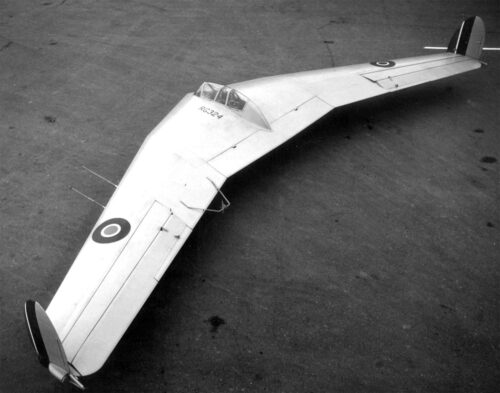
The A.W.52 was a tailless, swept-wing, twin-jet flying wing with a short central fuselage pod housing the cockpit and systems.
Its design emphasised laminar-flow surfaces, requiring an extremely smooth skin finish and precise manufacturing tolerances.
Key aerodynamic features included:
35° swept wings with small end‑plate fins and rudders for directional stability
Elevons provides combined pitch and roll control.
A straight trailing-edge section around the engine exhausts
Retractable tricycle undercarriage
Martin-Baker ejection seats, reflecting the experimental risk involved
Powerplant and Systems
The prototypes were powered by two Rolls‑Royce Nene turbojets, each producing roughly 5,000 lbf of thrust, mounted side‑by‑side within the wing root and fed by intakes at the wing leading edge near the cockpit.
Dimensions and Performance
Wingspan: 27.4 m
Length: 11.4 m
Gross weight: 15,490 kg
Maximum speed: 805 km/h
Range: 2,141 km
Crew: 2
Although designed to explore laminar‑flow efficiency, the A.W.52’s laminar‑flow wing did not perform as expected, with real‑world airflow contamination reducing the theoretical drag benefits.
This shortfall undermined the case for the full-scale flying-wing airliner.
Flight Testing and Operational History
Early Flights and Farnborough Appearance
The first prototype, TS363, flew successfully in late 1947 and appeared at the 1948 Farnborough Air Show, demonstrating the promise of the flying-wing concept and the aircraft’s generally stable handling at moderate speeds.
The 1949 Pitch-Oscillation Incident
On 30 May 1949, TS363 experienced severe pitch oscillations during a test flight.
Test pilot John Oliver Lancaster became the first British pilot to make a true emergency ejection, surviving the incident.
Remarkably, the aircraft descended relatively intact despite the ejection.
This event severely shook confidence in the design’s practicality, particularly regarding high‑speed stability and control.
Programme Termination
Following the accident and disappointing laminar-flow results, Armstrong Whitworth abandoned the flying-wing airliner concept and terminated A.W.52 development.
However, the second prototype continued flying with the Royal Aircraft Establishment (RAE) until 1954, contributing valuable aerodynamic data despite the programme’s cancellation.
Variants
A.W.52G (Glider)
Wooden, unpowered research glider
First flight: 2 March 1945
Used to validate flying‑wing aerodynamics and pitch‑control systems
Eventually scrapped after deterioration
A.W.52 (Jet‑Powered Prototypes)
Two aircraft: TS363 and TS368
Powered by Rolls‑Royce Nene turbojets
Built to test laminar‑flow wings and flying‑wing handling at high subsonic speeds
TS363 was involved in the 1949 ejection incident; TS368 flew until 1954.
Assessment and Legacy
Although the Armstrong Whitworth A.W.52 failed to achieve its intended aerodynamic breakthroughs, it played a significant role in post-war British research into:
Flying-wing stability
Laminar-flow wing behaviour in real atmospheric conditions
High‑speed control systems
Ejection-seat safety (via the first British emergency use)
Its shortcomings—particularly the inability to maintain laminar flow and the pitch‑oscillation problems—convinced Armstrong Whitworth and the Ministry of Supply that a large flying‑wing airliner was not feasible with the technology of the late 1940s.
Nonetheless, the A.W.52 contributed to the broader international understanding of flying‑wing aerodynamics, a lineage that would eventually culminate decades later in successful designs such as the Northrop B‑2.