By the late 1930s, the Luftwaffe faced a growing crisis in transport aviation.
Its workhorse, the Junkers Ju 52/3m, had been designed in the early 1930s and was increasingly obsolete for the demands of a mechanised, fast‑moving war.
German planners needed an aircraft capable of carrying larger, heavier, and bulkier loads, operating from rough, improvised fields, and loading/unloading far faster than the Ju 52 could manage.
These requirements were formalised in 1939 when the Reichsluftfahrtministerium (RLM) issued a tender for a next‑generation transport aircraft.
Arado and Henschel were invited to compete.
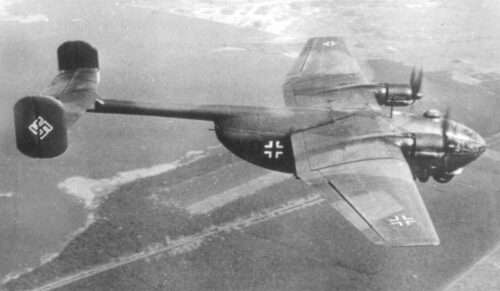
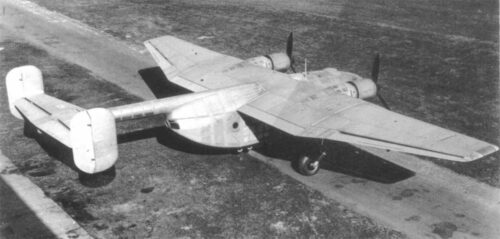
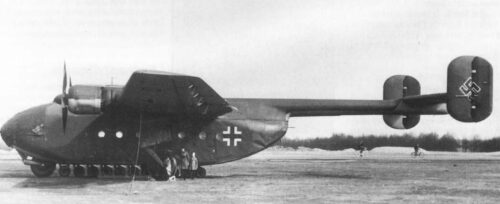
Arado’s design team, led by Wilhelm van Nes, proposed a radical solution: a high‑wing, box‑fuselage transport with a rear loading ramp, twin tail, and unprecedented rough‑field capability.
The RLM selected Arado’s proposal, issuing a contract for prototypes that would become the Arado Ar 232.
The original specification called for two BMW 801 radial engines, each producing 1,600 hp.
But the BMW 801 was already overcommitted—especially to the Focke-Wulf Fw 190 fighter—forcing Arado to redesign the aircraft around the more available Bramo 323 Fafnir engines.
This decision ultimately led to two parallel prototype lines:
Ar 232A – twin‑engine prototypes using the BMW 801 (only the first two aircraft).
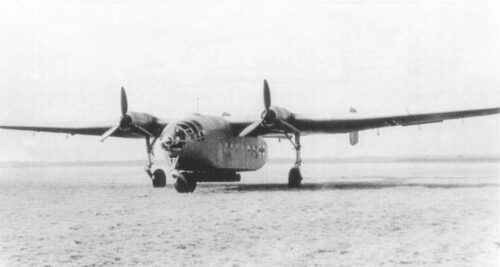
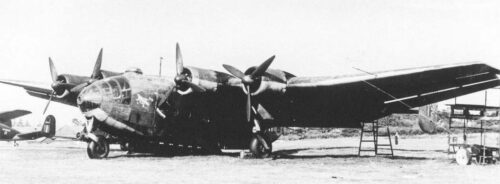
The Ar 232B – a four‑engine redesign using Bramo 323s, which became the definitive version.
The first prototype, Ar 232 V1, flew in June 1941, demonstrating both the promise and the novelty of the design.
A landing-gear malfunction collapsed the nose gear, but the aircraft survived unscathed thanks to its unusual belly-wheel array—an early sign of the type’s ruggedness.
Design Philosophy and Innovations
A Purpose‑Built Military Transport
Unlike the Ju 52, which was adapted from a civilian airliner, the Ar 232 was designed from the outset as a military cargo aircraft.
Its design incorporated nearly every feature that would later become standard in postwar transports:
High wing for ground clearance and unobstructed cargo space.
Box‑shaped fuselage optimised for volume rather than aerodynamics.
Rear loading ramp with hydraulically actuated clamshell doors.
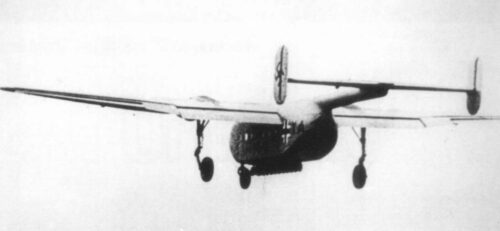
Twin‑fin tail mounted on a long boom to keep the cargo area unobstructed.
Short takeoff and landing (STOL) capability through advanced high‑lift devices.
Rough-field landing gear enabling operations from terrain unusable by other transports.
Cargo Compartment and Loading System
The cargo bay measured roughly 6.6 m × 2.3 m × 2.0 m in the A‑series, enlarged in the B‑series.
It was designed to carry vehicles, artillery, pallets, or paratroops.
A monorail crane ran along the ceiling for internal handling of loads up to 2,000 kg.
The rear fuselage could be lowered hydraulically, forming a ramp that allowed vehicles to be driven directly into the aircraft—an innovation decades ahead of its time.
The “Millipede” Landing Gear
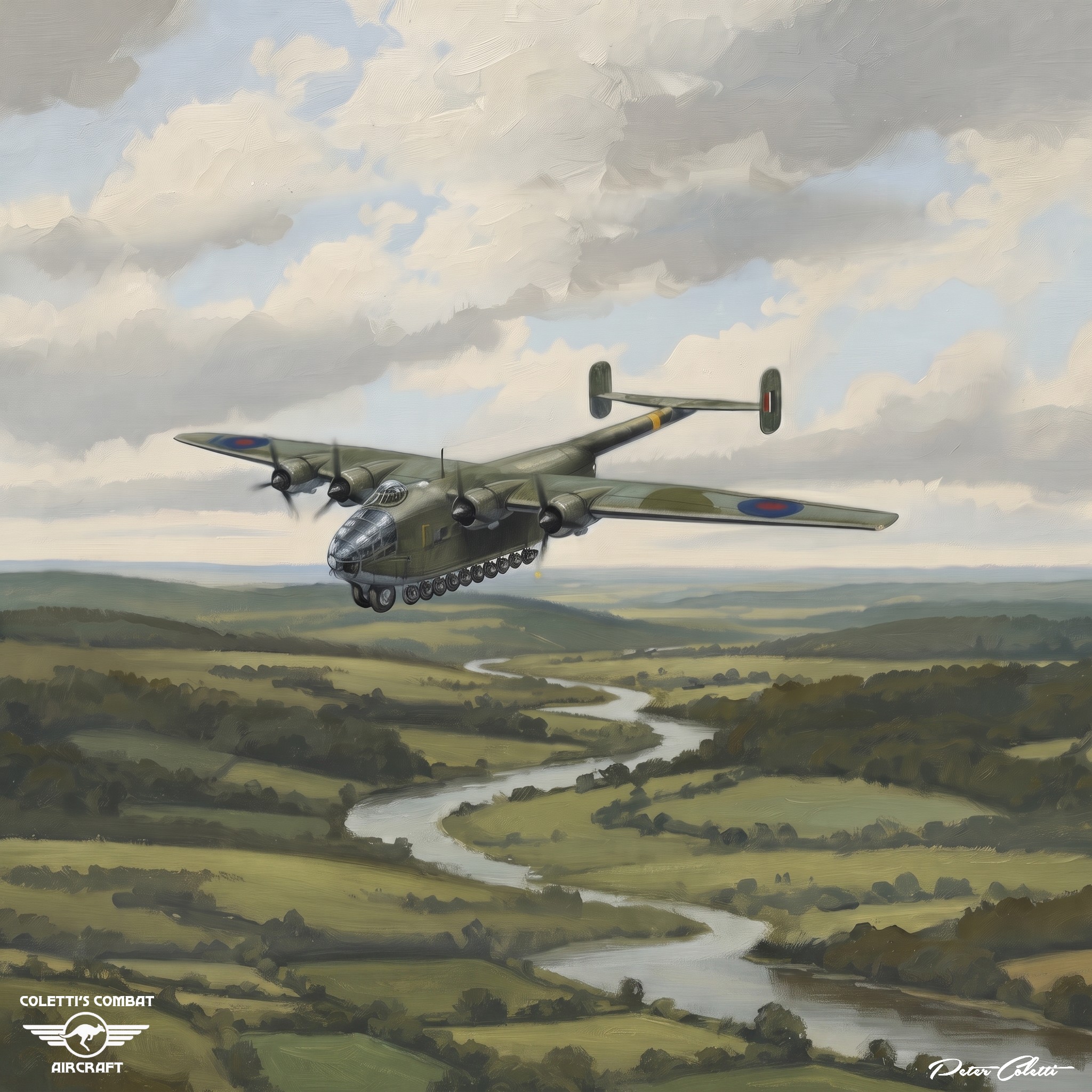
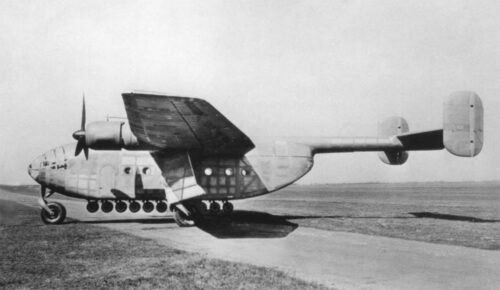
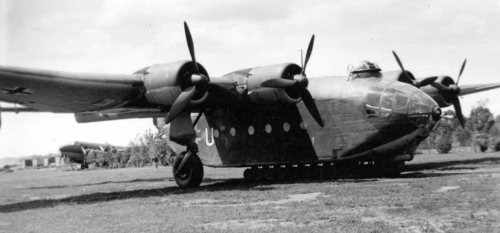
The Ar 232’s most distinctive feature was its 22 small belly wheels, arranged in pairs along the fuselage underside.
These supplemented a fully retractable tricycle landing gear.
On rough fields, the main gear could “kneel”, transferring weight to the belly wheels and allowing the aircraft to roll over obstacles such as
Tree trunks up to 15 cm thick
Ditches up to 1.5 m wide
This capability earned the aircraft its nickname: Tausendfüßler (“Millipede”).
Wing and High-Lift Devices
The wing incorporated Arado’s full‑span “travelling flap” system, which dramatically increased lift during takeoff and landing.
Combined with prop wash over the flaps and optional RATO (rocket‑assisted takeoff) units, the Ar 232 could lift off in as little as 200 metres, even at high weights.
Prototype Evolution and Production
Ar 232A (Twin‑Engine)
The first two prototypes (V1 and V2) used the BMW 801 engines as originally intended.
They demonstrated excellent handling and cargo performance but suffered from insufficient power margin—particularly dangerous in the event of an engine failure.
Only ten A‑0 pre‑production aircraft were built.
Ar 232B (Four‑Engine)
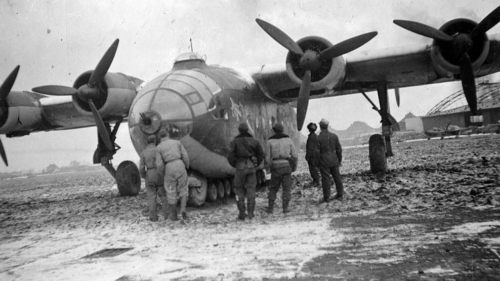
The definitive version, the Ar 232B, used four Bramo 323R‑2 engines. This solved the power deficiency and allowed the cargo bay to be lengthened.
Two prototypes (V3 and V4) flew in 1942, followed by ten B‑0 pre‑production aircraft.
Total production of all variants was approximately 20 aircraft.
Projected Variants
Arado proposed several enlarged or modified versions:
Ar 232C / Ar 432 – wooden outer wings to save aluminium.
Ar 532 / Ar 632 – enormous six‑engine transports with wingspans approaching 60 m.
The AR 430 – amphibious transport for Mediterranean use.
None reached the prototype stage.
Operational History
Stalingrad Airlift (1942–43)
The Ar 232’s combat debut came during the desperate attempt to supply the encircled 6th Army at Stalingrad.
Hermann Göring personally ordered the first two prototypes into service despite their incomplete testing.
V1 was lost in Poland when the crew became disoriented in snow and crashed.
V2 performed exceptionally, landing on rough fields to avoid Soviet ambushes and delivering critical supplies.
Four Ar 232B‑0 aircraft also participated in the airlift, operating until the final collapse of the pocket.
Arctic Operations (1943)
Ar 232A‑010 conducted long‑range missions from Germany to Banak, Norway, and onward to Spitsbergen, delivering meteorological equipment.
These flights required auxiliary fuel tanks, raising total fuel capacity to 5,000 litres.
The aircraft demonstrated its rough‑field capability repeatedly, including self‑recovering from a collapsed landing gear using its long‑travel shock absorbers.
The aircraft was later lost after an engine failure during climb-out in poor visibility.
Special Operations and Miscellaneous Use
The Ar 232’s unique capabilities made it valuable for the following:
Kampfgeschwader 200, the Luftwaffe’s clandestine operations unit.
Agent insertion missions behind Soviet lines, including attempts under Operation Zeppelin to infiltrate operatives near Moscow.
Operation Scherhorn, an NKVD deception in which Ar 232s unknowingly supplied a fictitious German “pocket” for months.
Arado factory logistics, transporting large aircraft components between plants.
Postwar Use
Two Ar 232B‑0 aircraft were captured by the British.
Test pilot Eric “Winkle” Brown praised their handling and rough‑field performance.
The RAF used them for transport flights between Germany and England into 1946.
Technical Description (Ar 232B)
General Configuration
High‑wing, all‑metal monoplane
Twin‑fin tail on a long boom
Crew of four: pilot, navigator/nose gunner, radio operator/dorsal gunner, loadmaster/rear gunner
Tricycle landing gear with 22 auxiliary belly wheels
Dimensions
Wingspan: 33.5 m
Length: 23.5 m
Height: 5.7 m
Wing area: 142.6 m²
Weights
Empty: 12,780 kg
Max takeoff: 21,150 kg
Payload: 4,500–6,600 kg depending on configuration
Powerplant
4 × Bramo 323R‑2 Fafnir radial engines
986 hp each
Three‑blade constant‑speed propellers
Performance
Maximum speed: 308 km/h
Cruise: 290 km/h
Range: 1,060 km (up to 3,200 km with auxiliary tanks)
Service ceiling: 6,900 m
Takeoff run: 200 m (minimum)
Armament
Typical B‑series defensive suite:
1 × 13 mm MG 131 in the nose
1 × 20 mm MG 151/20 in dorsal turret
1–2 × 13 mm MG 131 in rear position
Up to 8 × 7.92 mm MG 34 for side windows when carrying infantry
Assessment and Legacy
The Arado Ar 232 was arguably the most advanced transport aircraft of World War II.
It introduced nearly every feature that would define postwar cargo aircraft—from the rear ramp to STOL performance and rough‑field capability.
Its only real flaw was timing: Germany lacked the industrial capacity and strategic foresight to mass-produce it.
With only about 20 built, it remained a rare but remarkable machine.
Had it entered large‑scale production, the Ar 232 might have transformed the Luftwaffe’s logistical capabilities.
Instead, it stands as a brilliant but underutilised example of German aeronautical engineering at its peak.