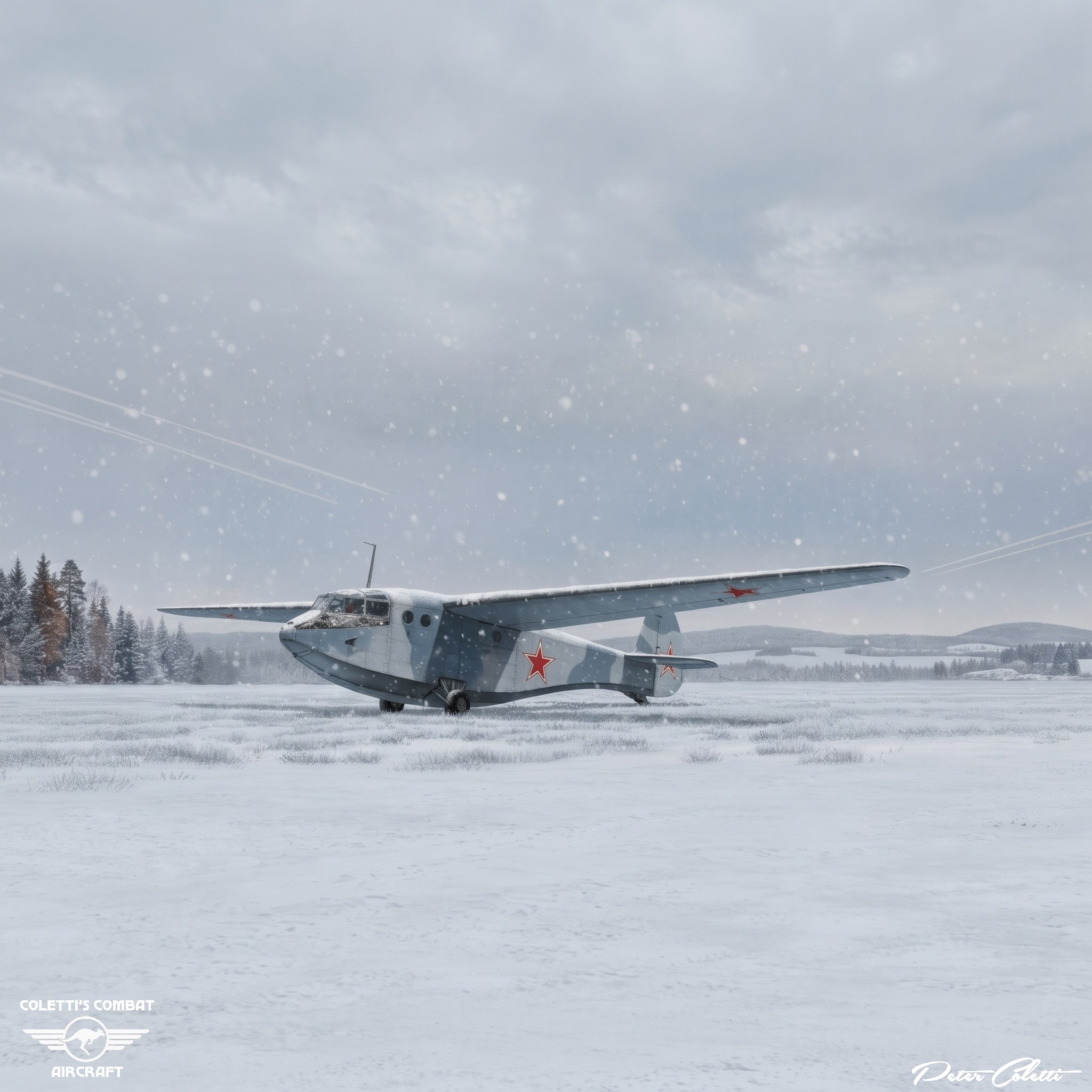
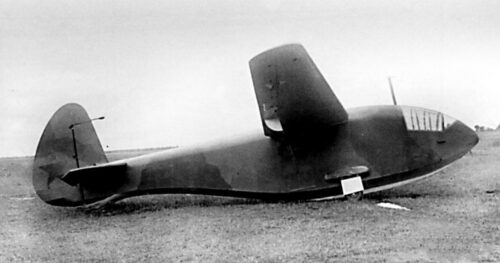
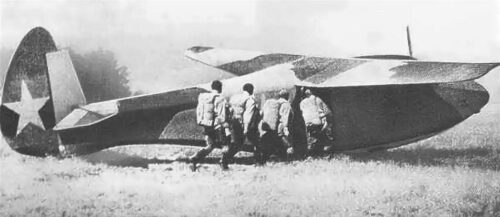
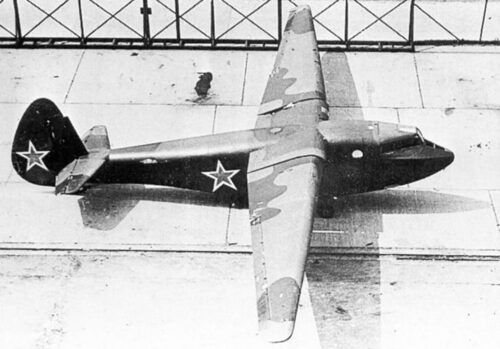
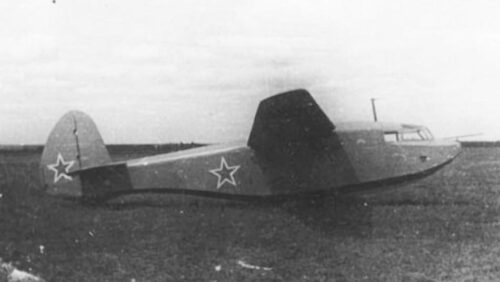
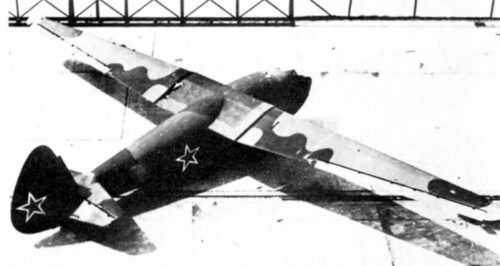
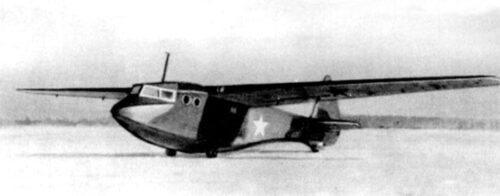
The Antonov A-7 was the Soviet Union’s principal light assault and transport glider of the Second World War—a compact, all-wood machine that sat at the intersection of pre-war sport gliding and brutal wartime necessity.
Designed by Oleg Antonov, it became one of the workhorses of clandestine supply and partisan support on the Eastern Front.
Origins and development
Pre‑war roots: from Rot Front to military glider.
Soviet gliding culture: In the 1930s, the USSR invested heavily in gliding clubs and soaring competitions, both for sport and as a low‑cost way to build a pool of pilots.
Oleg Antonov was deeply involved in this world, designing a series of “Rot Front” (Red Front) gliders.
RF‑7 and RF‑8: By 1939 Antonov had sketched a light transport/sport glider that evolved into the RF‑8 (Rot Front‑8), essentially an enlarged derivative of the
RF‑7 Sailplane: The RF‑8 retained the high‑aspect‑ratio wing and good soaring qualities of a sailplane but added a small troop compartment.
Initial RF‑8 prototypes were built just as Europe slid into war.
Flight testing in 1941 revealed structural and ergonomic issues: excessive control forces, limited pilot visibility, and landing-gear problems when fully loaded.
These were addressed by moving the pilot’s seat forward, revising the cockpit layout, adjusting the tail surfaces, and rearranging the landing gear.
The shock of 1941 and the push for gliders
The German invasion of the Soviet Union in June 1941 exposed a critical gap in Soviet airborne and special‑operations logistics.
The Red Army’s high command quickly ordered the development of transport and assault gliders to insert troops and supplies behind enemy lines, mirroring German and Allied efforts.
Antonov’s RF‑8, already in tests, was a natural candidate.
The military demanded more capacity—raising the requirement from five to seven persons (one pilot plus six troops)—and better suitability for rough-field operations.
After modifications and trials in late 1941, the design was accepted and re‑designated A‑7, “Antonov, seven persons”.
Production and industrial context
The early-war chaos forced the design bureau and factories to evacuate eastward.
Antonov’s team ultimately settled at a glider plant near Moscow (Tushino), where the A‑7 was readied for series production.
Production period: Approximately 1942–1945
Numbers built: About ∼ 400 aircraft, making it one of the most numerous Soviet gliders alongside the Gribovsky G‑11.
The A‑7 was deliberately simple and largely wooden, allowing construction in relatively modest facilities and conserving strategic metals for powered aircraft.
Airframe design and layout
General configuration
The Antonov A‑7 was a high‑wing, single‑pilot, light troop glider of mixed but predominantly wooden construction.
It was designed to be rugged, easy to tow, and capable of landing on small, unimproved fields or forest clearings.
Type: Light military transport/assault glider
Crew: One pilot
Typical load: six fully equipped troops (seven persons total) or up to about 900 kg of cargo.
Fuselage and cockpit
The fuselage was a semi‑monocoque wooden structure, rectangular in cross‑section, with plywood skin over frames and stringers.
This construction was light, relatively strong, and within the capabilities of Soviet woodworking industries.
Pilot’s position: A single‑seat cockpit at the extreme nose, giving the pilot a good forward view for approach and landing after the earlier RF‑8 visibility issues were corrected.
Troop compartment: Immediately behind the pilot lay the transport cabin with six seats.
Two seats on opposite sides at the front,
Two seats on opposite sides at the rear,
Two central seats facing fore and aft.
This arrangement maximised the use of the narrow fuselage but constrained cargo volume and made loading bulky items awkward—one of the A‑7’s main operational limitations.
Wing and tail
The A-7’s wing reflected its sailplane ancestry.
Wing type: High, cantilever monoplane wing with a relatively high aspect ratio, giving good glide performance and stable towing characteristics.
Structure: Wooden spars and ribs with fabric or plywood covering, optimised for lightweight and ease of repair.
Tail surfaces: Conventional tailplane and fin, slightly revised from the RF‑8 to improve handling and reduce control forces noted in early tests.
The high‑wing layout also provided ground clearance for the fuselage and simplified loading from the sides or rear.
Landing gear and landing method
One of the A‑7’s distinctive features was its retractable landing gear—unusual for a simple glider but intended to reduce drag during tow and glide.
Configuration: A main undercarriage that could be retracted after takeoff, with the glider landing on its belly and/or simple skids on rough ground.
Structural intrusion: The gear’s cantilever supports passed through the centre of the transport compartment, intruding into the cabin and further limiting cargo space and layout flexibility.
This compromise reflected the tension between aerodynamic efficiency and the cramped realities of a small troop glider.
Performance and handling
Basic performance characteristics
Exact performance figures vary slightly by source, but the A-7 sat firmly in the “light glider” category:
Capacity: Pilot plus six troops, or roughly 900 kg of cargo.
Dimensions (approximate, from RF‑8/A‑7 family data):
Wingspan around 19 m (about 62 ft)
Length around 11–12 m (about 37–38 ft)
The glider’s sailplane heritage gave it relatively benign handling and decent glide performance, important for night operations and landings in confined areas.
Its high‑aspect‑ratio wing and low wing loading helped keep stall speeds modest, which was critical when landing heavy loads on short, rough strips.
Towing and operational envelope The A‑7 was designed to be towed by standard Soviet bombers and transports:
Common tow aircraft: the Tupolev SB, the Ilyushin DB‑3/Il‑4, and, occasionally, the Li‑2.
A DB‑3 could tow two A‑7s simultaneously.
In practice, the A‑7 was flown mostly at night, often at low altitude in hostile airspace.
Pilots had to manage the following:
Long tows in turbulent air,
Release and glide to small, unlit landing zones.
One‑shot landings with no go‑around capability.
Despite these challenges, the A‑7 earned a reputation as a successful and reliable design, though its limited capacity meant more sorties were needed compared with larger gliders like the G‑11.
Variants and experimental developments
Standard A‑7 troop/cargo glider
The main production version was the basic A‑7 troop and cargo glider:
Role: Light transport for seven persons or equivalent cargo.
Use: Partisan resupply, insertion of small sabotage or liaison groups, and emergency logistics missions.
There is no evidence of major sub‑variants with different fuselage layouts; changes were mostly incremental improvements in production.
Tanker glider experiment
One of the most unusual experiments was a tanker version tested in late 1942 to early 1943:
Configuration: A‑7 fitted with a 1,000‑litre fuel tank in the cabin.
Concept: The glider was towed by a DB‑3 bomber, which would be refuelled in flight from the glider’s tank to extend its range—an early Soviet exploration of aerial refuelling using a towed tanker.
Outcome: The concept was tested but not adopted for production, likely due to complexity, vulnerability, and the rapid evolution of more practical refuelling and range-extension methods.
Relationship to other Antonov/Gribovsky gliders
The A‑7 sat within a broader Soviet glider family:
Gribovsky G‑11: A larger transport glider carrying around 11–20 troops, which, together with the A‑7, formed the bulk of Soviet wartime glider capacity.
A‑11/G‑11 (disputed): Some sources describe an “A‑11” as an improved, strut‑braced derivative of the A‑7, possibly overlapping with or evolving into the G‑11. This illustrates how Soviet glider development was iterative, with designers sharing ideas and airframe concepts.
Operational history and WWII context
Role in Soviet glider doctrine
Unlike Germany’s large-scale airborne assaults (e.g., Crete) or the Western Allies’ mass glider operations (Normandy, Market Garden), the Soviet Union used gliders primarily for:
Partisan support: Supplying guerrilla forces operating behind German lines,
Covert insertions: Delivering small sabotage, reconnaissance, or liaison groups.
Emergency logistics: Short‑notice delivery of critical supplies to isolated fronts.
In this doctrine, the A‑7’s small size was both a limitation and an asset: it could not carry large formations, but it could land in tiny clearings and rough fields close to partisan bases.
Partisan supply operation
The A‑7, together with the G‑11, formed the backbone of Soviet glider operations to support partisans:
Main theatre: Belarus, especially the Polotsk–Begoml–Lepel region, from April to November 1943.
Mission profile:
Night tow from a rear airfield.
Release near partisan-controlled territory.
Glide and land in a small clearing.
Rapid unloading of weapons, ammunition, medical supplies, radios, and trained personnel.
Several hundred gliders of all types were used in these night supply flights.
After landing, gliders were often deliberately destroyed to prevent capture; pilots might be flown back on powered aircraft or remain temporarily with the partisans.
Special missions and limitations
The A‑7 was also used to insert sabotage groups behind enemy lines, but its limited capacity made it less than ideal for larger commando teams.
Still, for small, high-value groups—radio operators, liaison officers, and demolition experts—it was a practical tool.
One notable mission type was an emergency “air bridge” during the Battle of Stalingrad.
Stalingrad antifreeze mission (November 1942): A‑7 gliders were used to deliver antifreeze coolant for tanks from the Moscow area to the Stalingrad front, where severe conditions and supply disruption threatened armoured operations.
This illustrates how gliders could bypass congested or damaged airfields and deliver critical supplies directly to improvised strips near the front.
Comparison with other WWII glider efforts
In the broader WWII context:
German gliders (DFS 230, Go 242) and Allied gliders (Airspeed Horsa, Waco CG‑4) were used for large airborne assaults, towing mass formations to seize bridges, airfields, and key terrain.
Soviet gliders, including the A‑7, were more often tools of clandestine warfare and logistics, reflecting the huge partisan movement and the vast, forested geography of the Eastern Front.
The A-7’s relatively small payload and cramped cabin meant it never played the dramatic, large-scale assault role of Western counterparts, but it was well suited to the Soviet emphasis on guerrilla support and small-unit operations.
Assessment and legacy
The Antonov A‑7 was regarded by Soviet authorities as a successful design:
Strengths:
Simple, largely wooden construction,
Good flying qualities and tow behaviour,
Ability to operate from small, rough landing zones,
Compatibility with existing bomber and transport types as tugs.
Weaknesses:
Limited capacity compared with the G‑11 and foreign gliders,
Cabin volume constrained by seat layout and landing‑gear structure,
One‑time‑use nature in many missions, as gliders were often destroyed after landing.
For Oleg Antonov, the A‑7 was an important step in a career that would later produce some of the world’s largest and most famous transport aircraft.
For the Red Army, it was a quiet but vital instrument of behind-the-lines warfare—an unpowered aircraft that carried weapons, people, and hope into some of the most inaccessible corners of the Eastern Front.