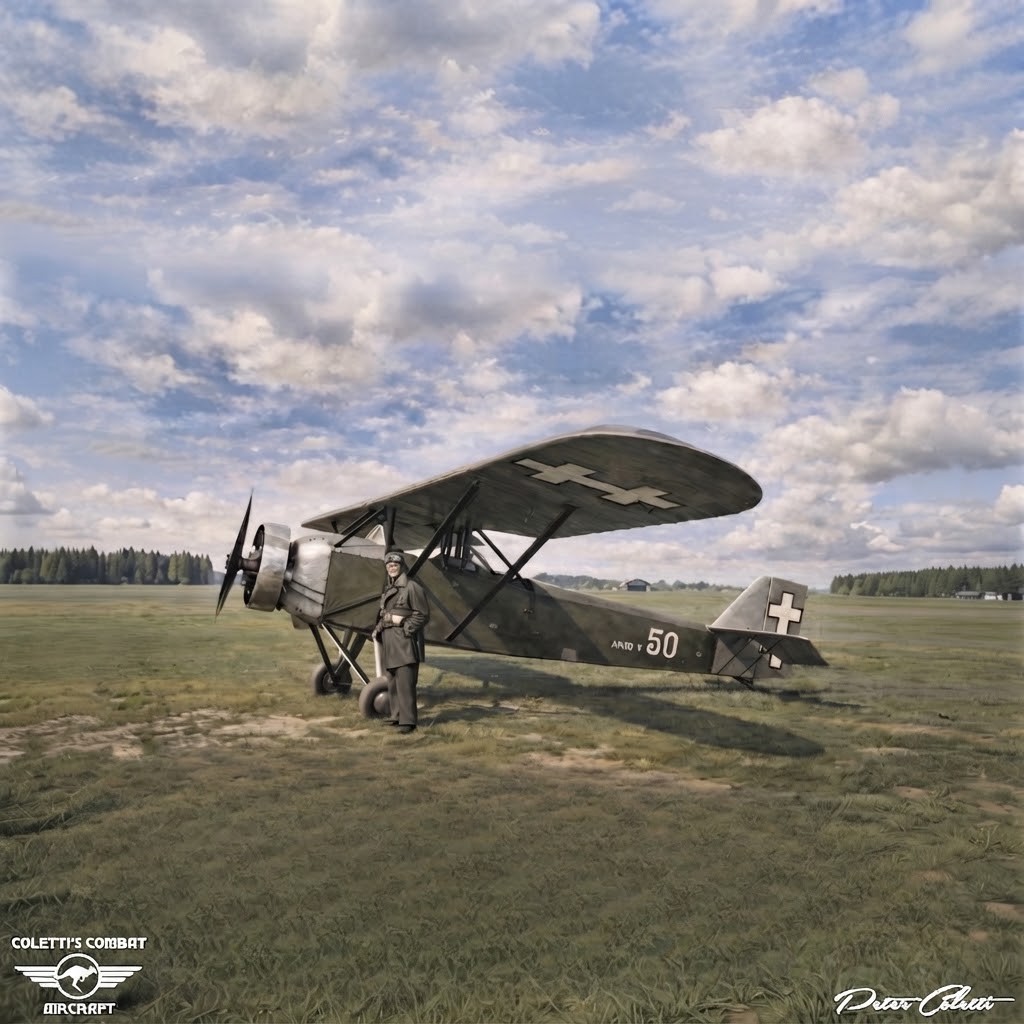
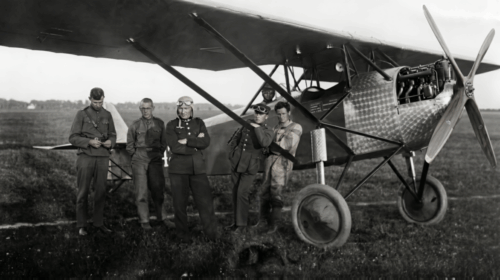
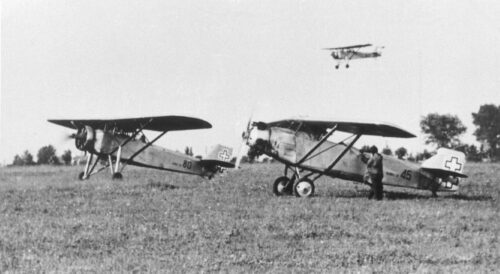
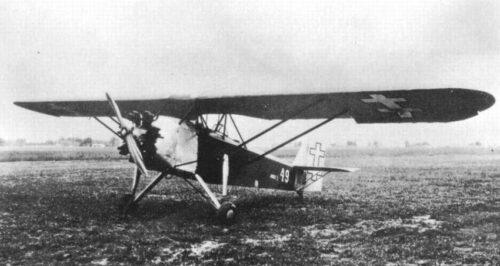
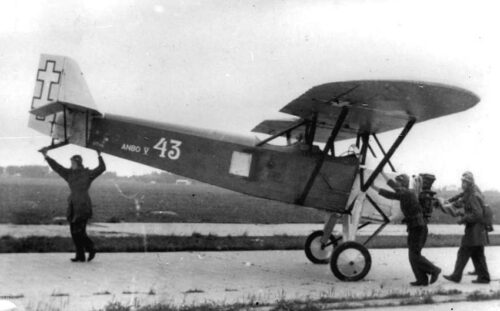
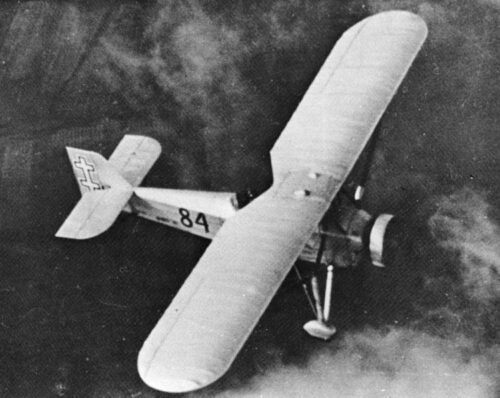
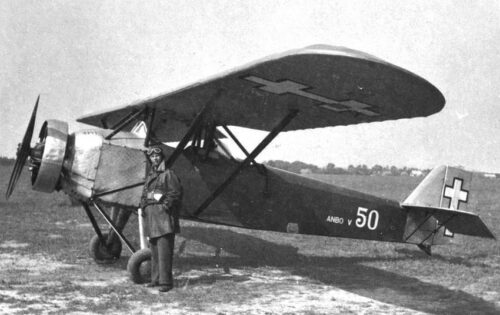
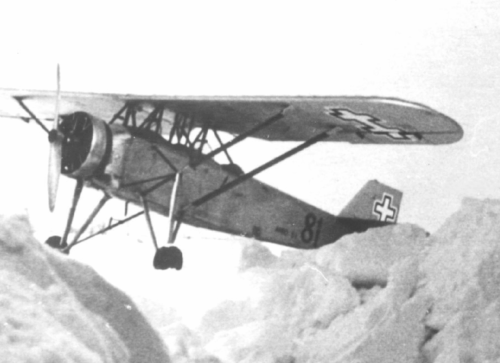
The ANBO V emerged from a pressing need within the Lithuanian Air Force during the early 1930s.
Until 1929, Lithuanian military pilots were still being trained on ageing German aircraft left over from the First World War, machines that were increasingly obsolete and inadequate for modern instruction.
This shortage of contemporary training aircraft prompted chief designer Antanas Gustaitis—the leading figure behind Lithuania’s indigenous ANBO aircraft series—to temporarily pause work on the ANBO IV reconnaissance aircraft and redirect his efforts towards a dedicated trainer.
Gustaitis completed the design in 1931, and the prototype ANBO V, powered by a Walter Vega I engine, made its maiden flight on 19 May 1931.
Following successful trials, four additional aircraft were produced, each fitted with more powerful Walter Venus or Armstrong Siddeley Genet Major engines to improve reliability and performance.
By the mid‑1930s, Lithuania sought a more robust and modernised trainer.
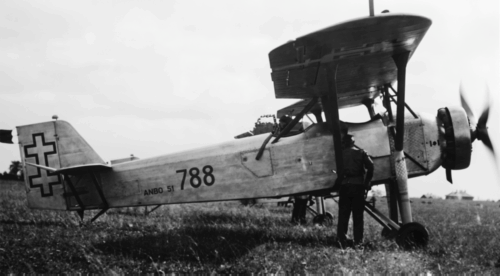
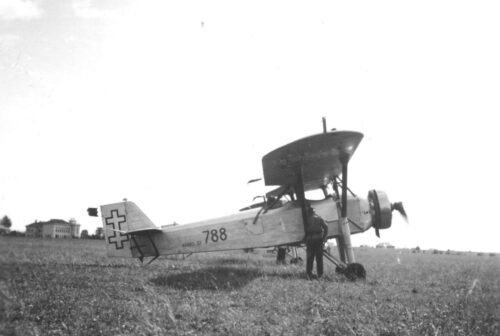
This led to the ANBO 51, an improved derivative introduced in 1936 and produced through 1938.
Ten examples were built, all powered by the Armstrong Siddeley Genet Major IV engine.
Design and Construction
General Configuration
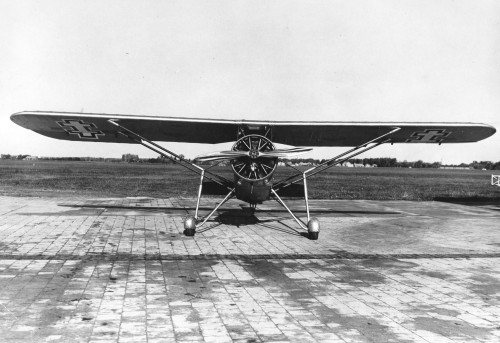
The ANBO V was a parasol‑wing monoplane of conventional layout, featuring the following:
A fixed tailwheel undercarriage
Tandem open cockpits for student and instructor
A simple, rugged structure optimised for basic flight training
The parasol wing was mounted above the fuselage on a system of struts: paired lift struts on each side and additional centre-section supports.
This arrangement provided excellent downward visibility and stable handling—ideal characteristics for novice pilots.
Structure and Materials
The ANBO V and ANBO 51 shared a hybrid construction typical of the era:
Fuselage: welded steel‑tube framework
Rudder and elevators: steel‑framed
Wings and fixed tail surfaces: wooden structures
External surfaces: fabric‑covered
This combination produced a light, easily repairable aircraft well suited to the limited industrial resources of interwar Lithuania.
Powerplants
ANBO V engines:
Prototype: Walter Vega I, 85 hp
Production aircraft: Walter Venus or Armstrong Siddeley Genet Major, approx. 110 hp
ANBO 51 engine:
Armstrong Siddeley Genet Major IV, 160 hp
The more powerful Genet Major IV gave the ANBO 51 significantly improved climb and speed, making it a more capable intermediate trainer.
Performance
ANBO V (typical early‑series figures)
(Values vary by engine; representative data from the Walter Vega I version.)
Maximum speed: ~170 km/h
Cruising speed: ~151 km/h
Service ceiling: ~4,000 m
Crew: 2
ANBO 51 (Jane’s 1938 data)
Maximum speed: 210 km/h
Rate of climb: 4.2 m/s to 2,000 m
Length: 7.30 m
Wingspan: 11.35 m
Height: 2.82 m
Wing area: 20.65 m²
Empty weight: 650 kg
Gross weight: 950 kg
Crew: 2
The ANBO 51’s improved engine and strengthened wings made it faster, more durable, and better suited for the increasingly demanding training syllabus of the late 1930s.
Operational Use
Both the ANBO V and ANBO 51 served exclusively with the Lithuanian Air Force, forming the backbone of the nation’s pilot‑training programme throughout the 1930s.
The ANBO V was used primarily for initial flight training, introducing cadets to basic handling, takeoff and landing procedures, and elementary aerobatics.
Its forgiving flight characteristics made it ideal for this role.
The ANBO 51, with its stronger engine and reinforced structure, was used for advanced training, including navigation, formation flying, and more demanding manoeuvres.
Between 1936 and 1938, ten ANBO 51s were built and successfully integrated into the military aviation school.
Context and Fate During World War II
Lithuania’s independence ended abruptly in 1940, when the Soviet Union occupied and annexed the country.
At that time, the Lithuanian Air Force—including its ANBO V and ANBO 51 trainers—was absorbed into the Red Army Air Force.
Although detailed Soviet records of the aircraft’s subsequent use are scarce, several outcomes are likely:
Some aircraft were impressed into Soviet training units, where their simple construction and low operating costs would have been useful for basic instruction.
Others were scrapped or cannibalised for parts, as Soviet training doctrine favoured standardised domestic types.
None are known to have survived the war, and no examples are preserved today.
The German invasion of the Soviet Union in 1941 further disrupted any remaining Lithuanian aviation infrastructure, effectively ending the operational life of the ANBO trainer series.
Variants
ANBO V (1931)
Five built
Engines: Walter Vega I (prototype), Walter Venus or Genet Major (production)
Role: Primary trainer
ANBO 51 (1936–1938)
Ten built
Engine: Armstrong Siddeley Genet Major IV with strengthened wings and improved performance
Role: Intermediate/advanced trainer
Significance
The ANBO V and ANBO 51 represent a remarkable achievement for a small nation with limited industrial capacity.
Designed and built entirely in Lithuania, they provided the country with a modern, indigenous training capability at a time when reliance on foreign aircraft was increasingly untenable.
They also stand as a testament to Antanas Gustaitis, whose ANBO series formed the backbone of Lithuania’s interwar aviation and whose work remains a point of national pride.
Check out theA N B Owebsite for more historical information and images.