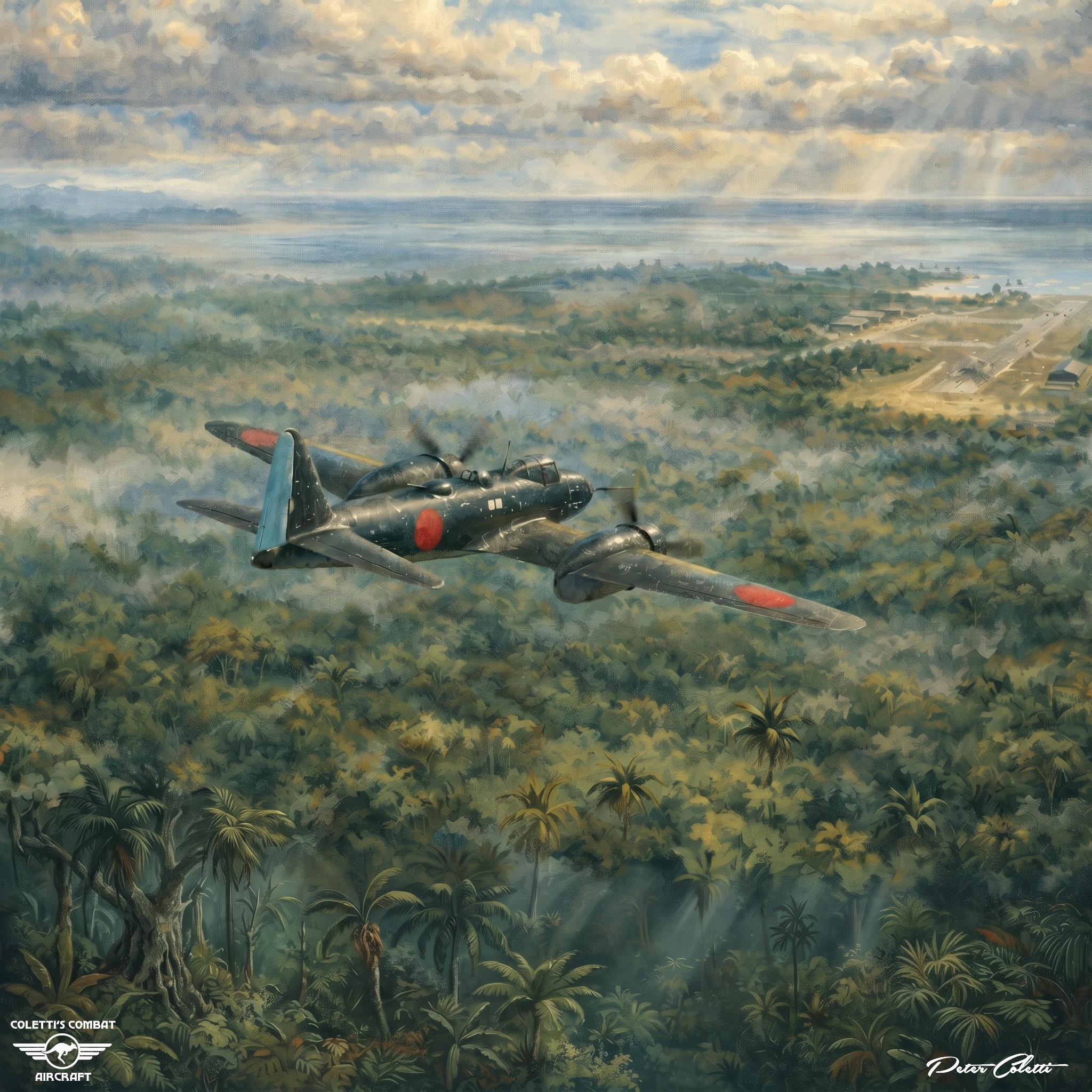
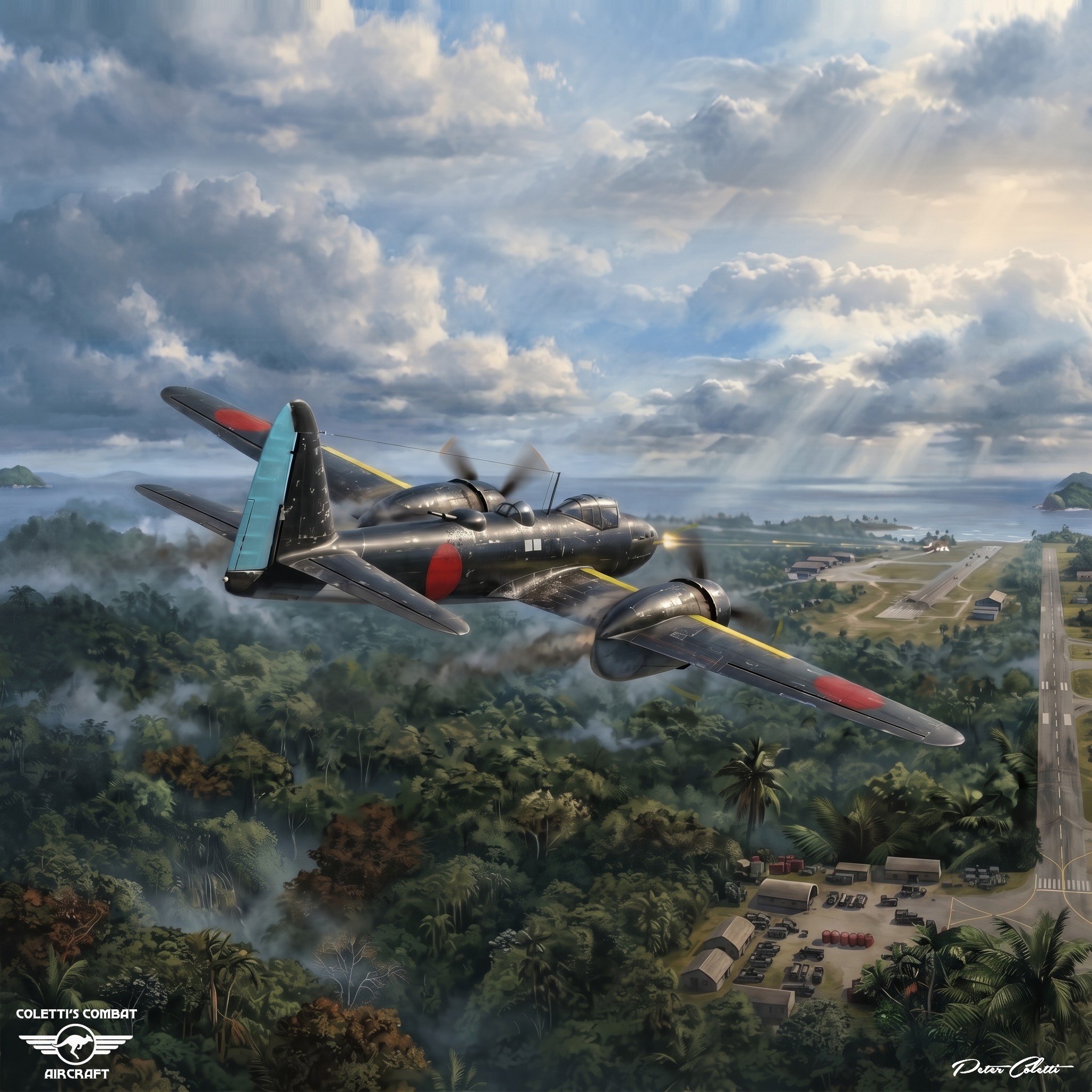
Aichi S1A Denkō The Aichi S1A Denkō—“Bolt of Light”—was one of Japan’s most ambitious late-war night-fighter projects: a large, radar-equipped, twin-engine interceptor conceived to counter B-29 raids over the home islands.
It never flew, but its design and troubled development capture the technical and strategic corner Japan had backed itself into by 1944–45.
Strategic and WWII context
By 1943–44, Japan faced a new kind of air war.
High‑altitude threat
The arrival of the Boeing B‑29 Superfortress brought fast, heavily armed bombers operating at altitudes around or above 9,000 – 10,000 m, beyond the comfortable reach of many existing Japanese fighters.
18‑Shi night-fighter requirement
Late in 1943 the Navy issued a specification (often referred to as the 18‑Shi night‑fighter requirement) calling for:
Top speed
about 426 mph (≈685 km/h) at roughly 9,000 m
Climb
to around 6,000m in about 8 minutes
Endurance
about 5 hours
Armament
heavy cannon and airborne radar for night interception of B‑29s
Major firms like Mitsubishi and Nakajima were already heavily committed, so Aichi—better known for dive bombers and seaplanes—was tasked with this demanding new night‑fighter project.
Development history
Concept and designation
Project identity
Aichi’s design was adopted as the Navy Experimental 18‑Shi Night Fighter, S1A, with the name Denkō (“Bolt of Light”).
It was intended as the direct successor to the J1N1‑S Gekkō in the night‑fighter role.
Twin-engine, two-seat layout
From the outset, the aircraft was conceived as a large, twin-engine, two-crew night fighter with:
A pilot in the forward cockpit
A radar operator/rear gunner in a separate aft position
Space for radar, oxygen systems, and other special equipment
Engine controversy and delays
A central problem was the choice of powerplant:
Navy preference
The Navy insisted on the Nakajima NK9K “Homare” series—compact, powerful 18‑cylinder radials already in service on other types.
Aichi’s concerns
Aichi engineers recognised that the Homare’s high‑altitude performance and reliability were marginal, especially once turbochargers and heavy equipment were added.
Early estimates with two Homare 22 engines suggested a top speed near 391 mph, but as weight grew and realistic performance figures were applied, the projected maximum speed dropped to around 360–366 mph at altitude—well below the Navy’s original requirement.
Turbocharger issues
The turbochargers were mounted at some distance from the engines, which created serious plumbing, heat, and reliability problems.
This arrangement, combined with the already demanding installation, contributed to long development times and repeated test‑stand difficulties.
Prototypes and wartime disruption
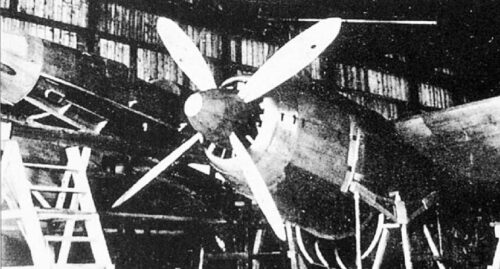
Prototype construction
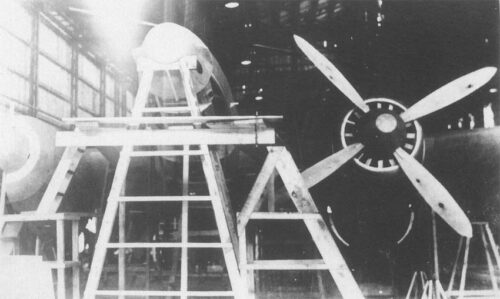
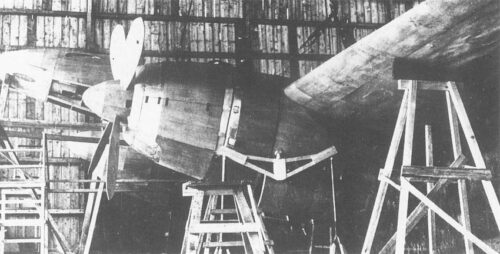
Two prototypes were laid down.
Both reached an advanced stage—roughly 70% and 90% complete—but neither ever flew.
Earthquake damage
The Tōnankai earthquake in December 1944 damaged Aichi’s facilities and the partially built aircraft, forcing dispersal of production and further slowing progress.
Air raids and destruction
On 9 June 1945, US air raids on Aichi’s plants destroyed the first prototype, which had been expected to fly later that summer.
The second prototype was moved to another factory at Gifu for completion, but a raid on 9 July 1945 destroyed it as well.
With both prototypes lost and Japan’s industrial situation collapsing, the programme effectively ended.
No further airframes were started, and the S1A never reached flight testing.
Airframe design and layout
General configuration
The S1A Denkō was, by Japanese standards, an enormous fighter:
Crew
2 (pilot and radar operator/rear gunner)
Length
about 15.1 m
Wingspan
about 17.5m
Height
about 4.6m
Wing area
about 47 m²
This made it the largest fighter‑type aircraft ever developed for the Imperial Japanese Navy.
Fuselage and cockpits
Forward cockpit
The pilot sat under a long, framed canopy positioned around the wing leading edge, giving good forward and downward visibility over a short nose that housed the main forward‑firing armament.
Aft station
The radar operator/rear gunner occupied a separate cockpit further aft, under a smaller dome-like canopy near the wing trailing edge.
This separation allowed space for radar equipment and the remote turret installation between the two crew positions.
Wings and control features
Wing planform
Low-mounted, thick, tapered wings with clipped tips, optimised to house engines and landing gear and to provide good lift at high weights.
Drooping ailerons and airbrake function
The wings incorporated drooping ailerons that could act as additional flaps, improving low‑speed handling and landing performance.
They could also be used as airbrakes to prevent overshooting a target during night interceptions—an advanced feature for a Japanese fighter of the time.
Tail and landing gear
Tail unit A conventional single vertical fin with low-mounted horizontal stabilisers on the rear fuselage.
Landing gear
A retractable tricycle‑type main gear arrangement with the main wheels retracting into the engine nacelles under the wings, typical of twin‑engine fighters of the era.
The Denkō’s “service weight” exceeded 10,000 kg because of:
Heavy engines and turbochargers
Radar and associated electronics
Oxygen injection and high‑altitude systems
Remote‑controlled turret and ammunition
Turbocharging and high‑altitude performance
Remote turbocharger layout
The turbochargers were mounted away from the engines, connected by long ducting.
This arrangement was meant to improve high-altitude power but caused the following:
Heat management issues
Pressure losses
Reliability problems under test
Resulting performance shortfall
Even with turbocharging, projected top speed settled around 360–366 mph (≈580–590 km/h) at altitude—respectable, but below the original Navy requirement and marginal against B‑29s.
Avionics and radar
Airborne radar
The S1A was designed from the outset to carry an airborne interception radar set in the nose, with the radar operator managing the scope and guiding the pilot onto targets.
Exact model details are scarce, but it would have been an evolution of the sets used on the J1N1‑S Gekkō, with improved range and reliability.
Electrical load
The radar, turret motors, and other systems demanded a robust electrical system, further adding to weight and complexity—one reason the aircraft ended up so heavy for a fighter.
Armament and projected performance
Armament layout
The Denkō was heavily armed for its role as a night bomber destroyer:
Forward‑firing guns (fuselage nose):
2 × 30 mm Type 5 cannon
2 × 20 mm Type 99 Model 1 cannon
Defensive/covering fire:
2 × 20 mm Type 99 Model 2 cannons in a remotely controlled dorsal turret, firing rearward from a position between the two crew stations.
This combination gave the S1A a formidable frontal punch for attacking bombers and some defensive capability against pursuing fighters.
Performance estimates (S1A1 Denkō)
Typical figures cited for the projected S1A1 prototype are:
Empty weight
≈7,320 kg
Loaded (gross) weight ≈10,180 kg
Maximum takeoff weight ≈11,510 kg
Maximum speed
About 360 mph (≈580km/h) at altitude (some sources give 366 mph at around 8,000 m)
Cruise speed
Around 273 mph (≈440km/h)
Range
Normal range
about 1,050–1,070 miles (≈1,700km)
Ferry range
up to about 1,550 miles (≈2,500km)
Service ceiling
Around 12,000m (≈39,000ft)
Wing loading
Roughly 44 lb/ft², high for a fighter, reflecting the aircraft’s mass and contributing to demanding handling characteristics at low speeds.
These numbers place the Denkō in the same general performance bracket as other late‑war heavy night fighters, but its speed and climb were not clearly superior to the B‑29’s operational envelope—especially given the B‑29’s ability to vary altitude and route.
Variants and projected improvements
S1A1 prototypes
S1A1 Denkō The initial prototype configuration with Homare 22 engines and full radar and armament fit.
Both prototypes were of this basic type, though neither reached flight testing before being destroyed.
Planned engine upgrades
Aichi and the Navy considered more powerful engines for later prototypes:
Proposed engines
Mitsubishi Ha‑211 (often referenced as HI MK9A Ru or MK10A Ru) turbocharged radials were planned for the third and fourth prototypes.
Goal of upgrades
These engines promised better high‑altitude performance and might have pushed maximum speed closer to the original 18‑Shi requirement, potentially making the Denkō a more credible B‑29 interceptor.
However, these later prototypes were never built.
Possible subvariants
While no formal sub‑variants were completed, it is reasonable—based on contemporary practice—to infer that Aichi and the Navy envisioned:
Radar‑optimised versions with improved sets as they became available.
Weight‑reduced or simplified versions if production realities demanded fewer systems or lighter armament.
None of these reached the design freeze or prototype stage before the programme’s cancellation.
Assessment and historical significance
Technical ambition vs. industrial reality
The S1A Denkō illustrates the gap between Japan’s late‑war ambitions and its industrial capacity:
Ambitious systems
Advanced radar, a remote turret, turbocharged engines, and complex high‑lift devices placed the S1A among the most sophisticated Japanese fighter designs on paper.
Overweight and underpowered
The combination of heavy equipment and engines that struggled at altitude produced an aircraft that was massive for a fighter yet only marginally fast enough for its intended role.
Development environment
Earthquake damage, dispersal of factories, shortages of skilled labour and materials, and relentless air raids made it nearly impossible to complete, test, and refine such a complex aircraft in 1944–45 Japan.
Comparison to contemporary night fighters
Heinkel He 219, P‑61 Black Widow, Ki‑83, Ki‑102:
The Denkō’s general concept—twin‑engine, two‑seat, radar‑equipped night fighter with heavy cannon—parallels aircraft like the German He 219 and American P‑61. In size and weight, it was comparable or even larger, but it lagged behind in engine maturity and radar sophistication.
Never-flown status
Unlike those contemporaries, the S1A never flew, so its true handling, reliability, and combat effectiveness remain speculative.
Legacy
Although the Denkō left no operational record, it remains historically interesting because:
It was the largest fighter‑type aircraft ever developed for the Imperial Japanese Navy.
It shows how far Japanese designers were willing to push complexity—radar, turbocharging, and remote turrets—in a desperate attempt to counter B‑29 raids.
Its failure underscores the strategic and industrial collapse of late‑war Japan: even promising designs could not be completed, let alone produced in numbers.