In 1941, the Imperial Japanese Navy (IJN) issued the 16‑Shi carrier attack bomber requirement.
The goal was ambitious: a single aircraft to replace both the Nakajima B6N Tenzan torpedo bomber and the Yokosuka D4Y Suisei dive bomber.
Instead of two specialised types, the Navy wanted one fast, long‑ranged, carrier‑borne strike aircraft capable of both torpedo and dive‑bombing roles.
The new design was intended for the upcoming Taihō‑class fleet carriers, whose larger elevators removed the traditional Japanese limit of about 11 m in aircraft length.
This freed designers from earlier dimensional constraints and allowed a larger, more capable airframe.
Aichi’s internal project designation was AM‑23, and chief engineer Toshio (often misrendered as Norio) Ozaki led the design.
The IJN also dictated the use of the new Nakajima NK9C Homare 12 radial engine, expected to become the navy’s standard high‑power powerplant.
Design philosophy and airframe layout
Overall concept
The B7A was conceived as a large, powerful, two-seat carrier attack aircraft with the following:
Dual role: torpedo bomber and dive bomber
High speed and range: to match or exceed contemporary fighters and reach distant targets
Good manoeuvrability: so it could at least defend itself and operate in contested airspace
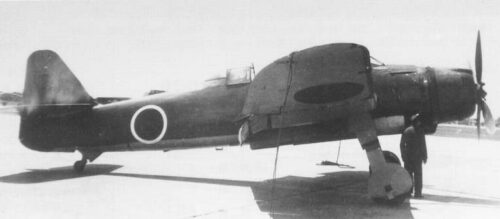
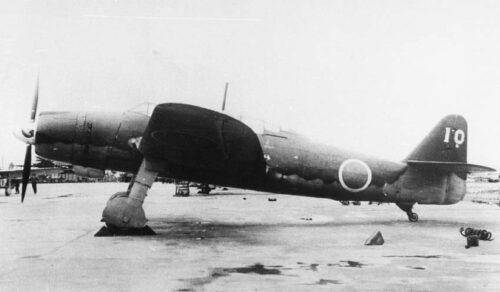
To achieve this, Ozaki’s team combined a relatively slim fuselage, a mid-wing layout, and a powerful engine, all wrapped in a structure optimised for carrier operations.
Mid‑wing and internal bomb bay
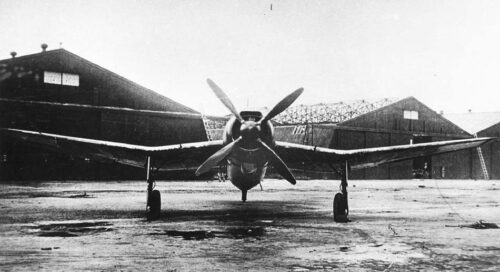
A key decision was the mid‑wing configuration.
This allowed:
Internal bomb bay: reducing drag and protecting ordnance
Adequate propeller clearance: for the large four‑bladed propeller driven by the Homare engine
The internal bay could carry either a torpedo or bombs, giving the aircraft flexibility without external drag penalties in many configurations.
Inverted gull wing and landing gear
The mid‑wing layout created a challenge: the landing gear would be very long if attached directly to a straight mid‑wing.
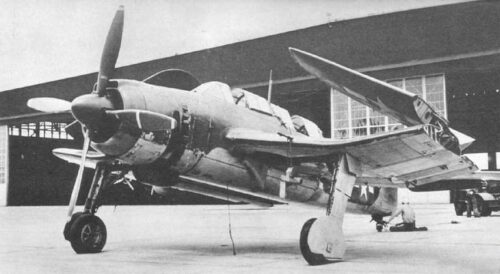
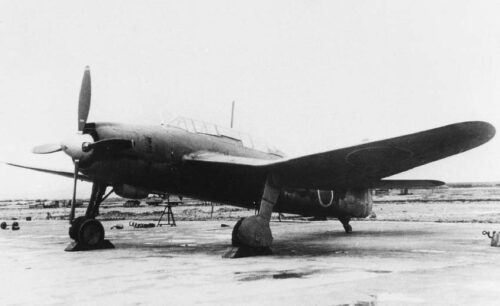
The solution was an inverted gull wing, reminiscent of the Vought F4U Corsair:
Wing root lower, outer panel higher: allowing shorter, sturdier main landing gear legs
Improved propeller clearance: without excessively tall gear
Structural efficiency: better geometry for gear attachment and wing strength
This distinctive wing gave the B7A its characteristic silhouette and helped reconcile carrier requirements with performance goals.
Folding wings and carrier stowage
As a carrier aircraft, the B7A needed to fit into limited hangar space.
Its outer wing panels folded hydraulically upwards, reducing span from about 14.4 m to roughly 7.9 m.
This allowed the large airframe to be handled on Taihō‑class elevators and stowed efficiently below decks.
Control surfaces and dive-braking
The wing incorporated several refinements:
Extendable ailerons with about 10° of deflection, allowing them to act as auxiliary flaps for improved low-speed handling and takeoff/landing performance
Dive brakes are mounted under the wing, just outboard of the fuselage, to stabilise the aircraft in steep dive-bombing attacks.
These features reflected the dual‑role requirement: the aircraft had to be stable and controllable in both torpedo runs and steep dives.
Powerplant, performance, and armament
Engine and propulsion
The IJN mandated the Nakajima NK9C Homare 12, an 18‑cylinder, two‑row air‑cooled radial engine rated at about 1,825 hp (1,360 kW).
It drove a four‑bladed propeller of roughly 3.5 m diameter.
In theory, the Homare promised an excellent power‑to‑weight ratio and was intended as a standard high‑output engine for multiple navy types.
In practice, it suffered from development and reliability issues, which delayed the B7A’s service entry and limited its operational effectiveness.
Performance envelope
Typical performance figures for the B7A2 production model include the following:
Maximum speed: about 352 mph (≈ 566 km/h)
Range: roughly 1,890 miles (≈ 3,040 km)
Service ceiling: around 36,900 ft (≈ 11,250 m)
These numbers placed the B7A among the fastest and longest‑ranged carrier attack aircraft of the war, at least on paper.
Its speed approached that of some contemporary fighters, and its range suited the IJN’s doctrine of long‑distance strikes.
Crew and cockpit
The B7A carried a crew of two:
Pilot: responsible for flying, navigation, and offensive weapons
Observer/rear gunner: handled radio, navigation assistance, and rear defensive armament
The cockpit arrangement reflected the need for both strike capability and self-defence, especially during long over-water missions.
Offensive and defensive armament
The aircraft’s armament was substantial for a carrier attack bomber:
Fixed forward armament:
Two 20 mm cannons in the wing leading edges
Defensive armament:
One flexible 7.92 mm or 13 mm machine gun in the rear cockpit
Ordnance load (internal bay and external):
One torpedo (around 800 kg / 1,764 lb class)
Or an equivalent weight in bombs
Interestingly, despite its size and power, the B7A’s maximum weapons load was not significantly greater than that of its predecessors; the design emphasis was more on speed, range, and versatility than on sheer payload.
Development timeline and production
Prototypes and testing
The first prototype, the B7A1, flew in May 1942.
Early testing revealed the aircraft’s promising performance but also exposed the Homare engine’s immaturity and various teething issues.
Development was further disrupted by natural disaster—an earthquake damaged Aichi’s facilities—compounding delays already caused by engine problems and wartime resource constraints.
As a result, the aircraft did not reach operational status until 1944, by which time Japan’s strategic situation had deteriorated dramatically.
Production numbers
Total production was small: about 114 aircraft were built between 1942 and 1945, broken down roughly as follows:
B7A1 prototypes: 9
B7A2 production aircraft: 105
This limited output reflected industrial strain, bombing damage, engine supply issues, and the shrinking utility of carrier attack aircraft as Japan lost its major carriers.
Armament: Two 20 mm wing cannons, a rear machine gun, and an internal torpedo/bomb bay
Quantity: about 105 built
The B7A2 incorporated improvements from prototype testing and represented the standard service configuration.
Experimental engine fits and B7A3 Ryūsei Kai (projected)
Aichi and the IJN explored further powerplant options to improve performance and reliability:
Homare 23:
One B7A2 airframe was experimentally fitted with the Nakajima Homare 23, rated around 2,000 hp (1,491 kW), to evaluate performance gains.
Mitsubishi MK9 and B7A3 Ryūsei Kai:
Plans existed to fit the Mitsubishi MK9 radial (around 2,200 hp / 1,641 kW) to a more advanced version designated B7A3 Ryūsei Kai.
This would likely have offered better high‑altitude performance and possibly improved reliability.
However, the B7A3 never progressed beyond planning, as Japan’s industrial and strategic situation collapsed before such developments could be realised.
Operational history and WWII context
Intended role versus reality The B7A was designed to operate from new, large fleet carriers like the Taihō, forming the core of a modernised IJN carrier air group.
In that envisioned future, Ryūsei squadrons would deliver powerful torpedo and dive‑bombing strikes at long range, protected by improved fighters.
By the time the B7A became operational in 1944, however, the IJN’s carrier arm had been crippled:
Major carriers had been sunk or heavily damaged in battles such as Midway and Philippine Sea and later engagements.
Fuel shortages, pilot attrition, and industrial bombing further eroded Japan’s ability to conduct large‑scale carrier operations.
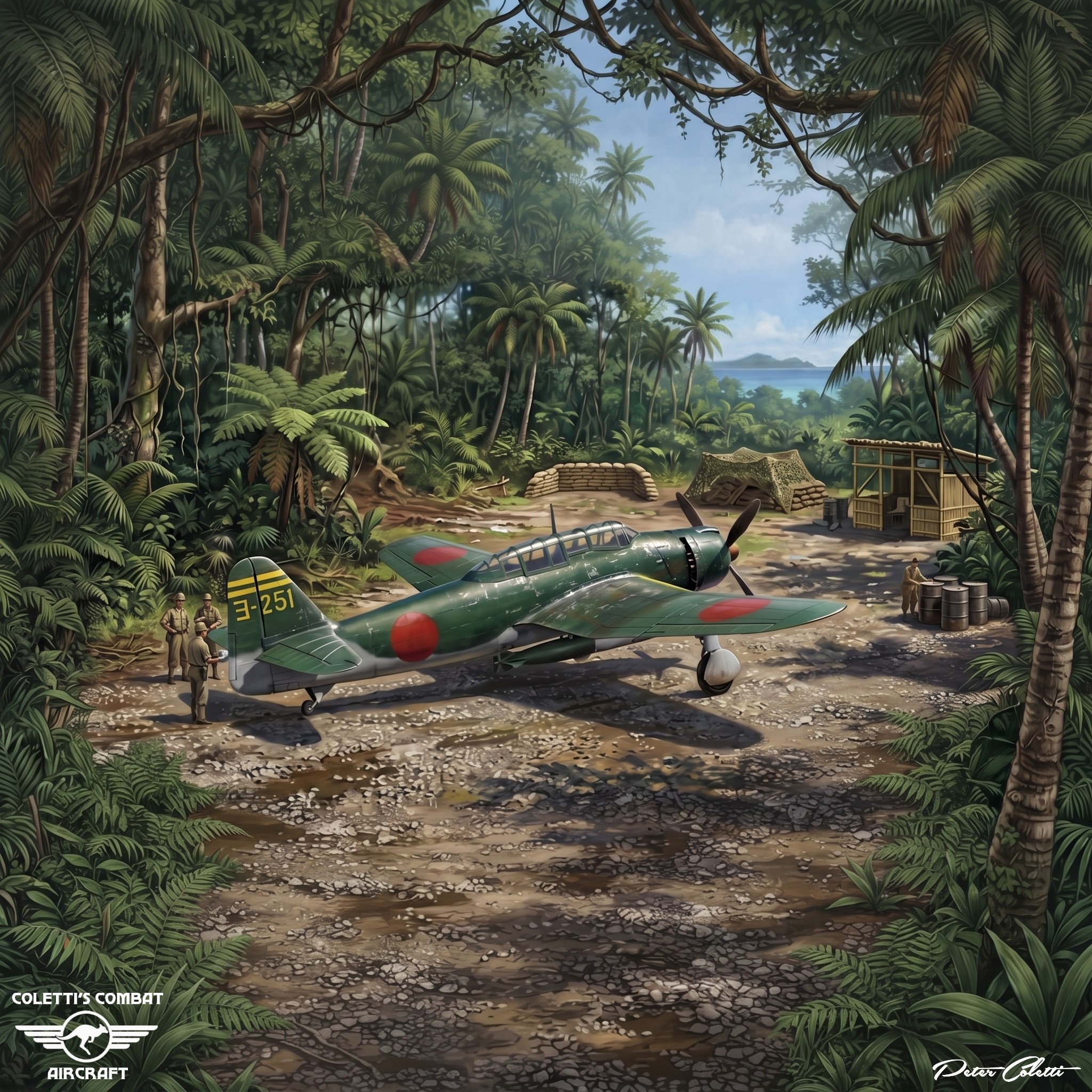
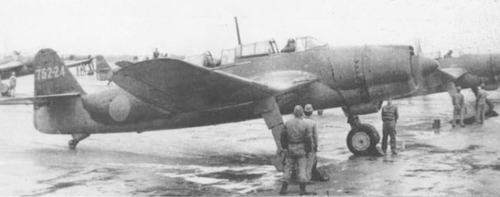
As a result, the B7A rarely operated from carriers.
Instead, it was used primarily from land bases, often in small numbers, and never had the chance to demonstrate its full potential in the role for which it was designed.
Combat use
Operational details are relatively sparse, but the B7A saw limited combat in the final stages of the Pacific War:
Employed in maritime strike and anti‑shipping missions from shore bases
Occasionally used in conventional bombing roles
Some aircraft may have been involved in desperate late‑war operations, including potential special‑attack (kamikaze) missions, though the type is not as strongly associated with this role as other aircraft.
Given the small production run and late introduction, the B7A did not significantly influence the course of the war despite its impressive specifications.
Comparison with contemporaries
In concept, the B7A paralleled other late‑war, high‑performance strike aircraft:
US Navy: Grumman TBF/TBM Avenger (earlier) and, to some extent, the Curtiss SB2C Helldiver
German Luftwaffe: Ju 88 and other multi-role bombers (land-based, but similar “do‑everything” philosophy)
Where the B7A stood out was its combination of speed, range, and dual‑role capability in a carrier-borne package.
On paper, it was arguably one of the most advanced carrier attack aircraft of the war; in practice, it arrived when Japan could no longer exploit such an asset.
Strategic and technological significance
A culmination of IJN carrier‑strike doctrine
The B7A represented the culmination of pre-war and early-war IJN thinking about carrier strike aircraft:
Long‑range, high‑speed attacks to surprise and overwhelm enemy fleets
Dual‑role flexibility to simplify logistics and air group composition
High performance to survive increasingly dense fighter and anti‑aircraft defences
It was, in many ways, the logical successor to the earlier B5N “Kate” and D3A “Val” and a more sophisticated counterpart to the B6N and D4Y it was meant to replace.
Limits of Japanese wartime industry and technology
The B7A’s story also highlights the limits of Japanese wartime industry:
The Homare engine, though powerful, was rushed and problematic, undermining the aircraft that depended on it.
Earthquake damage, bombing, and resource shortages disrupted production and development.
Strategic reverses meant that even excellent designs could not be produced or employed in sufficient numbers.
Legacy
After Japan’s surrender in September 1945, the B7A was quickly retired.
No large post‑war career or export story followed.
A few airframes were examined by the Allies, but the type did not directly influence post‑war designs in the way some German or American aircraft did.
Its legacy is more conceptual and historical:
As a late-war pinnacle of Japanese carrier strike design
As an example of how timing and context can render even an excellent aircraft strategically irrelevant
As a reminder that technology alone cannot overcome structural and strategic collapse.