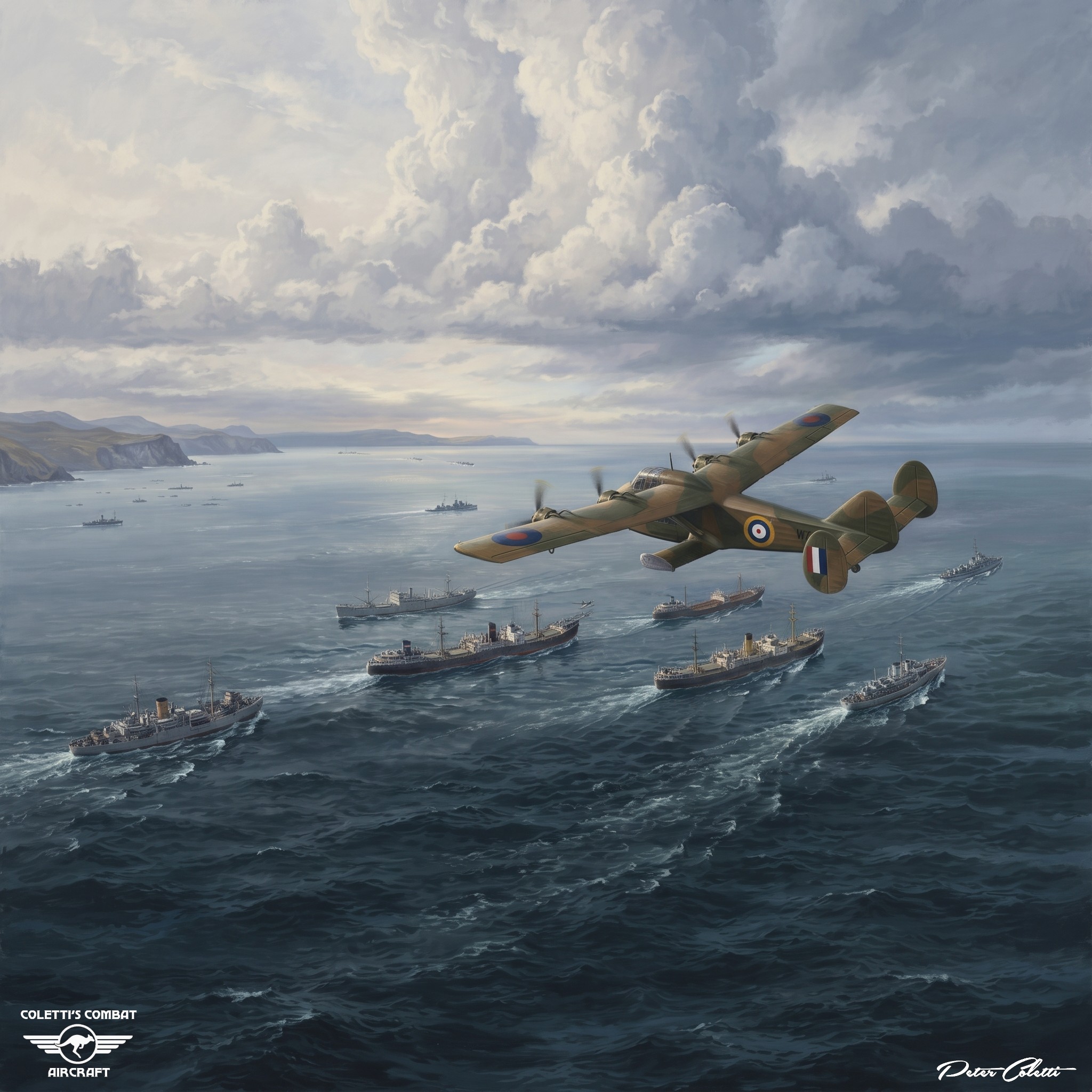
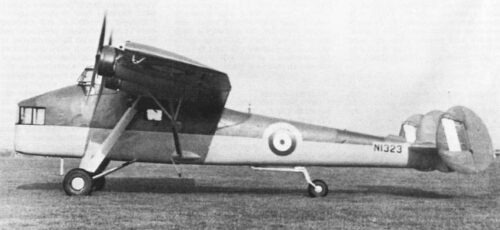
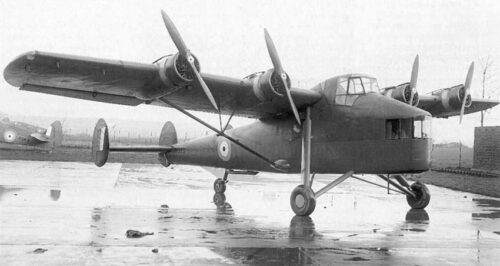
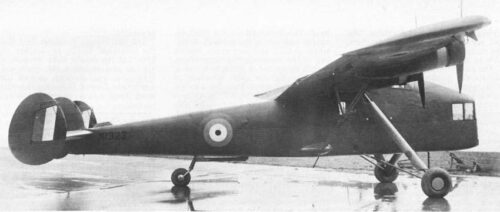
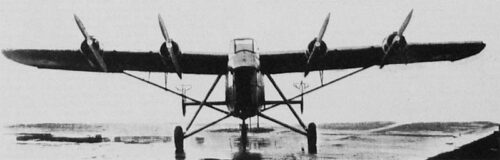
The Royal Navy issued Operational Requirement OR.52 for an aircraft capable of shadowing enemy fleets at night and flying extremely slowly, quietly, and for long durations over the ocean.
This led to Specification S.23/37, which demanded an aircraft able to fly at 38 knots (70 km/h) at 1,500 ft for at least six hours.
Five companies responded: Percival, Short Brothers, Fairey Aviation, General Aircraft Ltd, and Airspeed.
General Aircraft submitted the G.A.L.38, a design very similar to Airspeed’s proposal.
Both companies were selected to build two prototypes each, and Airspeed received its contract on 10 August 1938.
Design & Engineering
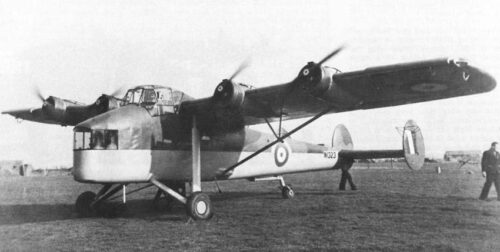
The Airspeed AS.39 was a high-wing, semi-cantilever monoplane with:
Wooden wings and tail
All‑metal monocoque fuselage
Fixed landing gear with tailwheel
Crew of three: pilot, observer, radio operator
Observer in a glazed nose, pilot raised for internal access
Four Pobjoy Niagara V radial engines (130 hp each) mounted to maximise propwash for low-speed lift
Folding wings for carrier storage
The aircraft was intended to fly extremely slowly while maintaining control — a unique requirement that shaped its unusual four‑engine layout.
Prototype Development & First Flight
Of the two prototypes ordered, only one was completed.
Its first flight occurred on 17 October 1940, delayed by vibration problems with the Niagara engines.
However, flight testing quickly revealed the following:
Stability problems
Poor stall behaviour
Insufficient engine power
These issues made the aircraft unsuitable for its intended role.
Attempted Redesign
The Royal Navy requested that Airspeed replace the four Pobjoy engines with two Armstrong Whitworth Cheetah XI radials and add rear‑facing defensive machine guns, but the second prototype was still incomplete when the entire programme was cancelled.
Cancellation of the Fleet Shower Programme
On 17 February 1941, the navy cancelled the following:
The Airspeed AS.39
The General Aircraft GAL.38
The entire Fleet Shadower concept
Both AS.39 prototypes were ordered scrapped.
The G.A.L.38 flew briefly but was also scrapped in March 1942.
Why did the programme die?
The concept was rendered obsolete by the rapid wartime deployment of airborne radar on long‑range patrol aircraft such as the Consolidated Liberator I.
Radar-equipped aircraft could detect fleets at long range without needing to fly slowly or remain visually hidden.
Specifications (AS.39) Crew
3
Length
39 ft 10 in (12.14 m)
Wingspan
55 ft 4 in (16.87 m)
Height
10 ft 5 in (3.18 m)
Wing area
469 sq ft (43.6 m²)
Empty weight
4,592 lb (2,083 kg)
Gross weight
6,935 lb (3,146 kg)
Powerplant
4 × Pobjoy Niagara V radials, 140 hp each
Performance
Max speed
126 mph (203 km/h)
Cruise speed
113 mph (182 km/h)
Stall speed
33 mph (53 km/h)
Endurance
6 hours
Service ceiling
14,700 ft (4,500 m)
Absolute ceiling
16,700 ft (5,100 m)
Rate of climb
865 ft/min
Time to 10,000 ft
18 minutes
Historical Significance
Although the AS.39 never entered service, it represents the following:
A rare attempt to build an aircraft optimised for extreme low‑speed endurance
A transitional moment before airborne radar revolutionised naval reconnaissance
An example of how rapidly wartime technology could render entire aircraft concepts obsolete
The Fleet Shadower is often cited in aviation literature as an example of a promising idea overtaken by technological change.