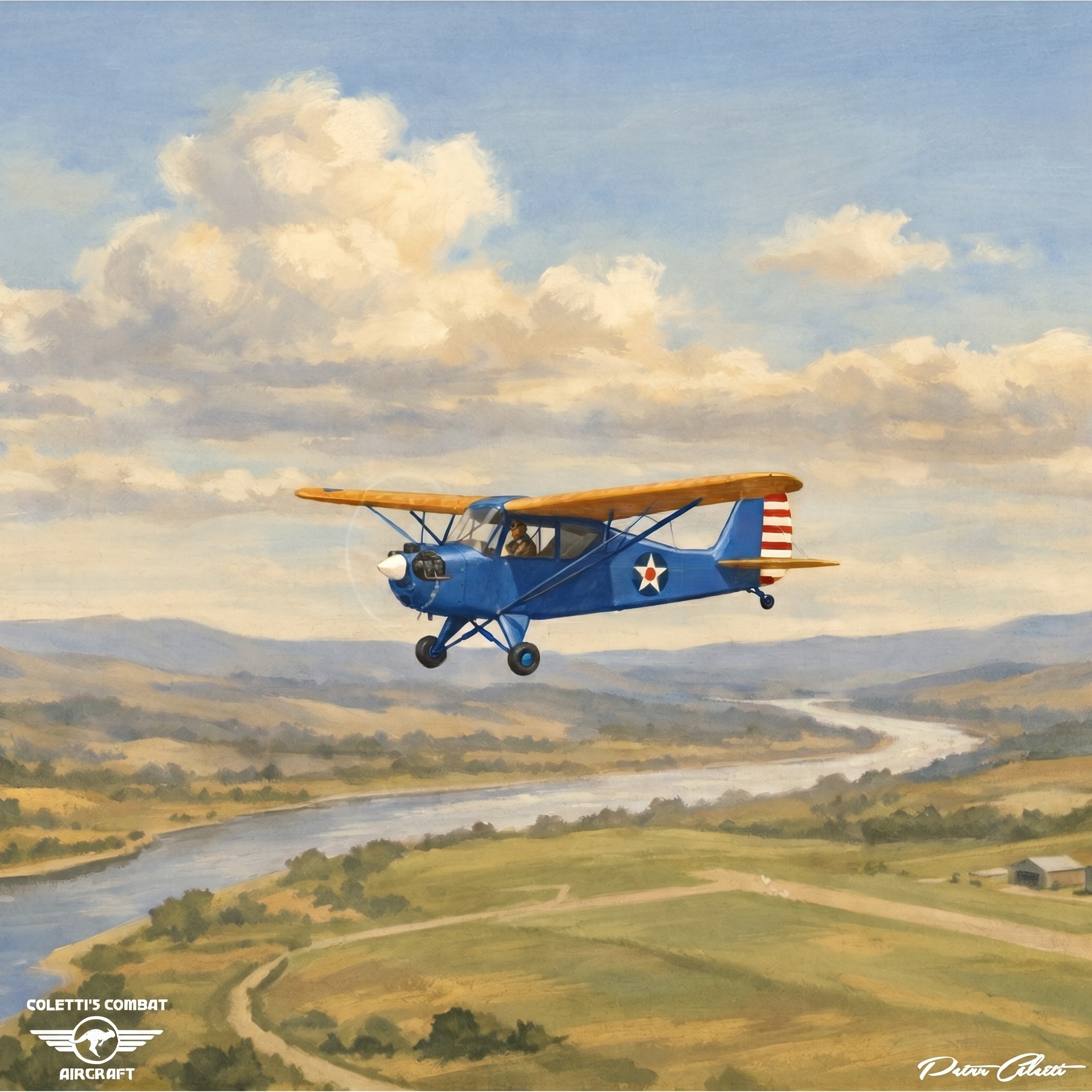
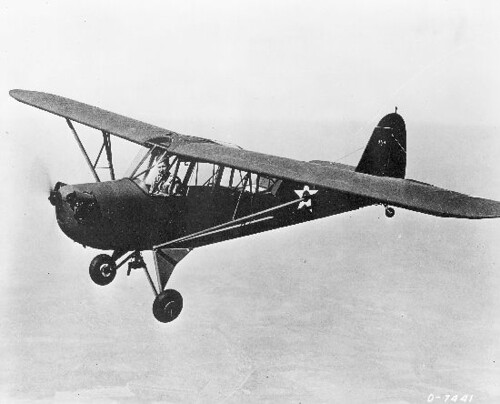
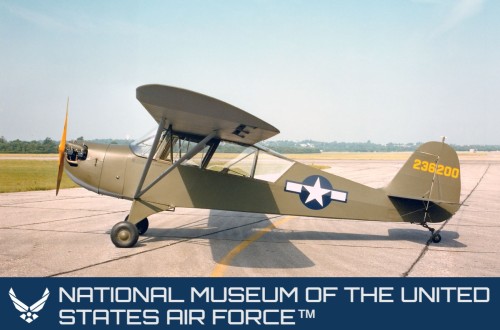
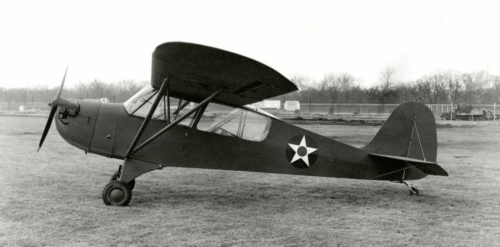
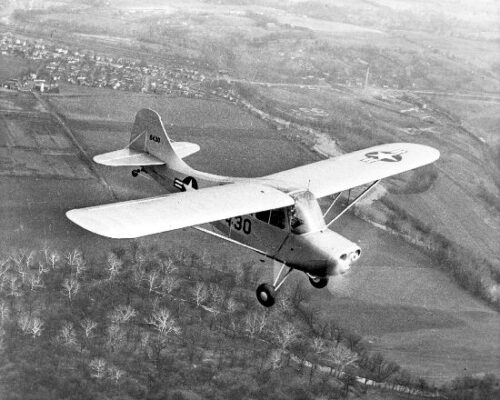
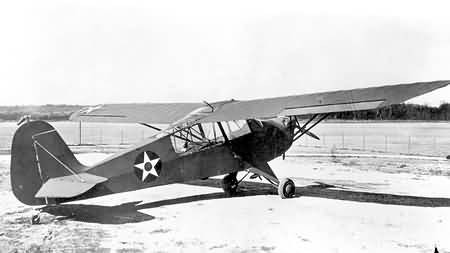
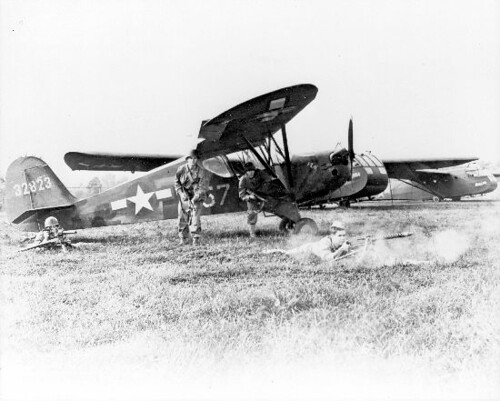
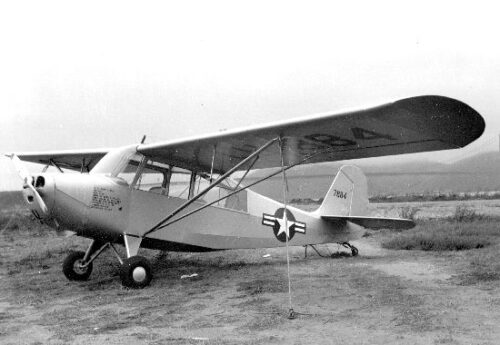
The Aeronca L‑3 was a family of light observation and liaison aircraft operated by the United States Army Air Corps and later the Army Air Forces during World War II.
Adapted from Aeronca’s pre‑war Tandem Trainer and Chief designs, the L‑3 became one of the early “Grasshopper” aircraft used for short‑range reconnaissance and battlefield support.
Design and Development
In 1941, the Army Air Corps ordered four Aeronca 65‑TC Defender aircraft—designated YO‑58—to evaluate whether lightweight civilian planes could serve effectively in observation and liaison roles.
Similar trials were conducted with Piper and Taylorcraft aircraft.
The YO‑58 performed well during large‑scale army manoeuvres, leading to expanded procurement.
In 1942, the designation O‑58 was changed to L‑3 as part of a broader reclassification of liaison aircraft.
After the attack on Pearl Harbour, L‑3s were deployed in roles reminiscent of World War I observation balloons—spotting enemy activity, adjusting artillery fire, and providing frontline commanders with real‑time battlefield awareness.
Their ability to take off and land on short, improvised strips made them ideal for courier work, personnel transport, and low‑level reconnaissance missions.
Liaison pilots typically trained on the L‑3 before transitioning to more advanced aircraft such as the Piper L‑4 or Stinson L‑5.
Some L‑3s were shipped to North Africa, where several were transferred to Free French forces operating in the region.
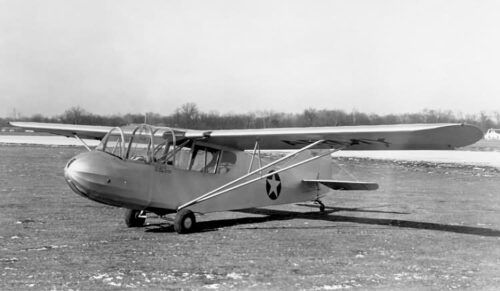
TG‑5 Glider Variant
In 1942, Aeronca developed the TG‑5, a three‑seat training glider derived from the O‑58 airframe.
It retained the original wings, tail, and rear fuselage but replaced the engine with a new extended forward fuselage for unpowered flight training.
A total of 250 TG‑5 gliders were produced for the army, and the U.S. Navy acquired three examples under the designation LNR‑1.
Aeronca L‑3 Variants
Designation Change
O‑58 → L‑3 (April 1942) — The U.S. Army Air Forces replaced the “O‑” (observation) prefix with the “L‑” (liaison) designation, converting all O‑58 models into the L‑3 series.
Prototype & Early Production
YO‑58
Quantity
4
Engine
65 hp Continental YO‑170‑3
Notes
Initial evaluation aircraft were used to test the suitability of light civilian planes for observation and liaison duties.
O‑58 / L‑3
Quantity
50
Role
Primarily used as trainers within the United States.
Notes
First production batch following the successful YO‑58 trials.
Improved Observation Models
O‑58A / L‑3A
Quantity
20
Changes
The fuselage was widened by four inches
Extended greenhouse canopy for improved visibility
Purpose
Enhanced observation capability.
O‑58B / L‑3B
Quantity
875 (largest production run)
Changes
Redesigned canopy
Additional radio equipment
Role
Standardised wartime liaison/observation model.
O‑58C / L‑3C
Quantity
490
Changes
Based on the L‑3B
Radio equipment removed
Role
Dedicated trainer variant.
Impressed Civilian Aircraft (Converted for Military Use)
These variants were civilian Aeronca aircraft taken into military service (“requisitioned”) and redesignated.
L‑3D
Quantity
11
Base Model
Aeronca 65TF Defender
Notes
Used mainly for training and utility roles.
L‑3E
Quantity
12
Base Model
Aeronca 65TC Defender
Engine
Continental
Notes
Similar to L‑3D but based on a different Defender sub‑model.
L‑3F
Quantity
19
Base Model
Aeronca 65CA Defender
Notes
Another impressed Defender variant.
L‑3G
Quantity
4
Base Model
Aeronca 65L Super Chief
Seating
Side‑by‑side (unlike most L‑3s)
Engine
Lycoming
Notes
Unique among L‑3s for its seating arrangement.
L‑3H
Quantity
1
Base Model
Aeronca 65TL Defender
Engine
Lycoming
Notes
Extremely rare, only a single aircraft impressed me.
L‑3J
Quantity
1
Base Model
Aeronca 65TC Defender
Engine
Continental
Notes
One additional impressed aircraft beyond the L‑3E batch.
Navy Variants
JR‑1
Quantity
3
Source
L‑3C airframes
Operator
U.S. Navy
Notes
Naval designation for transferred L‑3Cs.
Glider Variants
TG‑5
Quantity
250
Type
Three‑seat training glider
Design
Retained O‑58 wings, tail, and rear fuselage
New extended forward fuselage replacing the engine
Operator
U.S. Army Air Forces
Notes
Primary glider trainer derived from the L‑3 airframe.
TG‑33
Quantity
1 (converted)
Type
Prone‑pilot version of the TG‑5
Notes
Experimental modification.
LNR
Quantity
3
Source
TG‑5 gliders
Operator
U.S. Navy
Notes
Naval designation for TG‑5s transferred to navy service.
Specifications (L-3C)
Crew
2
Length
21 ft 10 in (6.67 m)
Wingspan
35 ft 0 in (10.67 m)
Height
9 ft 1 in (2.74 m)
Wing area
169 sq ft (15.6 m²)
Empty weight
835 lb (379 kg)
Gross weight
1,260 lb (572 kg)
Powerplant
1 × Continental O-170-3 OR a Continental A-65-8 flat-4 engine,