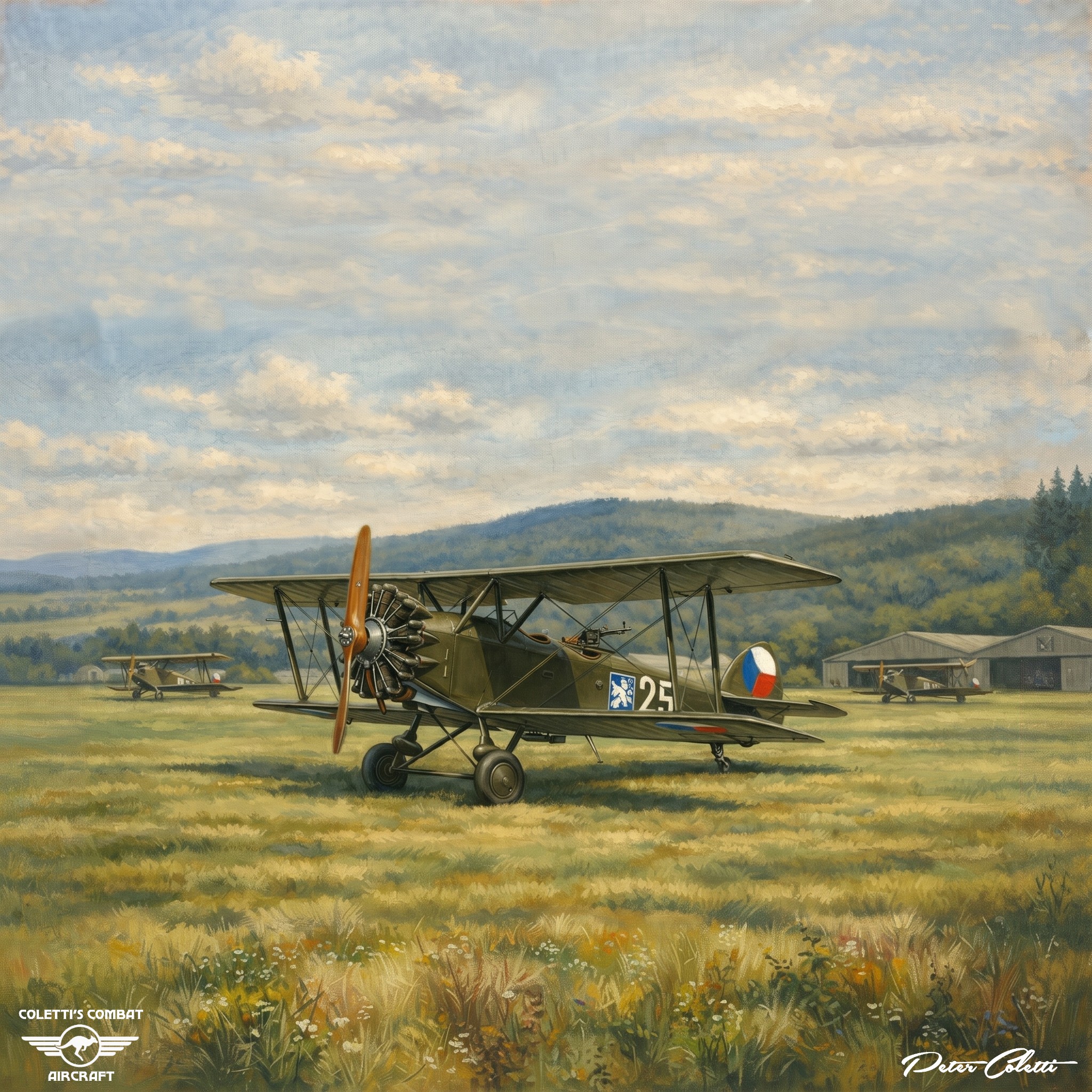
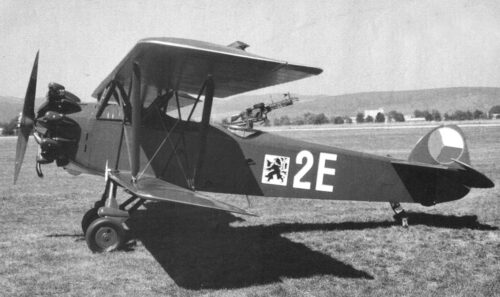
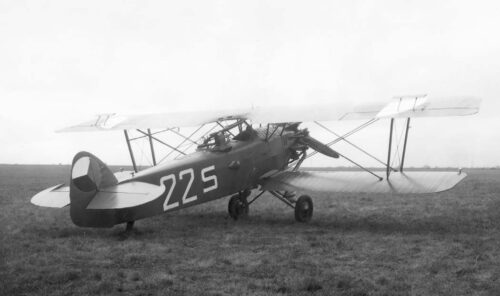
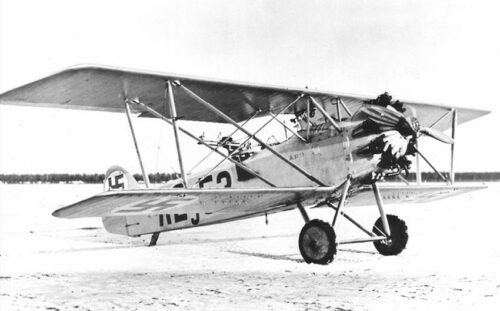
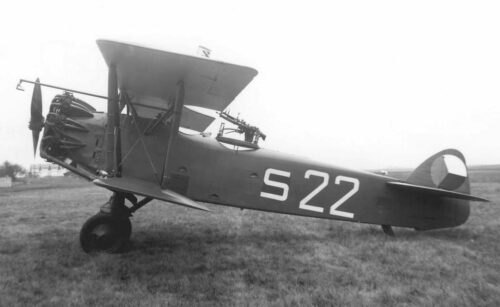
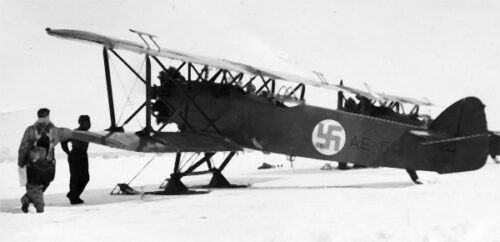
The Aero A.32 was a Czechoslovak light reconnaissance‑bomber biplane of the late 1920s, developed by the Aero company as a modernised successor to the earlier A.11.
Although overshadowed internationally by contemporaries like the Breguet 19 and Potez 25, the A.32 offered comparable capability and was valued for its reliability, simplicity, and ease of production.
Development
Origins
Design work began in 1925, shortly after WWI, and the aircraft’s appearance reflected the conservative design philosophy of the era.
Aero’s engineers intentionally avoided unnecessary innovation, focusing instead on a rugged, low‑maintenance aircraft that could be produced economically and operated easily by the Czechoslovak Air Force.
Design Characteristics
The A.32 retained many characteristics of the earlier Aero A.11, including general layout and some geometric dimensions.
It was a two-seat, mixed-construction, strut-braced biplane with fixed landing gear.
Armament consisted of:
Two 7.7 mm machine guns (observer’s turret)
Up to 100 kg of light bombs
The aircraft was powered by a Bristol Jupiter IV radial engine producing 455 hp, giving it modest but adequate performance for its intended reconnaissance role.
Adoption
Despite being slightly slower than the A.11, the A.32 met the Air Force’s requirements for reliability and manufacturability.
It was officially adopted in 1928, with the expectation that it would replace older reconnaissance types.
In practice, both A.11 and A.32 served concurrently until the early 1930s.
Variants
A.32 (Base Model)
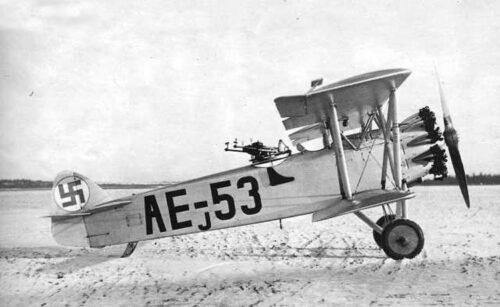
The standard reconnaissance‑bomber version was used by Czechoslovakia and exported to Finland.
Finnish Variant
Finland ordered aircraft fitted with Gnome‑Rhône Jupiter IV engines (licence‑built Jupiter).
One experimental aircraft attempted to use an Isotta‑Fraschini Asso Caccia V‑12, but the trial failed, delaying delivery of the final unit.
Operational History
Czechoslovakia
Entered service in 1928.
Served alongside the A.11 until replaced by the Aero A.100 in 1934–35.
Older A.32s were transferred to training and auxiliary units.
German Capture (1938–39)
After the occupation of Czech territories, several A.32s fell into German hands.
They were quickly scrapped as obsolete and unsuitable for Luftwaffe use.
Slovakia
Five aircraft were taken over by the Slovak Air Force in 1939, assigned to 12. letka as training aircraft.
Three were destroyed during a Hungarian air raid on 24 March 1939.
Finland
Finland was the A.32’s most significant foreign operator.
Ordered 16 aircraft in 1929 (15 delivered promptly; 1 delayed due to engine experiment).
Serial numbers: AEj‑49 to AEj‑64.
Served in units MLE, IlmK, and later ISK.
During the Winter War (1939–40) and Continuation War (1941–44), the A.32s were used exclusively for training, not combat.
All remaining aircraft were retired in 1944.
Role in WWII
By the outbreak of WWII, the A.32 was already obsolete as a front-line aircraft.
Its wartime roles were limited to:
Training (Finland, Slovakia)
Auxiliary duties
Noncombat support
No A.32s are recorded as having flown combat reconnaissance or bombing missions during WWII.
Its significance lies instead in its contribution to pilot training and its place in the interwar evolution of Czechoslovak military aviation.
Conclusion
The Aero A.32 represents a transitional interwar reconnaissance aircraft—technically conservative but dependable, widely used in training roles, and exported successfully to Finland.
While it played no major combat role in WWII, it served as an important stepping stone in Czechoslovakia’s aircraft development lineage and contributed to the preparedness of Finnish aircrews during the war.