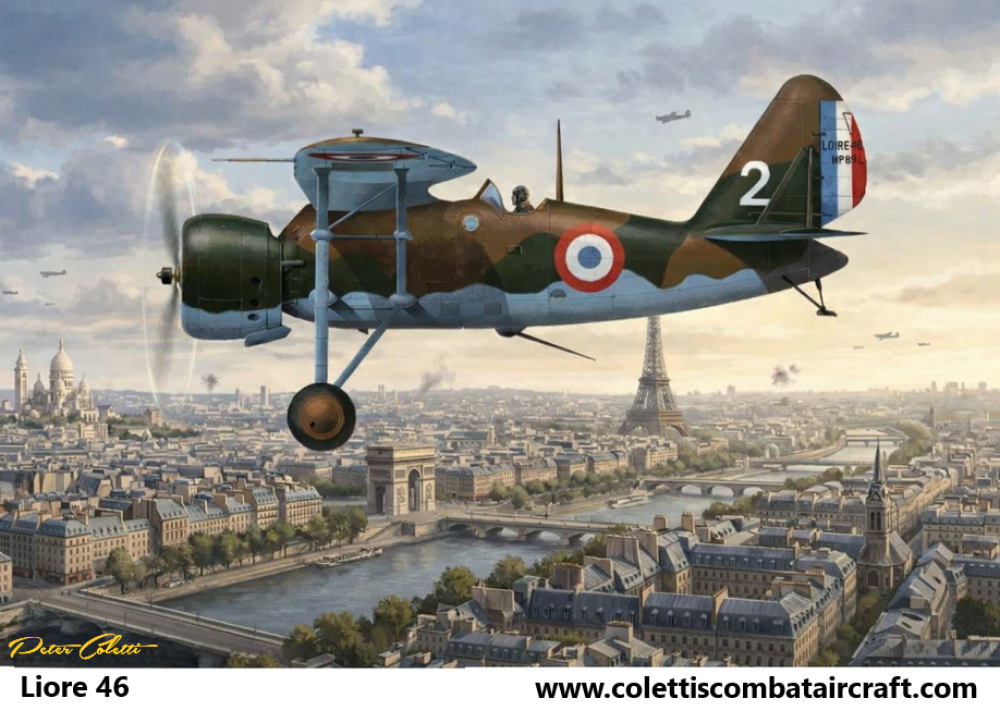
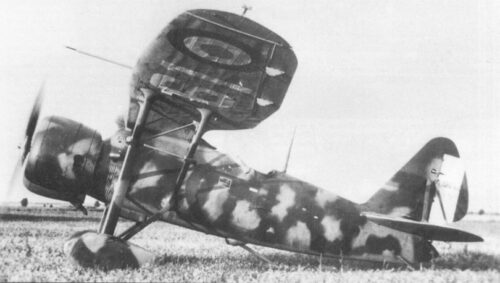
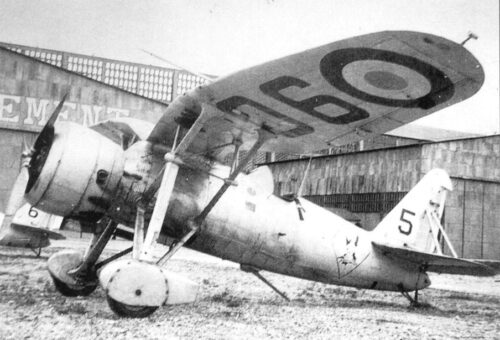
By September 1939, the Loire 46 was already obsolete.
Designed in the early 1930s, its fixed landing gear, open cockpit, and modest performance made it unsuitable for modern air combat.
Deployment
Still in service with several French Air Force squadrons at the start of the war.
Used primarily in training and second-line duties, not frontline combat.
Some aircraft may have been retained for local defence or liaison roles, but they were quickly phased out.
Retirement
The type was fully retired by 1940, following the rapid German advance and collapse of French military infrastructure.
Strategic Context
The Loire 46’s brief wartime role highlights the transitional nature of 1930s aviation.
It was a relic of interwar design philosophy—visually striking but tactically outclassed by faster, better-armed monoplanes like the Morane-Saulnier MS.406 and Dewoitine D.520.
Loire 46.01First Prototype
Origin & Purpose
The Loire 46.01 was the initial prototype of the Loire 46 series, developed by Loire Aviation in France during the early 1930s.
It was intended to modernise the earlier Loire 43 and 45 designs, which had proved unsatisfactory.
Design Features
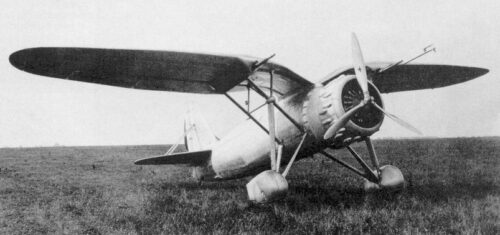
Retained the gull-wing monoplane configuration from its predecessors.
Featured an open cockpit and fixed landing gear, typical of interwar designs.
Incorporated a revised wing-fuselage junction, improving pilot visibility and handling.
First Flight
The Loire 46.01 took to the air on 1 September 1934, demonstrating promising flight characteristics that led to further development and eventual production.
Loire 46Production Model
Type
Single-seat fighter aircraft
Manufacturer
Loire Aviation, France
Production Quantity
61 units built between 1935 and 1936
Operational History
French Air Force
Entered service in 1936 as a frontline fighter
Spanish Civil War
A small number were supplied to the Spanish Republican Air Force.
World War II
By 1939–1940, the Loire 46 was obsolete and relegated to training and secondary roles.
It was retired shortly after the German invasion.
Specifications (Loire 46)
Crew
1
Length
7.88 m (25 ft 10 in)
Wingspan
11.83 m (38 ft 10 in)
Height
4.13 m (13 ft 7 in)
Wing area
19.5 m² (210 sq ft)
Empty weight
1,450 kg (3,197 lbs)
Gross weight
2,100 kg (4,630 lbs)
Powerplant
1 × Gnome-Rhône 14Kfs
14-cylinder air-cooled
radial piston engine,
694 kW (931 hp)
Propellers
3-bladed metal variable-pitch propeller
Performance
Maximum speed
370 km/h (230 mph, 200 kn)
Range
750 km (470 mi, 400 nmi)
Service ceiling
11,750 m (38,550 ft)
Rate of climb
12 m/s (2,400 ft/min)
Time to altitude
3,000 m (9,800 ft) in 3 minutes 18 seconds
Armament
Guns
4× fixed forward-firing 7.5 mm (0.295 inch) MAC 1934 machine guns mounted in the wings.