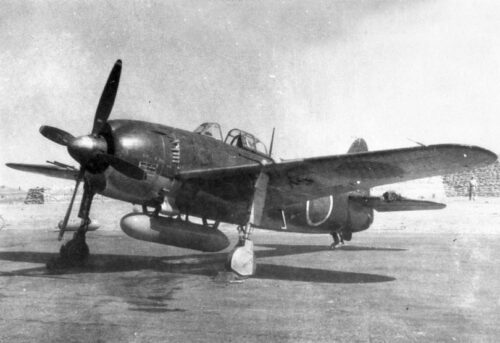
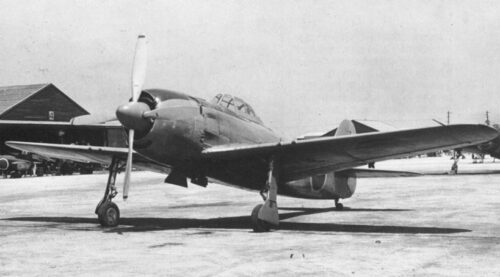
The Kawanishi N1K series was a family of Imperial Japanese Navy fighter aircraft developed in two distinct configurations.
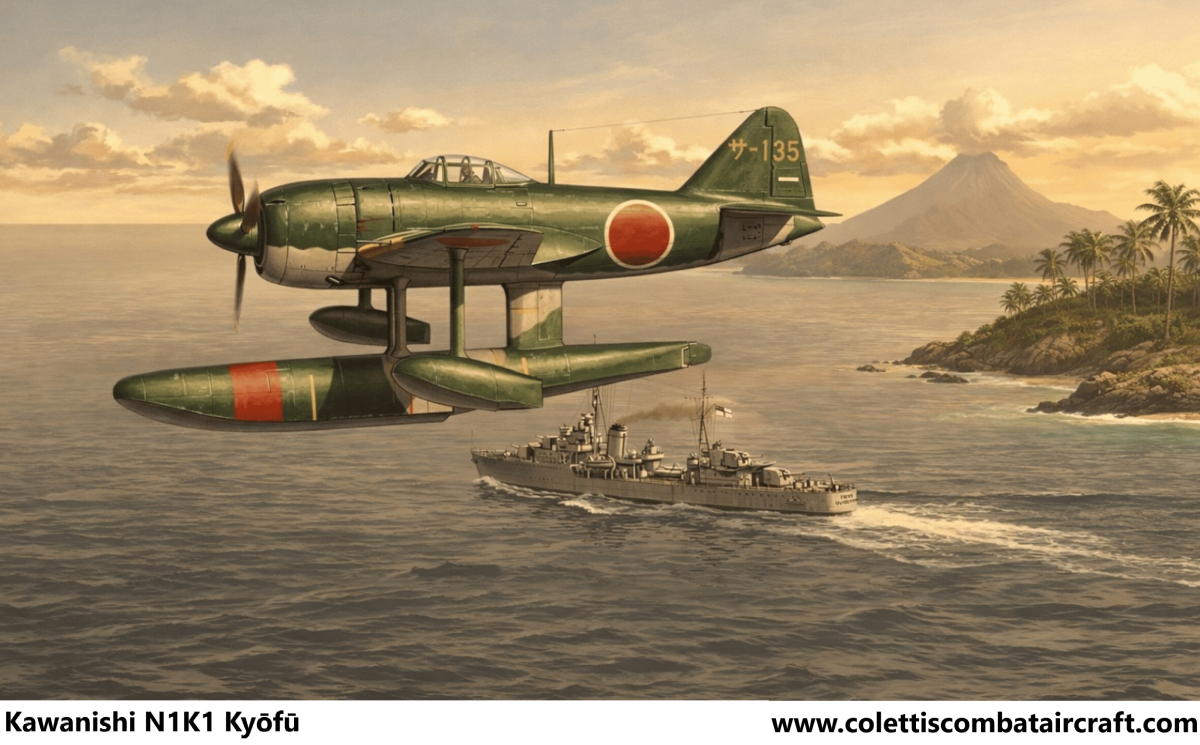
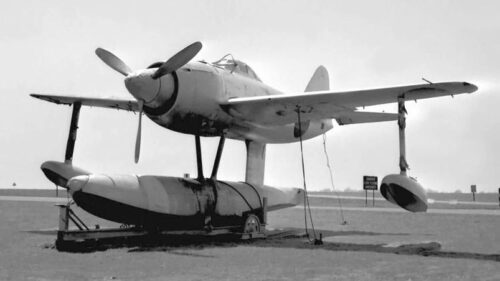
The original N1K1 Kyōfū was a floatplane intended for offensive operations from remote island bases lacking airstrips.
However, its operational relevance diminished as Japan shifted to a defensive posture.
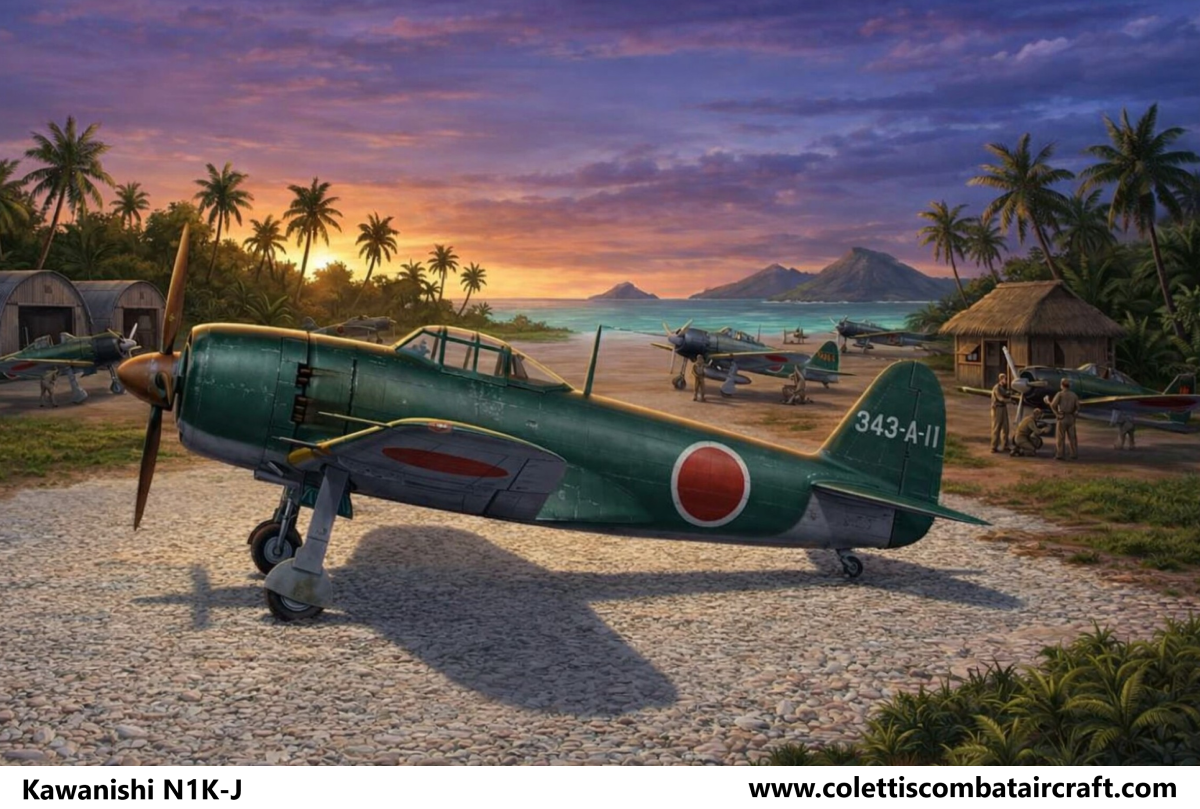
Recognising the limitations of the floatplane concept, Kawanishi engineered a land-based derivative—the N1K1-J Shiden.
Entering service in 1944, the Shiden quickly earned a reputation among Japanese pilots and Allied adversaries alike as one of the most formidable land-based fighters fielded by Japan during the war.
A further refinement, the N1K2-J Shiden-Kai, first flew on 1 January 1944.
This variant featured a redesigned airframe with simplified landing gear, improved aerodynamics, and retained the powerful Homare engine.
Notably, it incorporated an automatic combat flap system activated by a mercury switch, which deployed the flaps during high-G turns to enhance lift and enable tighter manoeuvring—an uncommon feature among Japanese fighters of the era.
Combined with its heavy armament of four wing-mounted 20mm cannons, the Shiden-Kai proved highly effective in skilled hands, particularly in homeland defence and late-war engagements.
N1K1 Kyōfū (Rex) Floatplane Fighter
Role & Deployment
Initially conceived as a floatplane fighter for forward island operations without airstrips.
By the time it entered service in 1943, Japan was on the defensive, limiting its strategic utility.
Combat Use
Saw limited action in South-east Asia, notably from bases in Ambon, the Aru Islands, and Penang.
Participated in the Battle of Okinawa.
Later used in homeland defence from inland waters like Lake Biwa by units such as the Sasebo and Ōtsu Air Corps.
Limitations
The float configuration severely hampered speed and manoeuvrability, making it vulnerable against Allied fighters.
N1K1-J Shiden (George) – Land-Based Fighter
Development
Kawanishi proposed a land-based version in late 1941.
The first flight occurred on 27 December 1942.
Combat Introduction
Entered service in early 1944
Despite engine reliability issues and complex landing gear, it was well-regarded for its firepower and resilience.
Performance
Armed with four 20mm cannons and capable of absorbing significant damage—rare for Japanese fighters of the era.
N1K2-J Shiden-Kai – Refined Land-Based Variant
Design Improvements
Lowered wing position for better visibility and simplified landing gear.
Reduced weight and improved aerodynamics.
Retained the powerful Homare engine.
Combat Deployment
Rushed into service by mid-1944 due to its superior performance.
Operated by elite units like the 343rd Kokutai, commanded by Minoru Genda.
Engaged U.S. Navy aircraft such as the F6F Hellcat and F4U Corsair with notable success.
Legacy
Considered one of the finest Japanese fighters of the war, capable of matching late-war Allied aircraft in skilled hands.
Specifications (N1K1-J)
Crew
1
Length
8.885 m (29 ft 2 in)
Wingspan
12 m (39 ft 4 in)
Height
4.06 m (13 ft 4 in)
Wing area
23.5 m² (253 sq ft)
Airfoil
LB620515-6075
Empty weight
2,897 kg (6,387 lb)
Gross weight
3,900 kg (8,598 lb)
Max take-off weight
4,321 kg (9,526 lb)
Fuel capacity
477 L (126 US gal; 105 imp gal) internal + 323 L (85 US gal; 71 imp gal) drop tank;
maximum 800 L (210 US gal; 180 imp gal)
Powerplant
1 × Nakajima NK9H Homare 21,
18-cylinder air-cooled radial piston engine,
1,473 kW (1,975 hp) at sea level
Propellers
4-bladed,
2.987 m (9 ft 9.6 in) diameter constant-speed propeller
Performance
Maximum speed
571 km/h (355 mph, 308 kn) at 3,500 kg (7,717 lb) at sea level
656 km/h (408 mph) at 6,100 m (20,000 ft)
Range
1,078 km (670 mi, 582 nmi) at 272 km/h (169 mph) at 460 m (1,500 ft)
813 km (505 mi) at 75% Vmax at 391 km/h (243 mph) at 460 m (1,500 ft)
Ferry range
1,746 km (1,085 mi, 943 nmi) maximum with drop tank at 269 km/h (167 mph) at 460 m (1,500 ft)
1,078 km (670 mi) at 75% Vmax at 381.5 km/h (237.1 mph) at 460 m (1,500 ft)
Service ceiling
12,009 m (39,400 ft)
Rate of climb
19.7 m/s (3,880 ft/min) at 3,500 kg (7,717 lb) at sea level
4,065 ft/min at 3,500 kg (7,717 lb) at 1,798 m (5,900 ft)
Time to altitude
3,000 m (10,000 ft) in 2 minutes 36 seconds
6,100 m (20,000 ft) in 5 minutes 36 seconds
Wing loading
166 kg/m² (34 lb/sq ft)
Power/mass
0.38 kW/kg (0.23 hp/lb)
Armament
Guns
4 × 20 mm (0.79 in) Type 99 Mark 2 machine guns in the wings.