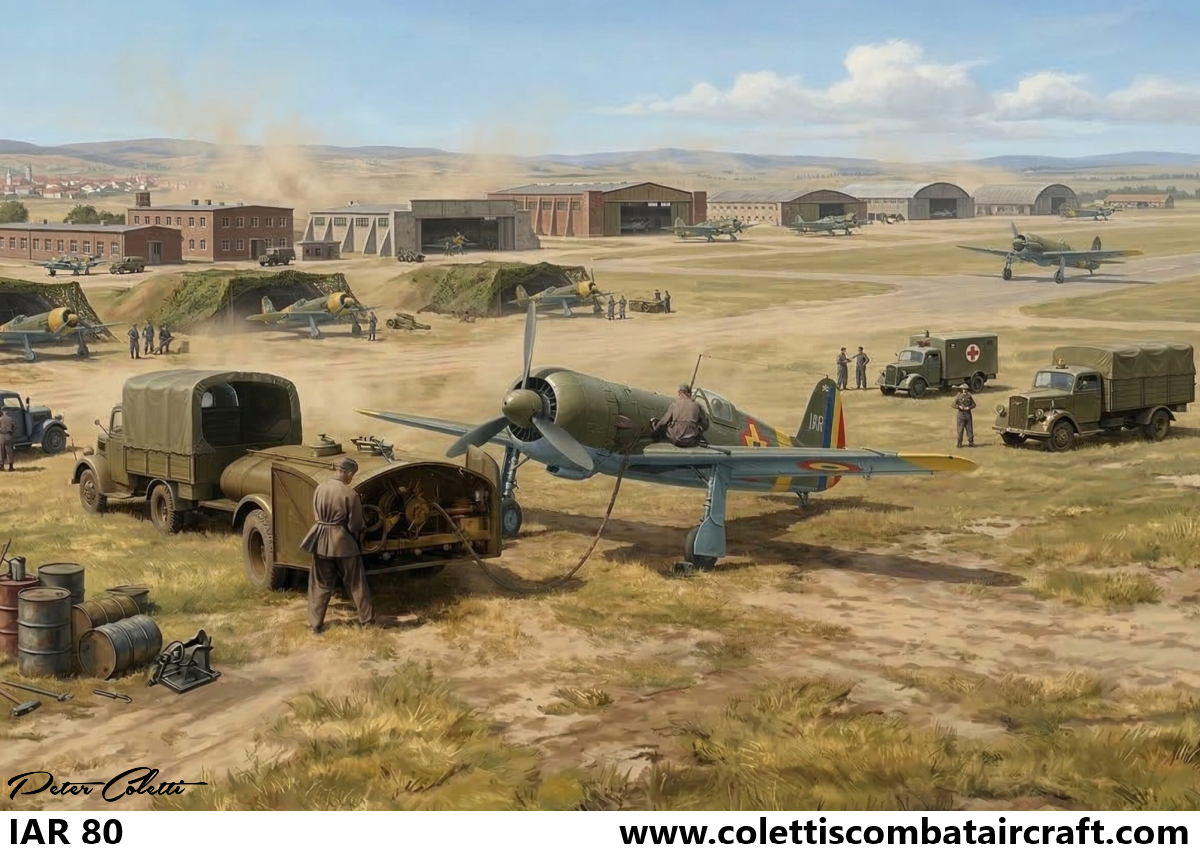
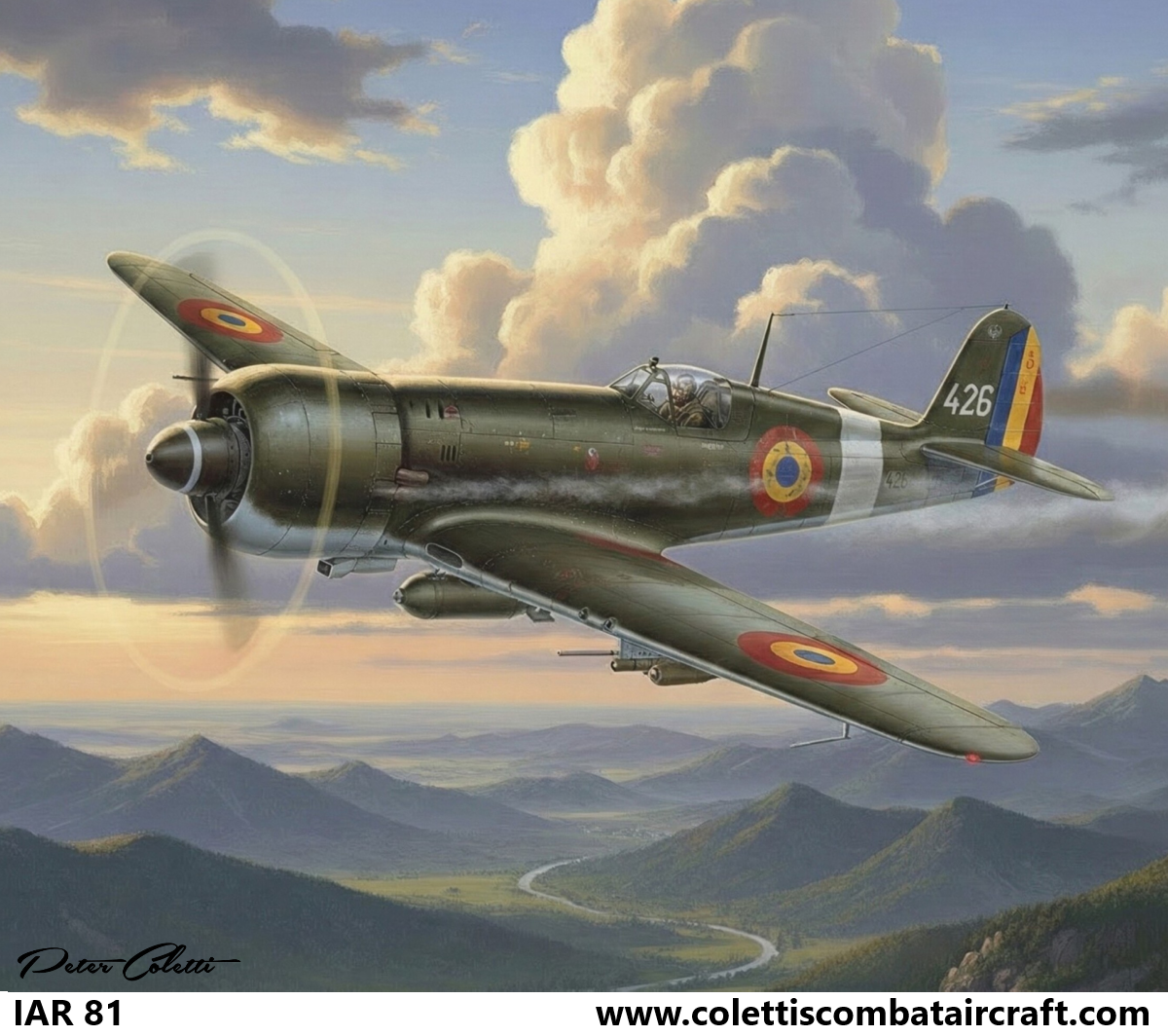
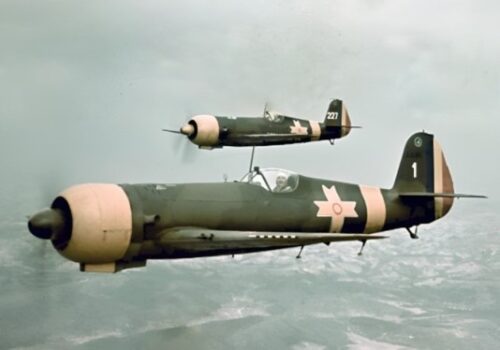
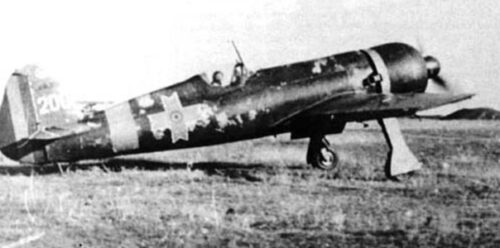
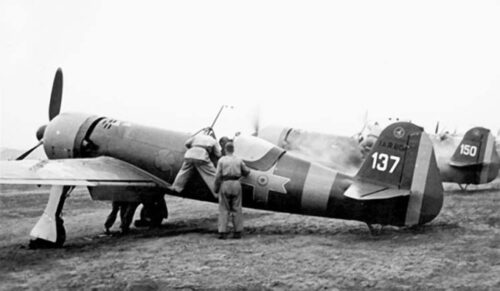
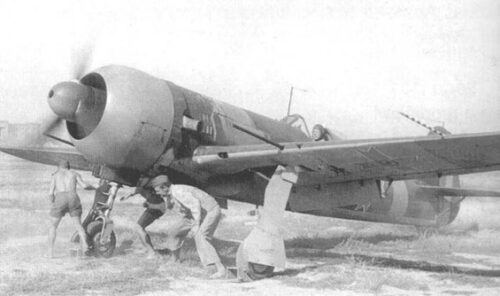
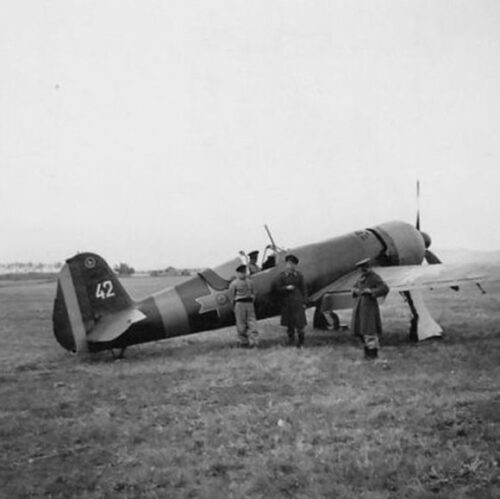
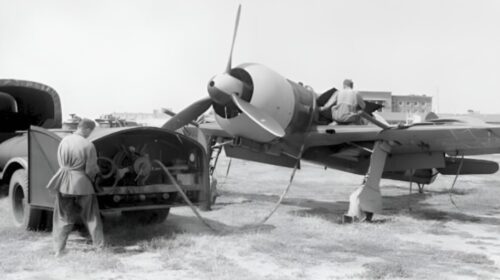
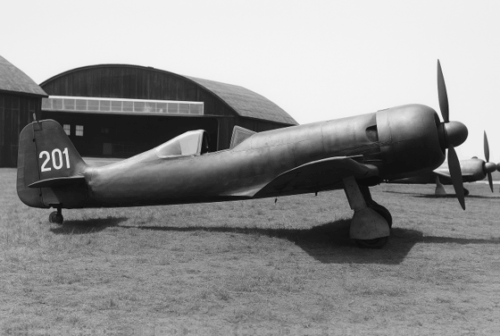
The IAR 80 and its successor, the IAR 81, formed the backbone of Romania’s wartime fighter force.
Introduced in February 1941, the IAR 80 was a nimble, homegrown fighter armed with up to six 7.92 mm FN Browning machine guns.
It saw extensive service on the Eastern Front and played a critical role in defending strategic targets such as the Ploiești oil fields.
By October 1941, the IAR 81A and 81B variants expanded capabilities into the fighter-bomber role, incorporating heavier armament—13.2 mm machine guns and MG FF 20 mm cannons—and enabling dive-bombing operations.
These models proved essential during campaigns such as Stalingrad, where air-to-ground support was pivotal.
The IAR 81C, introduced in 1943, represented the final refinement of the series.
Equipped with dual MG 151/20 cannons alongside two 7.92 mm machine guns, it was tailored for homeland defence during increasingly intense Allied bombing raids.
Though ultimately outpaced by newer aircraft designs, the IAR series remained a symbol of Romania’s technical resilience and contributed meaningfully to its air operations throughout the war.
Work on the IAR 80 began in late 1937, initially featuring an open cockpit and powered by the IAR K14-IIIc32—a 870 hp (650 kW) Romanian-built version of the Gnome-Rhône 14K II Mistral Major radial engine.
Progress was slow, and the prototype did not take to the skies until April 1939.
Despite the delay, early flight tests revealed promising performance: a top speed of 510 km/h (320 mph) at 4,000 m (13,000 ft), a service ceiling of 11,000 m (36,000 ft), and a climb to 5,000 m (16,000 ft) in just six minutes.
Although this was respectable for the era, it still fell short of the contemporary Spitfire and Bf 109 benchmarks.
Design Evolution
Fuselage stretched to accommodate weight distribution
Fuel capacity increased to 455 liters (100 imperial gallons)
Wing area enlarged
The tail was redesigned to eliminate external bracing
A raised pilot seat and bubble canopy added to improve limited forward visibility during taxiing
In competitive trials against the Heinkel He 112, which had recently arrived in Romania for evaluation, the IAR 80 demonstrated superior overall design characteristics.
Although the He 112 featured heavier armament (two machine guns and two 20 mm cannons), the IAR 80 impressed with its agility and practical engineering.
Production Orders
Dec 1939: 100 IAR 80s ordered, compared to 30 He 112s accepted
Aug 1940: Additional 100 IAR 80s
Sep 1941 & Apr 1942: Two batches of 50 aircraft each
May 1942: Further 100 units commissioned
Feb 1943 & Jan 1944: 35 IAR 81C and 15 more aircraft, respectively
IAR 80
Production of the IAR 80 commenced promptly in early 1940, following approval of its design.
However, significant issues with armament immediately hampered progress.
The prototype was equipped with just two Belgian-made Fabrique Nationale 7.92 mm machine guns, licence-built variants of the Browning. 30-calibre.
While suitable for initial testing, this configuration proved insufficient against contemporary combat aircraft.
A standard production configuration was envisioned to include six guns.
In May 1940, the German invasion of Belgium disrupted the supply chain from FN Herstal, and Romanian authorities were unable to secure a viable alternative.
This setback forced a revision of the production armament standard.
Despite these obstacles, the first production airframes were constructed beginning in January 1940.
The maiden flight of the IAR 80 occurred on 10 July, followed by the second prototype on 19 July.
Five aircraft were completed by November, with the first production batch of 20 delivered by mid-February 1941.
By April, all 50 units from the initial order had been supplied to the Royal Romanian Air Force.
Due to persistent supply limitations, early operational IAR 80s carried only four machine guns.
Romanian pilots praised the aircraft’s handling and modern design but criticised its limited engine power and inadequate firepower.
IAR 80A
By April 1941, Romania’s alignment with Germany resulted in increased access to Belgian-made FN 7.92 mm machine guns.
This enabled the IAR 80 to be upgraded to the 80A configuration, finally achieving its intended armament of six machine guns.
In addition to its enhanced firepower, the 80A introduced several defensive and operational improvements, including armoured windscreen glazing, seat-back armour, and a revised gunsight.
Powering this upgraded model was the IAR K14-IVc32 1000A engine, delivering 1,025 hp (764 kW).
However, the structural integrity of the airframe required reinforcement to handle the new engine’s output.
The first 95 examples of the 80A received a duralumin strengthening band behind the cockpit before the fuselage design was permanently revised.
Despite its more powerful engine, the added weight from armament and armour marginally reduced the aircraft’s top speed to 316 mph (509 km/h).
Nonetheless, the 80A represented a clear technological and tactical improvement, replacing earlier models on the production line beginning with the 51st airframe.
A total of eight were operational by the time Romania joined the invasion of the Soviet Union on 22 June 1941.
Due to ongoing shortages of FN guns, additional units were equipped by salvaging armament from retired PZL fighters and reconnaissance aircraft during late 1941 and early 1942.
Operational experience over the Eastern Front revealed that the standard armament of six FN machine guns was insufficient against increasingly resilient targets.
IAR 80B
In response, firepower was enhanced with the installation of 13.2 mm FN heavy machine guns, repurposed from retired Romanian SM.79 bombers.
This upgrade necessitated a redesigned, lengthened wing structure to accommodate the new weaponry.
The improved variant, designated IAR 80B, also addressed previous shortcomings in communications by introducing updated radio equipment.
A total of 55 aircraft were produced between June and September 1942, incorporating these advancements.
Notably, 20 of these airframes were originally slated to be built as IAR 81As and retained their underwing hardpoints, enabling the carriage of either 50 kg (110 lb) bombs or 100-litre (22 imperial gallons; 26 US gallons) drop tanks per wing — enhancing operational versatility.
IAR 81
With Germany unable to supply the Junkers Ju 87, Romania sought an alternative dive bomber design in 1941.
Modifying the existing IAR 80A platform offered a practical solution, streamlining production and preserving resources.
The resulting IAR 81 incorporated a hinged bomb cradle beneath the centreline, designed to safely release a 225 kg (496 lb) bomb past the propeller.
Dive profiles typically ranged from 3,000 to 1,000 metres at speeds approaching 470 km/h.
Pilots criticised the IAR 81 for its performance limitations, primarily due to drag from the centreline bomb cradle.
Of the 50 units ordered in mid-1941, the first 40 were delivered in standard dive bomber configuration.
Subsequent models received 50 kg (110 lb) bomb racks beneath each wing, which also accommodated 100-litre drop tanks—expanding the aircraft’s role to include long-range fighter missions.
IAR 81A
Developed alongside the IAR 80B, the IAR 81A shared its upgraded 13.2 mm armament but retained the centreline bomb rack for dive bombing.
Built on the same production line, the first batch was redirected to fighter units as 80Bs after cancellation of the original order.
A second batch of 10 was commissioned in May 1943 to replace earlier losses, but with the sudden availability of the Ju 87, these too were reassigned for fighter use.
IAR 80C
The IAR 81C marked the final evolution of the IAR 80 series during World War II.
This variant introduced the Mauser MG 151/20 cannons, which replaced the older MG FF/M armament and reflected the transition underway within the Luftwaffe.
The weapon system had only recently become available for Romanian use when the 81C order was placed in May 1942 — notably preceding the second production batch of the earlier 81A model.
An initial contract for 100 aircraft was fulfilled with modifications consistent with prior upgrades in the 81 series, including the removal of the centreline bomb rack to optimise the type for fighter duties.
Supplementary orders followed: 35 aircraft in February 1943 and an additional 15 units in January 1944.
These latter batches were primarily intended to offset attrition among earlier variants as Romania increased its reliance on the Bf 109G, which was entering large-scale production by that time.
IAR 81M
By mid-1944, the Romanian Air Force (ARR) frontline fighter units fielded a diverse mix of IAR 80 and 81 variants—including A, B, and C subtypes alongside the newer 81C.
To streamline armament logistics and elevate combat capability, a standardised upgrade initiative was launched to retrofit existing airframes to the 81C weapon configuration: two Mauser MG 151/20 cannons paired with two FN 7.92 mm machine guns.
This retrofit process led to the designation of converted IAR 80A and 80B models as IAR 80M, while similarly modified IAR 81 aircraft became the IAR 81M.
By this stage, dive-bombing operations had largely ceased, and no dedicated dive bombers were active in Romanian service.
Precise production figures for the M-series conversions remain undocumented, leaving the scope of implementation uncertain.