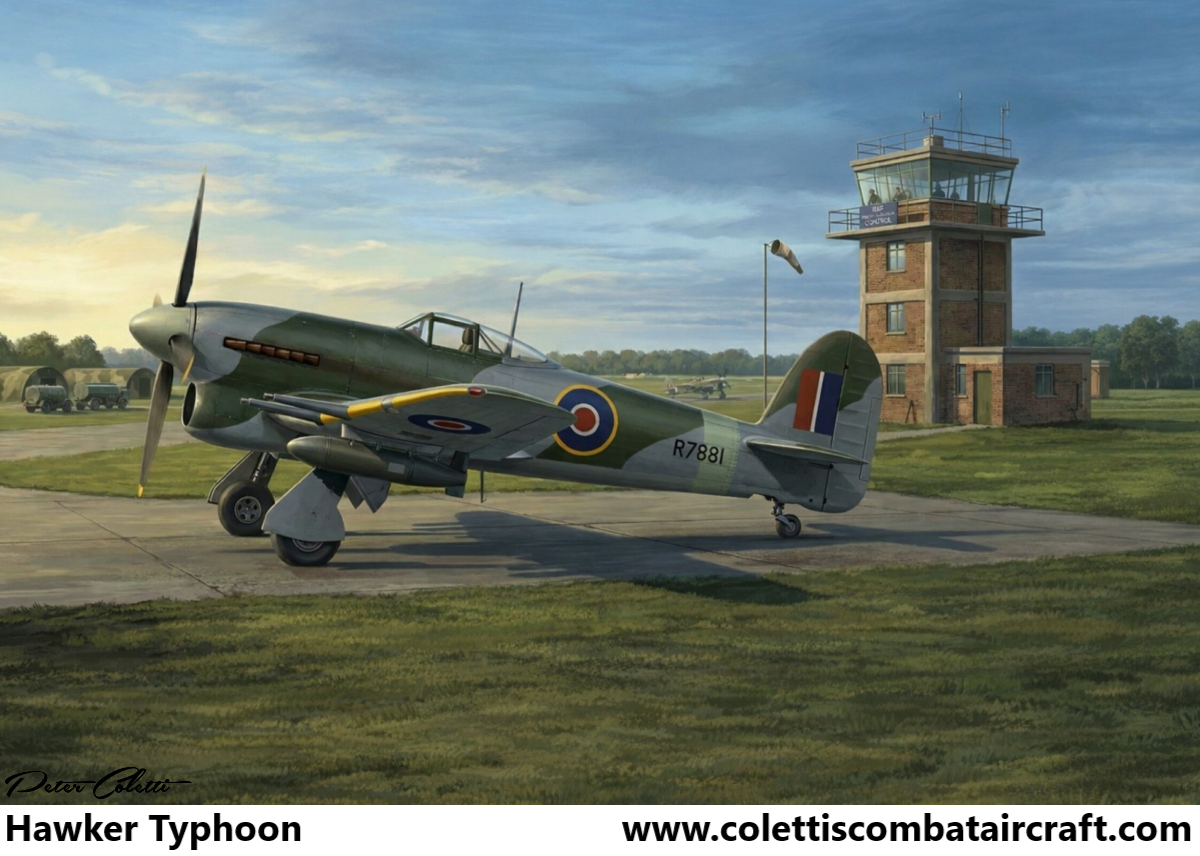
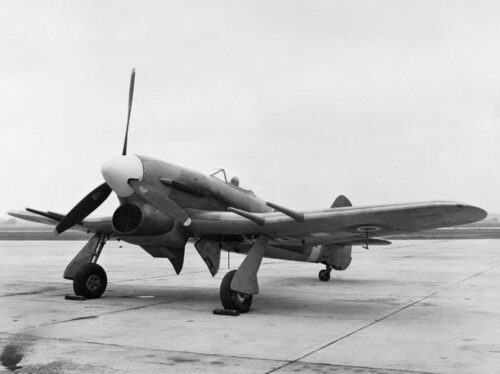
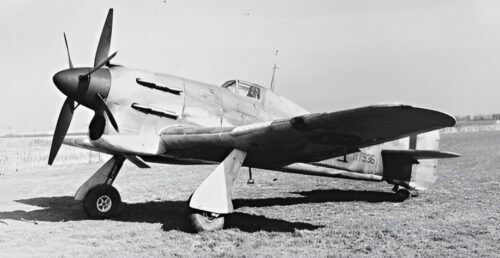
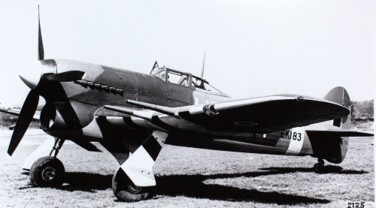
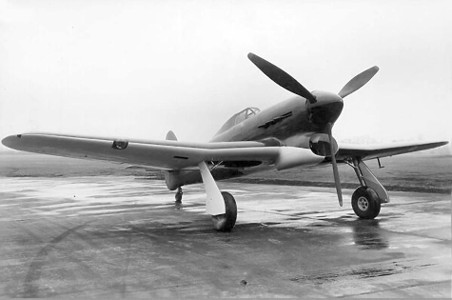
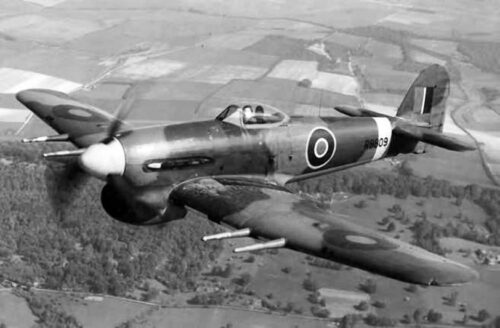
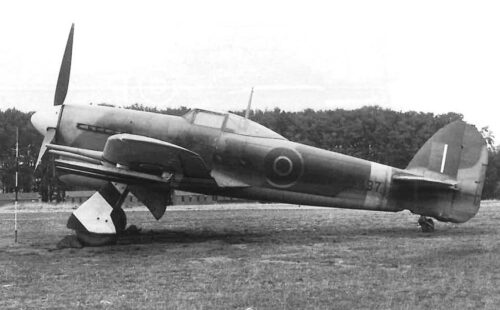
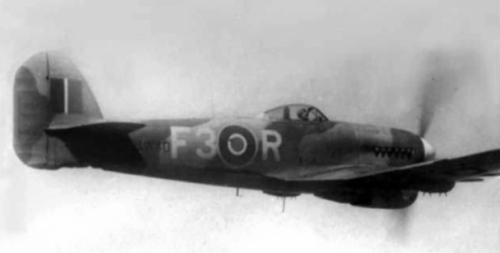
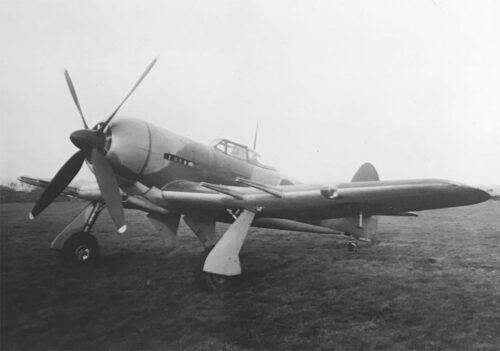
Originally conceived as a high-speed interceptor to replace the Hawker Hurricane, the Typhoon faced early setbacks but evolved into one of the Allies’ most formidable ground-attack aircraft.
Early Challenges
Engine Issues
The Napier Sabre engine, while powerful (2,000 hp), suffered from overheating and mechanical failures.
Structural Weaknesses
Tail flutter at high speeds led to catastrophic failures, mitigated by external fishplates (Modification 286).
Cockpit Safety
Carbon monoxide leaks were resolved with Modification 239.
Role Evolution
Initially deployed as a low-altitude interceptor, especially effective against the Focke-Wulf Fw 190.
Transitioned into a fighter-bomber by late 1942, earning the nickname “Bombphoon” when equipped with 1,000 lb bombs.
By 1943, armed with RP-3 rockets, it became a feared tank buster.
Key Engagements
Southern England (1942)
Countered Luftwaffe “tip-and-run” raids.
Normandy Campaign (1944)
Played a decisive role in disrupting German armour and logistics.
Notably, Typhoons destroyed 137 tanks in a single day during the Falaise Pocket.
Western Europe (1944–45)
Provided close air support, interdicted supply lines, and attacked retreating forces with devastating effect.
Armament & Tactics
Primary Weapons
Four 20 mm Hispano cannons.
Secondary Loadouts
RP-3 rockets, bombs, and drop tanks.
Tactics
Low-altitude, high-speed strikes against convoys, bridges, and fortified positions.
Legacy
Retired in October 1945, having flown over 3,300 units.
Paved the way for the Hawker Tempest and influenced postwar ground-attack doctrine.
Prototype Development History
Origins
In 1937, Hawker Aircraft’s chief designer, Sydney Camm, began work on a successor to the Hurricane, anticipating future Air Ministry requirements.
The project was initiated under Specification F.18/37, which called for a high-performance single-seat fighter powered by either the Napier Sabre or the Rolls-Royce Vulture engine — both 24-cylinder designs exceeding 2,000 hp.
Dual-Engine Approach
Two parallel prototypes were developed
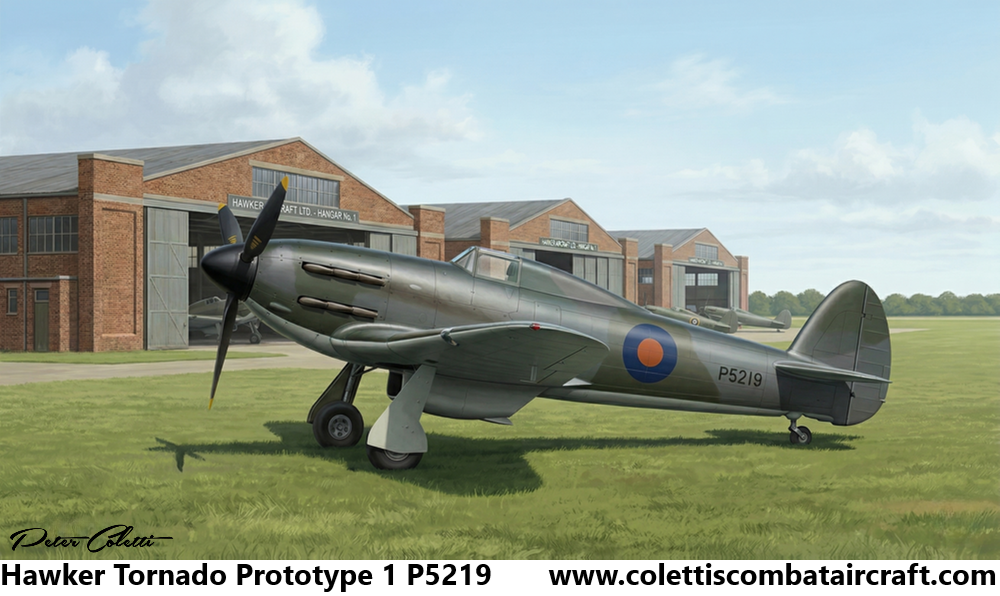
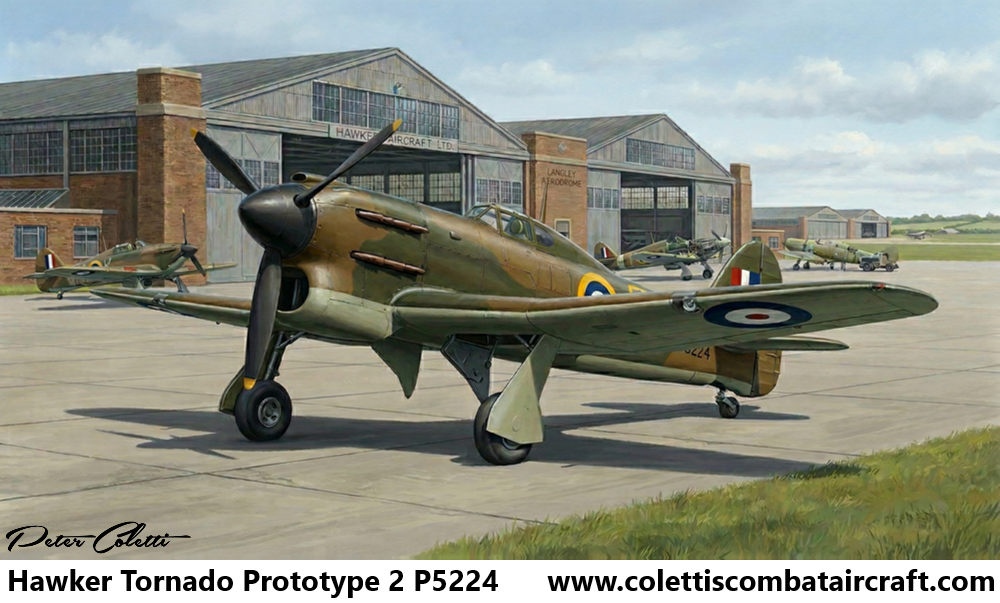
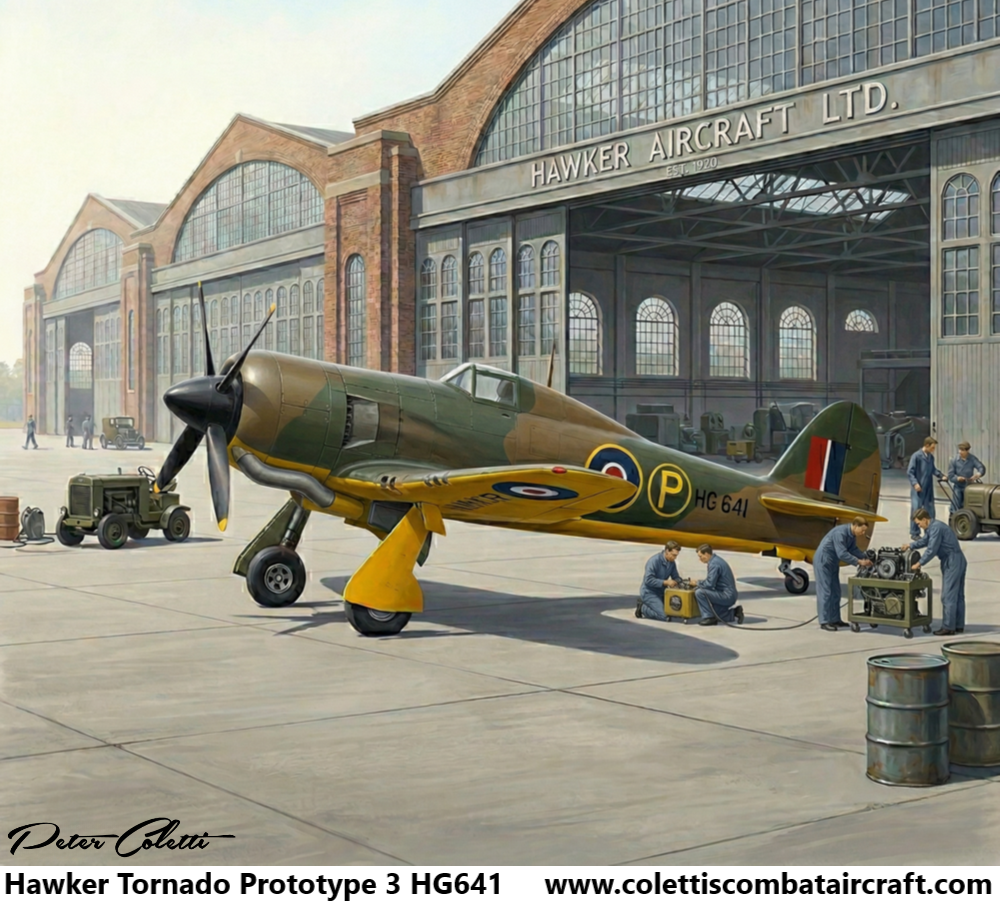
Hawker Tornado
Vulture-powered variant.
Hawker Typhoon
Sabre-powered variant.
The Tornado was eventually abandoned due to persistent engine issues and limited development support from Rolls-Royce.
First Typhoon Prototype
Serial Number
P5212.
First Flight
24 February 1940.
Configuration
Powered by the Napier Sabre I engine.
Featured a small tail unit and a solid fairing behind the cockpit.
Access was via “car door” side hatches.
Initial trials revealed structural weaknesses and engine reliability issues, particularly overheating and poor altitude performance.
Second Typhoon Prototype
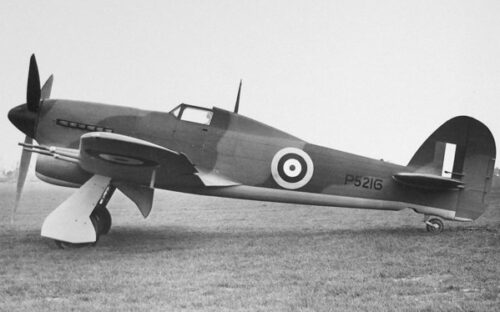
Serial Number
P5216.
Incorporated refinements based on feedback from P5212.
Continued to suffer from Sabre engine teething problems,
Though Napier’s dedicated development eventually stabilised performance.
Production Variants
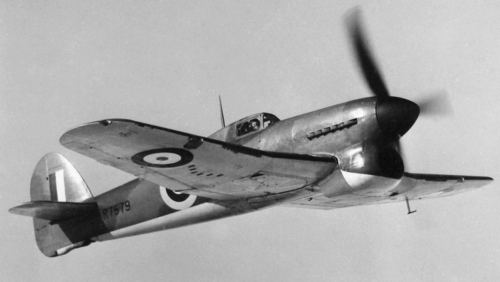
The Hawker Typhoon underwent several refinements during its production run from 1941 to 1945, resulting in two principal variants: the Typhoon IA and Typhoon IB.
Though initially plagued by design and engine issues, the aircraft matured into a formidable ground-attack platform.
Production Shifts
Initial Production
Hawker Aircraft built the first 15 Typhoons.
Main Production
Transferred to Gloster Aircraft Company at Hucclecote, which manufactured the remaining aircraft.
First Gloster-built Typhoon
R7576, flown on 27 May 1941.
Notable Modifications
Modification 286
External fishplates were added to reinforce the tail section.
Modification 239
Addressed cockpit carbon monoxide leaks.
Late-War Adaptations
Enhanced ground-attack capabilities with rockets and improved targeting systems.
Typhoon 1A
Armament
Twelve .303-inch Browning machine guns.
Production
Very limited; only a small number were built before the variant was discontinued.
Purpose
Intended as a high-speed interceptor.
Issues
Poor altitude performance and structural weaknesses led to its rapid replacement.
Typhoon 1B
Armament
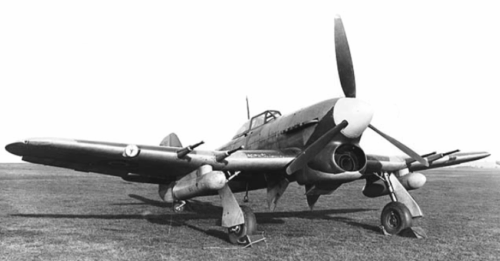
Four 20 mm Hispano Mk II cannons.
Production
The definitive version, with over 3,300 units built.
Enhancements
Strengthened airframe.
Improved cockpit ventilation and pilot protection.
Capability to carry bombs (1,000 lbs) and later RP-3 rockets.
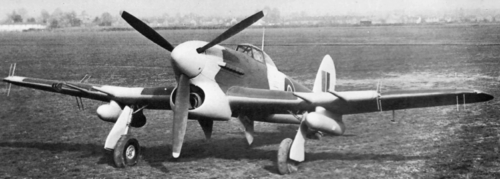
Introduction of four-blade propellers and enlarged tailplane for stability.
Roles
Fighter-bomber, close air support, and tank buster.
Specialised Variants
While the Typhoon IB was the principal production model, several specialised variants and experimental adaptations were developed to expand its operational versatility.
These variants explored improvements in armament, reconnaissance, and aerodynamic performance.
Typhoon FR IB (Fighter Reconnaissance)
Purpose
Tactical reconnaissance.
Modifications
Equipped with vertical and oblique cameras in the rear fuselage.
Retained standard armament for self-defence.
Operational Use
Limited deployment for battlefield photography and post-strike assessment.
Typhoon IB (Bubble Canopy Conversion)
Purpose
Improve pilot visibility.
Modifications
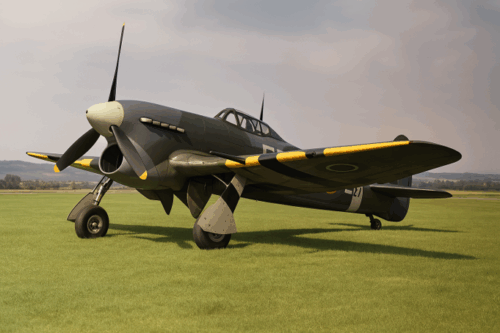
Replaced the original “car door” cockpit with a one-piece sliding bubble canopy.
Became standard from late 1943 onward.
Impact
Enhanced situational awareness and pilot survivability.
Typhoon IB (RP-3 Rocket Variant)
Purpose
Anti-armour and ground attack.
Modifications
Fitted with four underwing rails for eight RP-3 rockets.
Required reinforced wing structure and revised electrical systems.
Operational Use
Highly effective in the Normandy campaign and Falaise Pocket, credited with destroying large numbers of German tanks.
Tropicalised Typhoon
Purpose
Evaluate performance in hot climates.
Modifications
Added dust filters and revised cooling systems.
Tested in Middle East and India, but not adopted for mass production.
Outcome
Trials revealed limited suitability; focus remained on European theatre.
Experimental High-Altitude Typhoon
Purpose
Assess viability for high-altitude interception.
Modifications
Featured a pressurised cockpit and extended wingtips
Powered by uprated Sabre IIC engine.
Outcome
Abandoned due to poor performance at altitude and shift in tactical priorities.
Night Fighter History
Concept & Development
In 1943, the RAF explored adapting the Typhoon IB for night interception, aiming to counter nocturnal Luftwaffe raids.
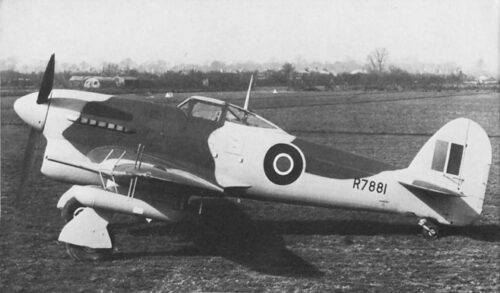
The prototype, Typhoon N.F. Mk IB, was based on airframe R7881, modified for night operations.
Modifications
Radar Installation
Fitted with AI (Airborne Interception) radar, likely the AI Mk IV or Mk V, housed in a nose radome.
Cockpit Adaptations
Special night-flying instrumentation.
Enhanced internal lighting and blackout shielding.
External Changes
Flame dampers on exhausts to reduce visibility.
Operational Evaluation
The night fighter variant underwent limited trials but was never adopted for widespread service.
Challenges included;
Poor high-altitude performance.
Limited radar integration compared to dedicated night fighters like the Mosquito.
Engine reliability concerns during extended night sorties.
Specifications
Crew
One
Length
31 ft 11.5 in (9.741 m)
Wingspan
41 ft 7 in (12.67 m)
Height
15 ft 4 in (4.67 m)
Wing area
279 sq ft (25.9 m²)
Airfoil
Root
NACA 2219
Tip
NACA 2213
Empty weight
8,840 lb (4,010 kg)
Gross weight
11,400 lb (5,171 kg)
Max take-off weight
13,250 lb (6,010 kg) with two 1,000 lb (450 kg) bombs
Powerplant
1 × Napier Sabre IIA, IIB or IIC
H-24 liquid-cooled sleeve-valve piston engine,
2,180 hp (1,630 kW)
Sabre IIB
2,200 hp (1,600 kW)
Sabre IIC
2,260 hp (1,690 kW)
Propellers
3- or 4-bladed de Havilland or Rotol constant-speed propeller
Performance
Maximum speed
422 mph (679 km/h, 367 kn) at 12,500 ft (3,800 m) with Sabre IIA & 4-bladed propeller
Stall speed
88 mph (142 km/h, 76 kn)
Range
510 mi (820 km, 440 nmi) with two 500 lb (230 kg) bombs; 690 mi (1,110 km) “clean”;
1,090 mi (1,750 km) with two 45 imperial gal (200 L, 54 US gal) drop tanks.
Service ceiling
31,800 ft (9,700 m)
Rate of climb
2,740 ft/min (13.9 m/s) F.S supercharger at 3,700 rpm and 14,300 ft (4,400 m)
Wing loading
40.9 lb/sq ft (200 kg/m²)
Power/mass
0.20 hp/lb (0.33 kW/kg)
Armament
Guns
4 × 20 mm (0.787 in) Hispano Mk II cannon
Rockets
8 × RP-3 unguided air-to-ground rockets.
Bombs
2 × 500 lb (230 kg) or 2 × 1,000 lb (450 kg) bombs.