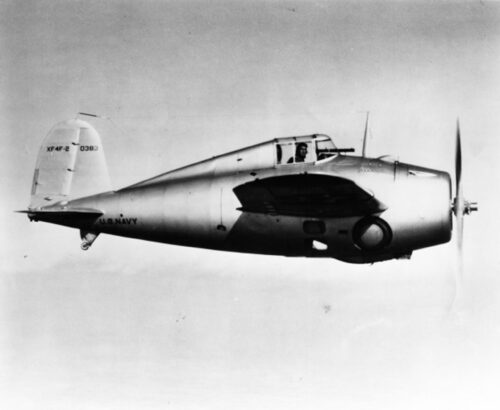
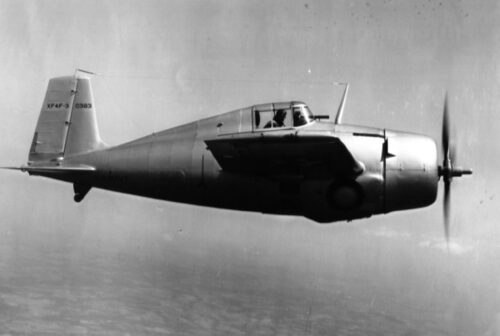
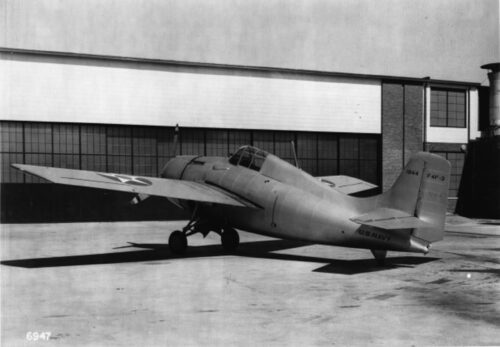
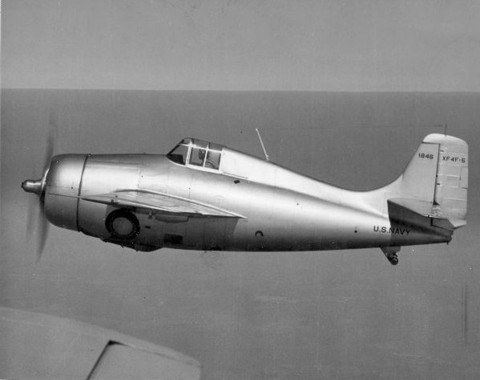
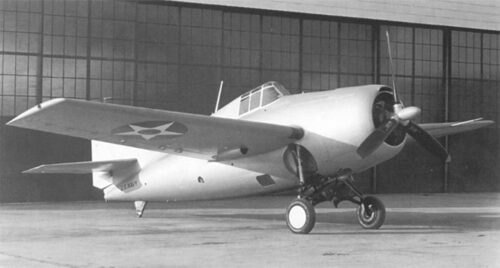
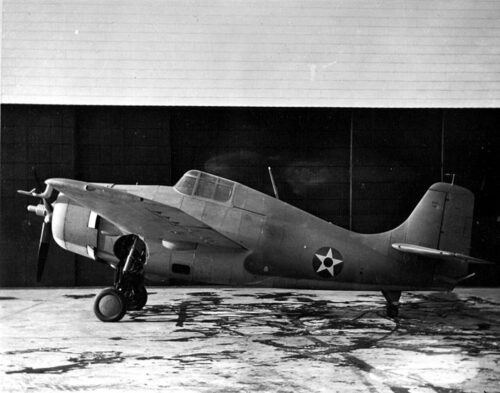
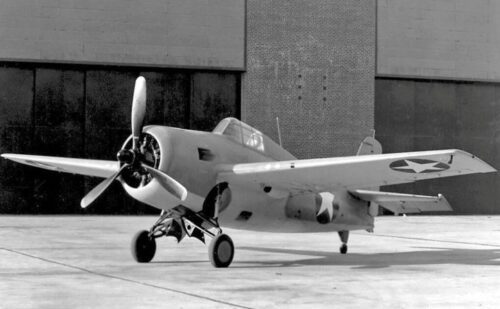
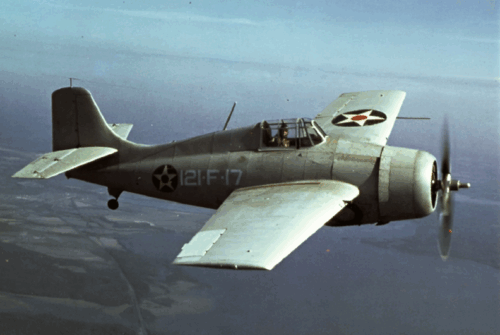
Built as an “insurance policy” in case the Twin Wasp engine supply faltered
Outcome
Demonstrated adequate performance but was not adopted for production; the Navy preferred the Twin Wasp’s two-stage supercharging for high-altitude capability.
XF4F-6
Purpose
Evaluation of alternative supercharging
Engine
Pratt & Whitney R-1830-90 Twin Wasp with single-stage, two-speed supercharger
Significance
Served as a test platform for optimizing engine performance at various altitudes
Outcome
Contributed data for refining the F4F-3A and later production models.
XF4F-7
Long-Range Photo Reconnaissance Wildcat
Modifications
Airframe
Based on F4F-3 with major internal changes.
Fuel
Enlarged tanks raised capacity to 555 gallons.
Armament
Removed entirely to reduce weight.
Cameras
Fuselage-mounted for vertical and oblique shots.
Operational Use
Only one prototype built.
Not adopted for production due to newer aircraft like the F6F and F8F.
XF4F-8
First Flight
8 November 1942
Purpose
Prototype for escort carrier operations
Engine
Wright R-1820-56 Cyclone, rated at 1,350 hp
Design Changes
Lighter airframe
Taller tail fin for improved stability
Optimized for short-deck take-offs and landings
Legacy
Direct precursor to the FM-2 Wildcat, mass-produced by General Motors for escort carriers.
F4F-3
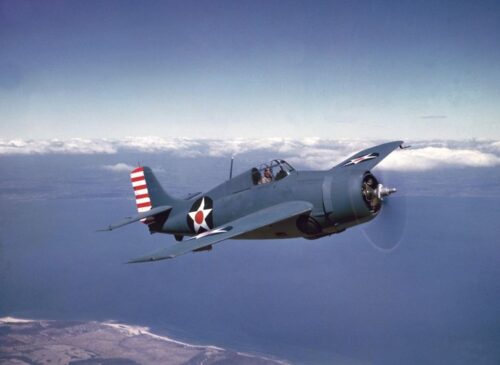
Initial production fighter: two-stage supercharged engine, four .50 calibre guns.
F4F-3A
Variant with single-stage supercharger; reduced high-altitude performance.
F4F-4
Folding wings for carrier storage; six .50 calibre guns; slightly heavier.
General Motors Eastern Aircraft Division Variants
FM-1
Based on F4F-4; retained folding wings; reverted to four guns to reduce weight.
FM-2
Lighter airframe; more powerful Wright R-1820 engine; taller tail fin for stability; optimised for escort carrier operations.
British Fleet Air Arm Variants (Martlet Series)
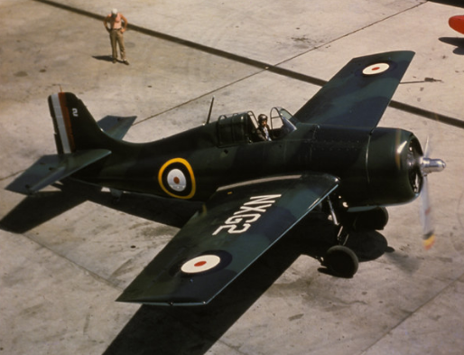
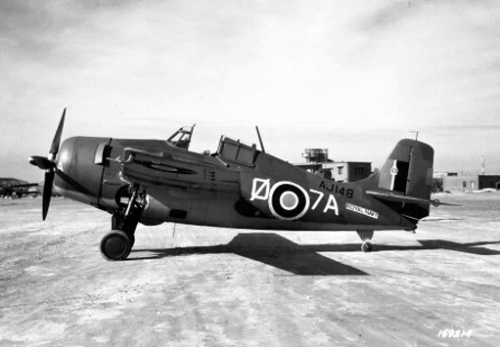
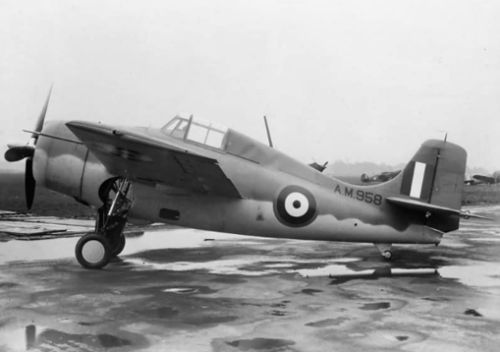
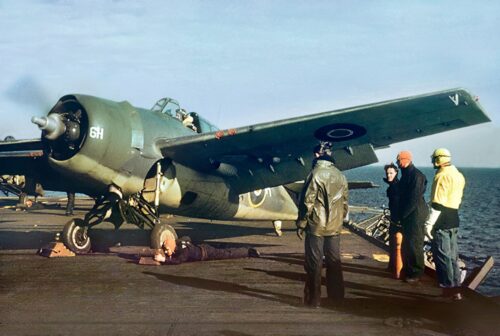
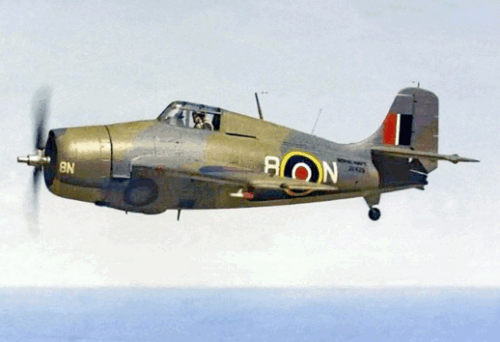
Martlet I
Export version of the G-36A; fixed wings; French contract redirected to Britain.
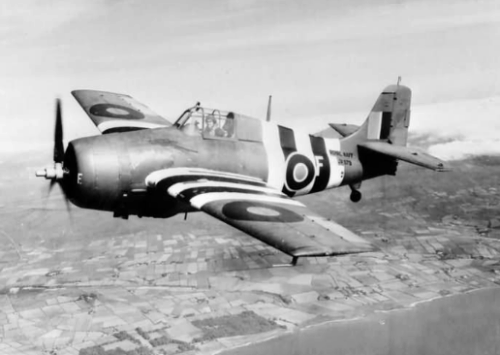
Martlet II
Equivalent to F4F-3; used by Royal Navy with minor modifications.
Martlet III
Mixed batch of aircraft, including ex-French and ex-U.S. Navy models.
Martlet IV
British designation for FM-1.
Martlet V
British designation for FM-2.
Martlet VI
Final British variant; equivalent to late FM-2 models.
The Wildcatfish Floatplane
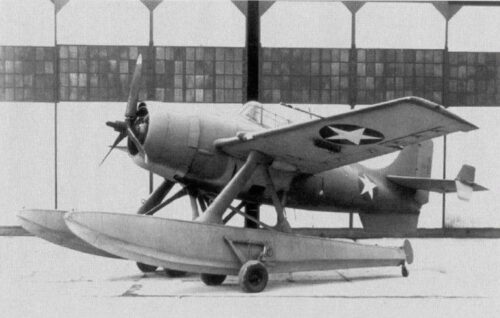
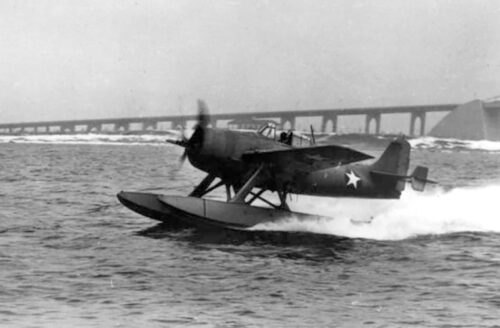
The F4F-3S “Wildcatfish” was a float-equipped adaptation of the Grumman F4F-3 Wildcat, developed for potential operations from remote island bases in the Pacific prior to the establishment of airfields.
The concept was influenced by the Japanese A6M2-N “Rufe”, a floatplane derivative of the Mitsubishi A6M2 “Zeke”.
Bureau Number 4038 was selected for conversion.
Edo Aircraft Corporation supplied the twin floats, which were installed beneath the fuselage.
To compensate for the altered aerodynamics and maintain stability, small auxiliary fins were added to the tailplane.
These proved insufficient, prompting the later addition of a ventral fin.
The F4F-3S made its first flight on 28 February 1943.
However, the added weight and drag of the floats significantly reduced its performance, limiting top speed to 241 mph (388 km/h).
Given that the standard F4F-3 already lagged behind the A6M Zero in combat capability, the floatplane version offered little operational advantage.
Ultimately, rapid airfield construction by U.S. Navy Seabees rendered the floatplane concept obsolete.
Only a single aircraft was converted.
Specifications (F4F-3)
Crew
1
Length
28 ft 9 in (8.76 m)
Wingspan
38 ft 0 in (11.58 m)
Height
11 ft 10 in (3.61 m)
Wing area
260 sq ft (24 m²)
Airfoil
Root
NACA 23015
Tip
NACA 23009
Empty weight
4,907 lb (2,226 kg)
Gross weight
7,423 lb (3,367 kg)
Powerplant
1 × Pratt & Whitney R-1830-76,
14-cylinder air-cooled radial piston engine,
1,200 hp (890 kW)
Propellers
3-bladed constant-speed propeller
Performance
Maximum speed
331 mph (533 km/h, 288 kn)
Range
845 mi (1,360 km, 734 nmi)
Service ceiling
39,500 ft (12,000 m)
Rate of climb
2,303 ft/min (11.70 m/s)
Wing loading
28.5 lb/sq ft (139 kg/m²)
Power/mass
0.282 kW/kg (0.172 hp/lb)
Armament
Guns
4 × 0.50 in (12.7 mm) AN/M2 Browning machine guns with 450 rounds per gun