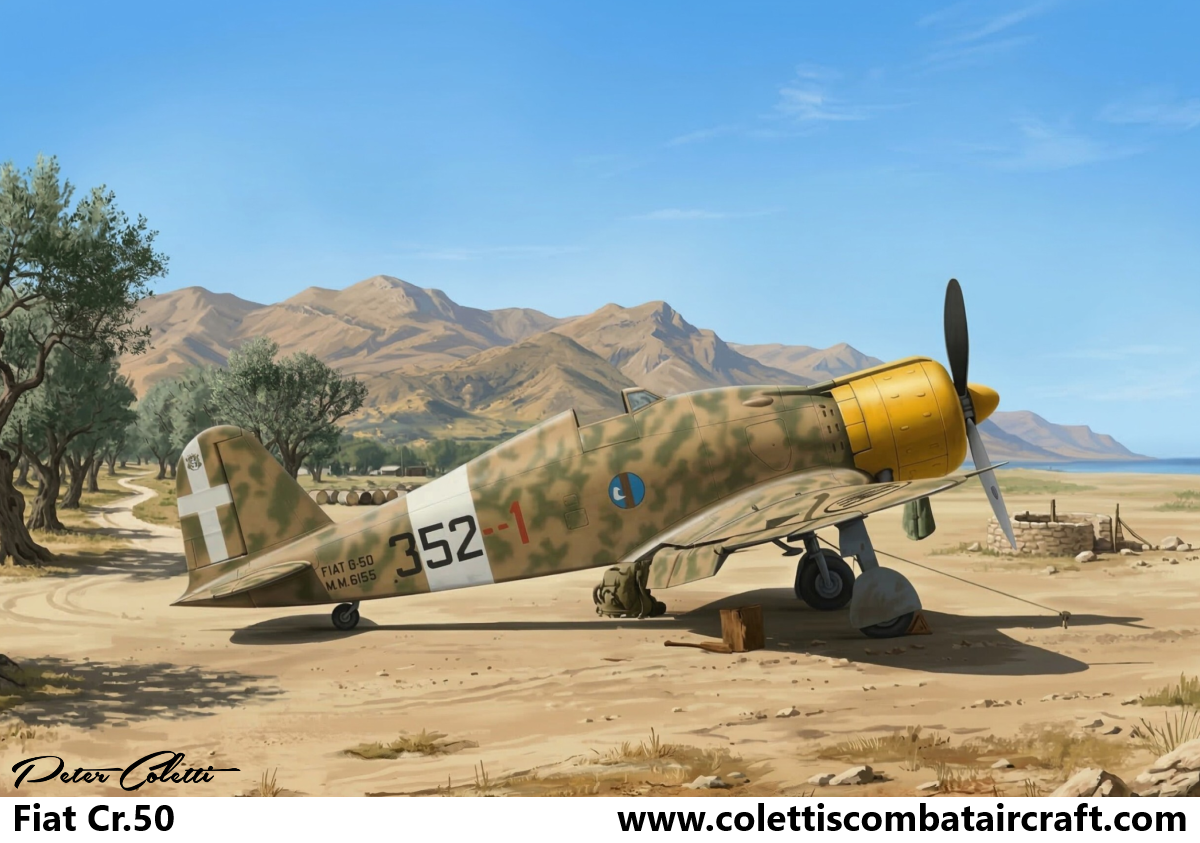
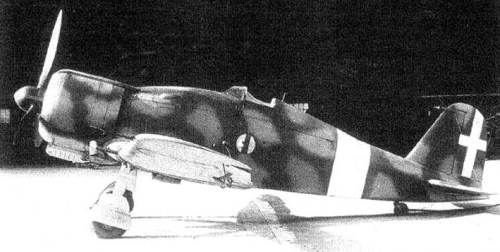
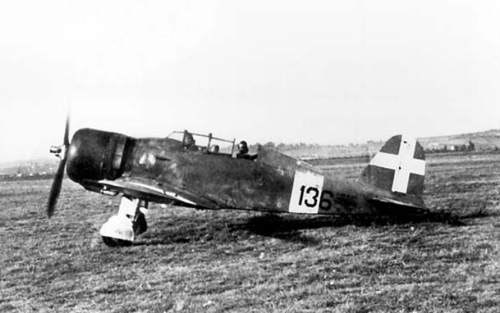
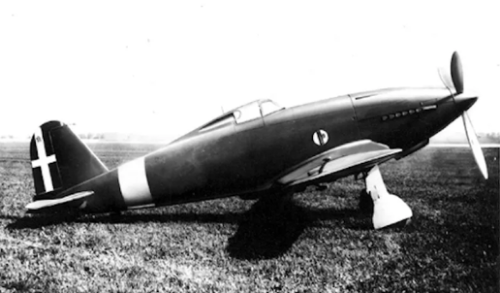
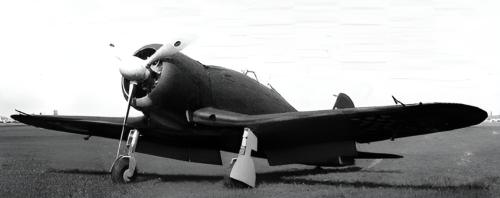
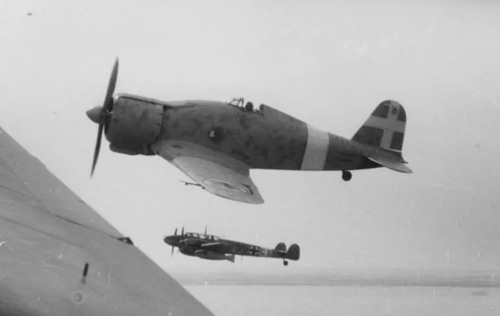
The Fiat G.50 Freccia (“Arrow”) was Italy’s first all-metal monoplane fighter with an enclosed cockpit and retractable undercarriage.
Designed by Giuseppe Gabrielli, it entered service in 1938 and saw action across multiple theatres during World War II.
Early Deployment
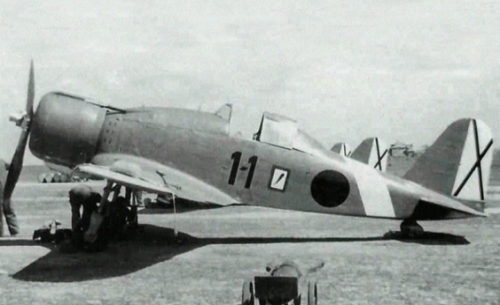
Spanish Civil War (1938–1939)
A small number of G.50s were dispatched to support the Aviazione Legionaria.
They performed adequately, demonstrating good manoeuvrability and speed.
Pre-War Production
By June 1940, Italy had 118 G.50s available, with 97 ready for frontline service.
European Operations
Battle of Britain (1940)
G.50s operated from Belgium alongside the Luftwaffe.
Their limited range and weak armament (two 12.7 mm Breda-SAFAT machine guns) made them ill-suited for extended missions over England.
Balkans Campaign (1941)
G.50s supported Italian operations in Yugoslavia and Greece, facing mixed success due to terrain and evolving Allied air superiority.
North African Theatre
Libya and Egypt (1940–1942)
G.50s were deployed in desert conditions, often outclassed by British Hurricanes and P-40s.
Their short range and lack of armour limited effectiveness in prolonged engagements.
Eastern Front
Finnish Service (1939–1944)
Finland received 35 G.50s, which performed exceptionally during the Winter War and Continuation War against the Soviet Union.
Finnish pilots achieved a reported kill/loss ratio of 33:1, aided by superior tactics and maintenance.
Decline and Legacy
Obsolescence
By 1942, the G.50 was largely phased out of frontline service, replaced by more capable designs like the Macchi C.202 and Fiat G.55.
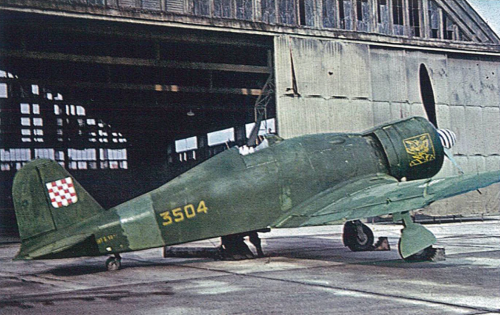
Export Use
Small numbers were used by Croatia and Spain, primarily for training or secondary roles.
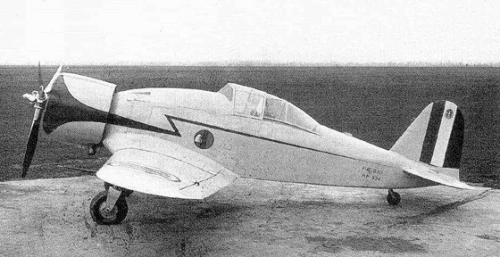
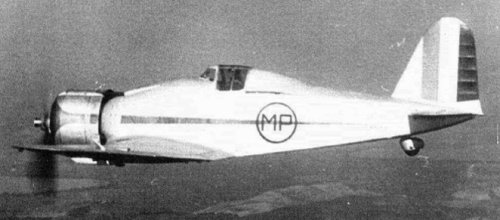
The Prototypes
First Flight
The inaugural flight of the first prototype occurred on 26 February 1937, piloted by Giovanni De Briganti, a seasoned test pilot.
Performance
The aircraft demonstrated an excellent climb rate and manoeuvrability but suffered from limited armament (two 12.7 mm Breda-SAFAT machine guns) and a short operational range.
Modifications
Feedback from test pilots led to revisions in canopy design and minor aerodynamic refinements before production approval
The Production models
G.50
First production version.
G.50 bis
Development of the G.50 version with extended range; 421 built.
G.50bis / AN (Assalto)
Single-seat fighter-bomber intended for the Regia Marina.
It had modified wings and extra armament.
G.50B
Two-seat trainer version, 100 aircraft built.
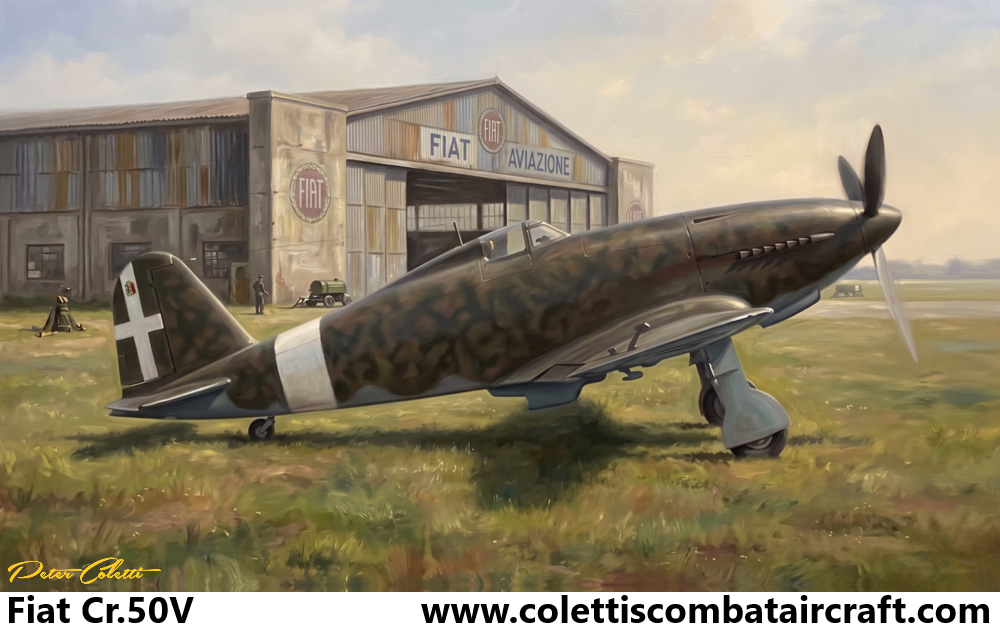
G.50V
Liquid-cooled V12 variant with a Daimler-Benz DB 601 engine; one built.
G.50 Ter
More powerful version with a 746 kW (1,000 hp)
Fiat A.76 engine; one built.
Specifications
Crew
1
Length
8.01 m (26 ft 3 in)
Wingspan
10.99 m (36 ft 1 in)
Height
3.28 m (10 ft 9 in)
Wing area
18.25 m² (196.4 sq ft)
Empty weight
1,963 kg (4,328 lb)
Max takeoff weight
2,402 kg (5,296 lb)
Powerplant
1 × Fiat A.74 R.C.38 14-cylinder air-cooled radial piston engine,
649 kW (870 hp) for takeoff and 720 kW (970 hp) at 3,800 m (12,500 ft)
Propellers
3-bladed Hamilton Standard-Fiat constant-speed propeller